
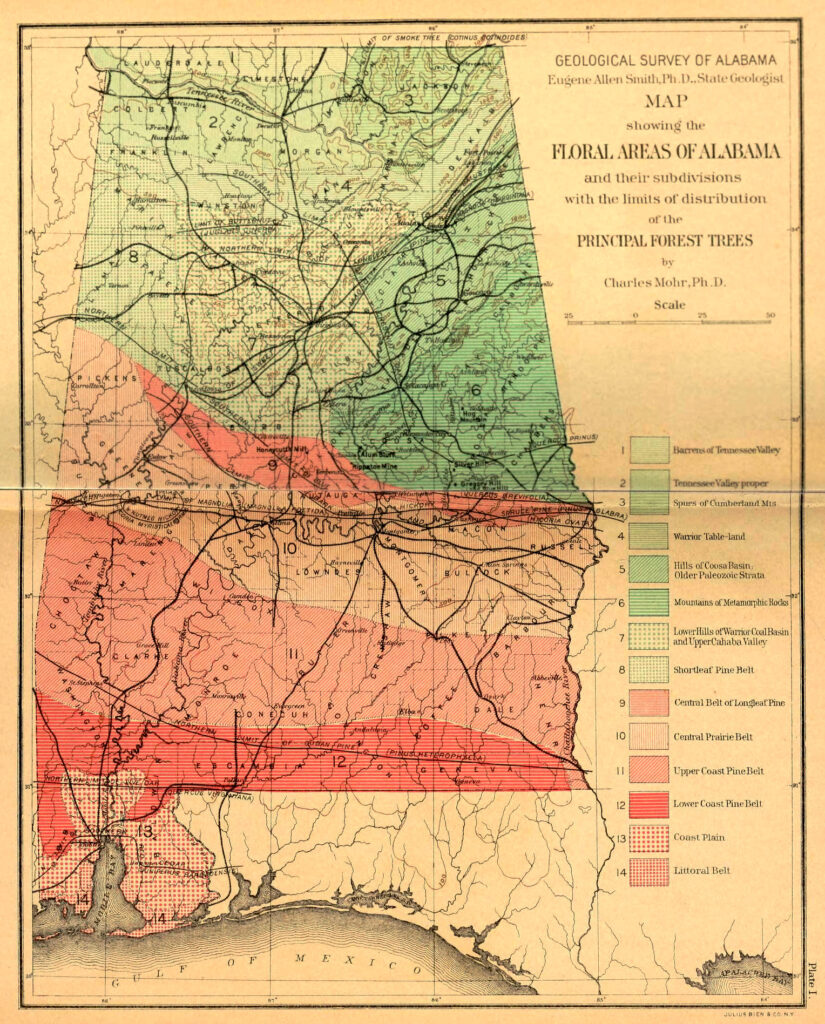
Carolinian Area or Flora
“A line drawn from the northwestern corner of the State to the lower part of Lee County, crossing the Coosa Valley near Childersburg, makes the limit of the highlands having an average elevation of 800 feet above sea level (E. A. Smith). This line coincides approximately with the isothermal line of 60 deg F., and may be regarded as the boundary in Alabama of the Upper and Lower Austral zones, therefore of the Carolinian and Austroriparian or Louisianian areas. It winds its way from northwest to southeast and southward to the “fall line.”‘ Accepting this zonal line, a botanical limit is gained, northward of which is found a flora different in character from that to the southward, generally described as the flora of the great Central Mississippi Valley, and distinguished by the feeble representation, if not total absence, of the subtropical element and the exclusive prevalence of deciduous forests. Various shrubs and trees coincide in their limits of northern and southern distribution closely with this boundary line, and serve as unerring guides in pointing out its course. Such truly zonal plants are:
Pinus virginiana (scrub [Virginia] pine), Prunus americana (American plum), Quercus acuminata [Q. muehlenbergii] (yellow bark chestnut oak) [Chinquapin oak], Azalea [Rhododendron] arborescens (sweet-scented azalea), Stuartia pentagyna [Stewartia malecodendron] (fringed stuartia) [silky camellia], Quercus prinus [Quercus montana] (mountain [chestnut] oak). Butneria fertilis (mountain spicewood or smooth Calycanthus) [Calycanthus floridus (Sweetshrub)], Quercus coccinea (scarlet oak), Quercus rubra (red oak), Rhus aromatica (aromatic sumac), Acer leucoderme (white-bark sugar maple) [chalk maple], Adelia [Forestiera] ligustrina (southern [glade] privet).
These all find in Alabama their southern limit on this line. Although the vegetation of the Carolinian area presents in its broad features great uniformity, particularly in its tree growth, there exist in its range of nine degrees of latitude differences in the latitudinal distribution of heat, which necessarily affect the distribution of plants within its limits and present insurmountable obstacles to the extension of a number of species northward. Due to this temperature element, there is a most pronounced limit beyond which the successful cultivation of the cotton crop can not be pushed, and which also presents a barrier to several trees and a number of other plants of Southern distribution that are only rarely met farther north, as for example, the willow oak (Quercus phellos), loblolly pine (Pinus taeda), longleaf pine (Pinus palustris) and cane (Arundinaria macrosperma [gigantea]). This line, roughly extending from the Atlantic Coast at the mouth of the Chesapeake Bay westward to southwestern Missouri and northern Arkansas, was located by Gray along latitude 30 deg 36′, and by him was regarded as the line of separation between the two principal floral divisions of eastern North America, namely, the flora of the northern United States and Canada and the flora of the Southern States. In Alabama it is only this lower belt of the Carolinian area, embracing the mountain region and the lower hills with which we are concerned.”
From the Plant Life of Alabama by Charles Mohr (1901) pp 57-58
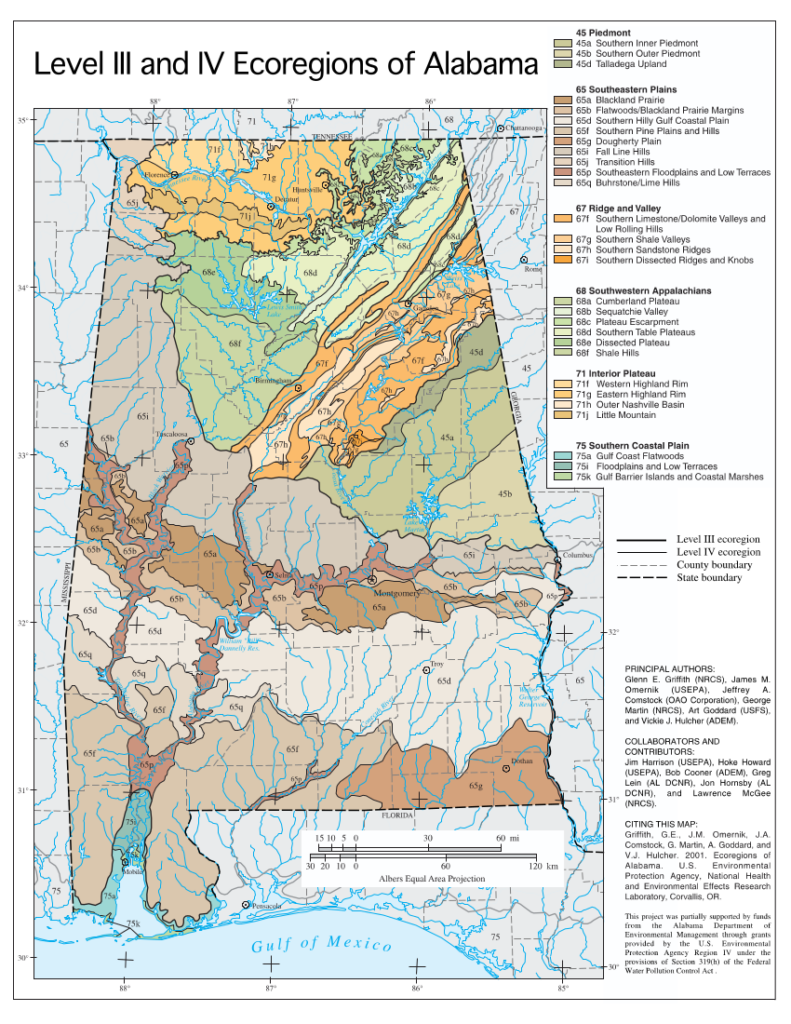
Southwestern Appalachians
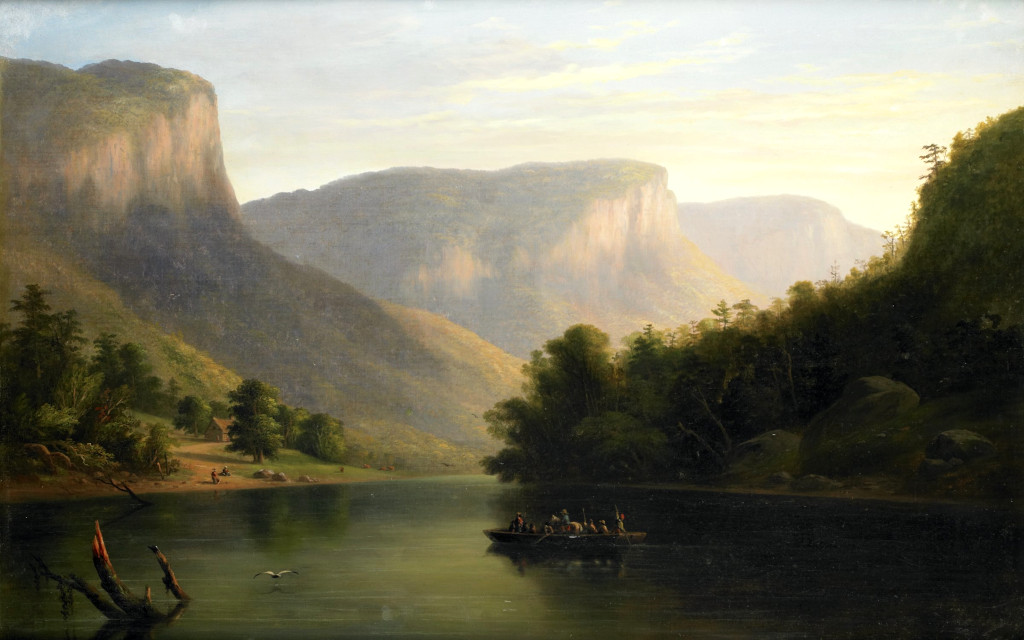
“Westward of this valley lies the Cumberland Table-land, the eastern boundary of which is high and almost unbroken from Kentucky to Alabama, while the western boundary is very irregular, with less elevation and with numerous valley and stream indentations. Though the table-land contains many streams and small valleys, it is, in the main, of uniform surface, but broken with mountainous ridges and knobs, particularly in the northeastern portion. The mean elevation is about 2,000 feet, and the extent is about 5,100 square miles.”
From a History of Tennessee by Westin A. Goodspeed (1886) p. 14
“The area of the coal-bearing strata amounts to 5,100 square miles, and over this vast extent of country from one to sixteen seams occur. The coal fields include the counties of Scott, Morgan and Cumberland, the greater portions of Pickett, Fentress, Yan Buren, Bledsoe, Grundy, Sequatchie and Marion; considerable portions of Claiborne, Campbell, Anderson, Bhea, Roane, Overton, Hamilton, Putnam, White and Franklin, and small portions of Warren and Coffee. About 1,000 square miles of the northeastern portion of this tract consists of a series of short irregular mountain chains, breaking away from the main Cumberland Mountain ridge, and casting heavenward numerous peaks of great height. The remainder of the coal tract, except certain portions in the southern part, is the true Cumberland Table-land or plateau. The upper coal measures embrace one or two principal sandstones (one of which may be a conglomerate) and an equal number of coal horizons in which one or more beds of coal may be expected. These and their accompanying strata compose the upper plateau, and have a thickness of from 200 to 300 feet, but are not typical of the tract of 1,000 square miles, to which reference was made above. The conglomerate sandstone, upon which the upper coal measures rest, usually contains numerous small white quartz pebbles, and is sometimes a double seam, embracing an important coal horizon. The lower coal measures consist of a series of sandstones and shales with from one to three or four coal veins, and constitute the most important division of the carboniferous period in the State and over a considerable area the only one available as a source of coal. Excluding the Cliff rock the thickness of this division ranges from a few feet to 300. These characteristics are, in general, typical only of the southern, western and northwestern portions of the table-land, as the northeastern portion and a strip along the eastern side, in the counties of Claiborne, Scott, Campbell, Anderson and Morgan, have a thickness of the upper coal measures, in some places of over 2,000 feet. The coal measures above the conglomerate have been much denuded, particularly on the western side of the table-land, and at points where the formations are much elevated, the reverse being true where the elevations are low. Where the coal measures are thickest the conglomerate is depressed and the waste by denudation is measurably compensated by the superior development, at many points, of the lower coal measures.”
From a History of Tennessee by Westin A. Goodspeed (1886) pp. 27-28
“The northern coal district is made to embrace that part of the tableland lying north of Van Buren and Bledsoe Counties and west of the Crab Orchard range, and a line running through Montgomery and Huntsville, and within its limits are parts of White, Cumberland, Morgan, Putnam, Overton, Fentress, Pickett and Scott Counties. Here the top of the table-land is usually a flat surface, and back from the slopes appears an upper plateau..”
From a History of Tennessee by Westin A. Goodspeed (1886) p. 31
“The soil of the Cumberland Table-land, which covers over 5,000 square miles of the State, is sandy and thin, though there are areas of moderate fertility at the foot of knobs and ridges, where fertile washings from the slopes are gathered. All the valleys are fertile, and accordingly productive. No lime appears, all being sand, and compost soon sinks below plant roots. The yellowish red subsoil, with a thin coating of humus, is more valuable than that with less iron and little or no humus. The former, with care and proper composts, may be made highly productive; not so the latter, which is too porous and tender, and, when uncultivated, produces nothing but shrubby trees, hardy, coarse weeds and grass, lichens and mosses. The glades and wet lands along the streams may be made valuable by drainage and by the use of alkalies to neutralize the abundant acid liberated by the decomposition of a superabundance of vegetable remains.”
From a History of Tennessee by Westin A. Goodspeed (1886) p. 27
“..the western iron region, which occupies a belt of high lands contiguous to the western valley and a part of the valley itself, and extends from Kentucky to Alabama..
“Several wild or indigenous grasses grow spontaneously, one of which is the barren, or prairie grass [likely Schizachyrium scoparium or Little Bluestem]. It covered all the prairie lands when the country was first settled by white people. It springs up about the 1st of April, grows to the height of two feet, and affords good pasturage from April to the 1st of August, when it becomes hard and woody so that stock refuse to eat it. Wherever the forest is not so dense as to exclude the light and heat of the sun, on the streams and tablelands of the Cumberland Mountains and on the sandy, flinty and siliceous “flat woods” of the whole State, this grass still holds possession, and is a blessing to the inhabitants of all lands which are deficient in lime.”
From a History of Tennessee by Westin A. Goodspeed (1886) p. 243
“Chestnut [Castanea dentata] is a valuable timber on account of its durability, and is abundant in the State. Large forests are found on the ridges of East Tennessee, on the sandstone soils of the Cumberland Table-land, and in portions of the Highland Rim..”
From a History of Tennessee by Westin A. Goodspeed (1886) p. 255
“The pine is one of the most abundant, and at the same time one of the most valuable of the forest growths of the State. There are two species, the white [Pinus strobus] [eastern white pine] and the yellow [Pinus echinata] [shortleaf pine]. The latter [shortleaf pine] grows in considerable quantities in the vicinity of Knoxville, and in many of the parallel ridges in the valley of East Tennessee. It is also found in extensive forests in the Cumberland Table-land, and forms considerable belts in Hardin and Lawrence Counties…It abounds on poor soils, those usually of sandstone, but often on red clay with gravel. It takes possession of abandoned old fields, and grows with rapidity when the soil is too sterile to produce other vegetation. In the regions where it abounds it forms the principal timbers for domestic purposes. The [eastern] white pine is not so abundant as the preceding; it is distributed in greater or less quantities over the slopes of the Unaka Mountains, and is found locally on the Cumberland Table-land. It grows to a larger size than the yellow pine, and makes a quality of lumber highly prized on account of its lightness and comparative freedom from resinous exudations.”
From a History of Tennessee by Westin A. Goodspeed (1886) p. 256
PAINT ROCK VALLEY
“These Coves nestle in this valley between the river and the mountains, like the parts of a jig-saw puzzle. As the land in the valley and on the sides of the mountains was so rich, it was covered with a very dense forest of large trees of many kinds. If this timber were here now, it would be worth a fortune of more than a million dollars.
When the first’ settlers came, they made their homes up in the Coves and on the sides of the Mountains. Down near the river, there were so much big timber, vines, canes, ponds, lagoons and lakes, the climate was unhealthful and the land was difficult to clear for cultivation. The land in the coves and on the hillsides was more easily cleared and very rich and loose. It is said that in the spring of the year a man could bend over a dogwood sapling large enough for a good hand spike—a stick used to roll logs—and pull it up by the roots, because the ground was so rich and loose. The foregoing conditions account for most of the old graveyards being located up on the sides of the mountains.
As the first settlers had small fields or patches of corn in cultivation, some years the squirrels, coons and bears would eat up nearly all of it. It was the habit of the bear to go into the field at night and gather 40 or 50 ears of corn, pile it up and sit down to eat all he wanted. The women did not need to raise turkeys for there were great flocks of wild turkeys in the woods near. When they wanted a turkey for dinner, the man would go out and shoot one, or if the ammunition was scarce, he would build a pen to catch them alive. The writer has seen a few — pens. These pens were built of ten-foot rails, about — six or eight rails high, covered with rails so that when the turkeys got in the pen they could not get out. About six or eight feet from one side of the pen, a ditch 18 inches or two feet deep was dug under the bottom rail of the pen and to the center, and covered the ditch two or three feet inside the pen, then scattered shelled corn in the ditch. The turkeys would go in. When they got in and raised up their heads, they never stooped down again to go back out, but put their time in going round the pen trying to get out at a crack.
As a rule there were so much beech mast, acorns, hickory nuts and chestnuts that their hogs got fat enough for meat in the woods with but little or no feed at all.
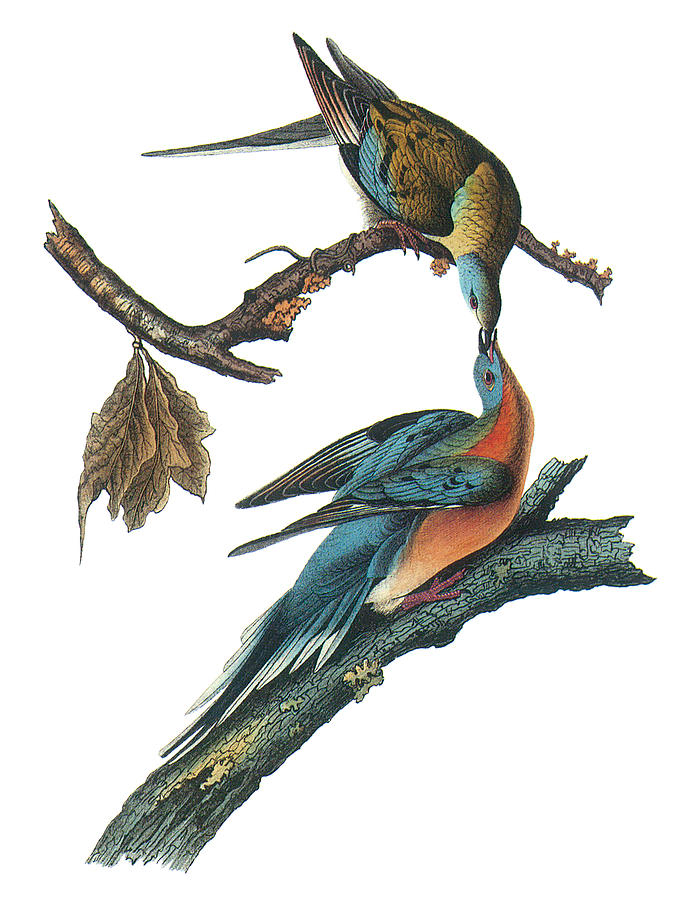
Birds were so numerous that boys with traps could keep a supply for the table without great effort. Some winters such flocks of wild carrier pigeons came and as their habit was to select certain trees to roost in, so many would get on a limb that they would break it off. These pigeons are now extinct, like the buffalo. For many years, millions of these pigeons were killed in the north and shipped to market. Agriculture was the main industry of the people of the valley. It was hard to clear the land and dispose of the great amount of timber. Before it could be cultivated, they cut and rolled logs for many days before planting the crop. They lived in log houses with either a dirt floor or a puncheon floor—that was slabs split out of logs and hewn smooth with a broadax. Malecome Thompson, a great-uncle of John K. Thompson, once owned the place where John Beason lives, at Princeton. To build his dwelling, he cut a large poplar tree [Liriodendron tulipifera] , sawed off two logs, split them into long thin slabs, hewed them in proper shape and put up a two-room house of good size.
To make a wheat bin, one would go down in the bottoms, cut a large hollow sycamore, cut off about six feet, nail plank on one end and use it to put grain in. These Sycamores were so large that once W. W. Thompson’s father led his horse with his saddle on, through a big hollow cut. All the cedars were big, old trees, which grew on the sides of the mountains. If one now had all the cedar that was burned to kindle fires and to make molasses, he would be rich.”
From History of Jackson County, Alabama (1935) by John Robert Kennamer pp. 137-139
“The small farmer settled back on the mountains and in the hill section of the county [circa 1817-1818]. He had come in search of economic freedom and more liberty of life in the forest. He loved his rifle and the pursuit of the game in the woods. He built his house of logs, cleared his corn patches and raised his hogs and cattle on the range. The ring of the axe in the forest was a familiar sound among the pioneers, and to clear the land was a great task. The usual mode was to ‘belt‘ or deaden all the timber save the smaller saplings, and commence cultivating before the roots and small stumps were out of the way. This ‘New’ ground was planted in corn.”
From History of Jackson County, Alabama (1935) by John Robert Kennamer p. 12
“However, the great bulk of the county was uncultivated and lay wild in native forest. It ‘was a county of springs. No purer water ever gushed from under hill or mountain in any land, and rippled cheerily on toward the larger streams all the year around.”
From History of Jackson County, Alabama (1935) by John Robert Kennamer p. 13
“The valleys of the Tennessee, Paint Rock and the low level lands lying along Crow, Mud and Sauta Creeks were covered with dense cane-brakes, brushwood and briers matted together with vines; and towering above all this were large oak, poplar, gum and other trees, with a lake or lagoon here and there.
The ridges and coves which were bordered by the Cumberland, Sand and Gunter’s Mountain were fertile and had a luxuriant growth of cane and forest. The mountain tops were better suited for the early settler to make his home, or to live while hunting, with no undergrowth except tall grass, with trees far enough apart that one could drive a team and wagon for miles without a road. Deer were plentiful and turkeys as numerous as chickens are at the present time. One has described these mountains as follows: “The mountain air sighed through the treetops as pure and sweet as the breath of a maiden; squirrels gambled in the forest trees; turkeys gobbled and strutted on the mountains; eagles screamed from their lofty perch on towering cliffs; and doves cooed their story of love on every hill and in every dale.
Such scenes were here to be found as the pioneer hunter, trapper or trader wended his way single-file along an Indian trail when the United States government acquired this land from the Indians on February 27, 1819.”
From History of Jackson County, Alabama (1935) by John Robert Kennamer pp. 6-7
“The eastern part of the County (White County, TN) for six or eight miles is Cumberland Mountain Plateau. It is mostly gently rolling and is suitable for fruits and vegetables and fine for grazing…Coves and small valleys cut their way into the mountain on its Western side. These coves are very fertile. Leaves washed down make a rich mold. These coves often open into wider valleys, as the Valley of the Calfkiller which runs through the County, widening as it reaches Southward. Through the center of the County west of Calfkiller Valley there runs a narrow mountain range, the highest peak being the Gum Spring Mountain, named from a gum [likely Nyssa] around a boiling spring. The peak is twenty-seven feet higher than the opposite Cumberland mountain.”
From a History of White County, Tennessee by Monroe Seals (1867), p. 53
“Like an island in an emerald ocean, the Cumberland Plateau rises from the surrounding valleys, inviting alike to the health seeker the [..?] or the man of capital. There is no plateau like it on the continent. It is unique. No other bears such a treasure of iron and coal and timber. So great a wealth of natural resources cannot be found so closely associated.
In this respect, it stands without a peer. The broad, level areas are carpeted with native grasses, and are adapted to farming. Fruit and vegetables fluorish. It is the natural home for sheep and cattle and hogs, which can live the year round.
Coal exists in vast measures which underlie the entire area, except where cut by streams, and these little valleys give access to it. It is used at South Pittsburgh and other places and makes a good quality of coke. It is also prized as a domestic fuel for steaming, as it leaves no clinkers. One county that lies in the region can of itself furnish enough coke for all the furnaces in the south, were there transportation. This is Cumberland. Its county seat is Crossville, which lies at the center of one of the best coal regions in America. For its coal and iron, Cumberland is fully equal to Allegheny County, Pa. Its value may be the better understood when it is known that no coal exists between this field and the Atlantic Ocean and for hundreds of miles to the westward…”
From the Chattanooga News, July 5th, 1891
“TABLE-LANDS OF THE WARRIOR AND COOSA BASINS.
PHYSIOGRAPHICAL FEATURES AND CLIMATE.
This area comprises about 4,500 square miles, including all of Cullman, Winston, Walker, and Blount counties, nearly all of Marshall and Dekalb, and small portions of Etowah and Cherokee counties, with the detached spurs of the Cumberland Mountains in the northeastern part of the Tennessee Valley in Jackson County. About threequarters of this area contains the coal measures, with their drainage level above the Subcarboniferous limestone lands.
The extreme southern spurs of the westerly Alleghanian ranges, including the Cumberland Mountains and all of the strata of the lower coal measures and underlying Subcarboniferous rocks, constitute this floral subdivision. It comprises the extensive table-lands drained by the Warrior River and of the coal field drained by the Coosa River, covering fully three-quarters of the area of the mountain region, and also the valleys with their water level not below 700 or 800 feet above the sea.
The lower Carboniferous sandstones and conglomerates form the surface rock of these table-lands. Their surface is furrowed by the narrow beds and deep gorges through which the numerous tributaries of the main channels of drainage have worn their way. The soil resulting from the disintegration of the strata is a light, more or less sandy, loam, and where shallow, full of thin rocky fragments.
The mean annual temperature on these highlands at their average elevation of from 800 to 1,500 feet is about 55° F., with a mean of 45° for the winter and 75° for the summer months; average minimum 12° in January, and maximum 87° in August. The mean annual precipitation amounts to 55 inches; mean for the winter months 18 inches, for the summer months 14 inches. The larger streams forming the main channels of drainage have cut their bed through the Subcarboniferous limestone. The calcareous strata constitute the floor of the wide valleys of erosion by which the diverging ranges are separated and also of their foothills.
VEGETATION OF THE PLATEAUS, MOUNTAIN SLOPES AND HIGHER VALLEYS
Xerophile forests – An uninterrupted forest of a varied growth of deciduous-leaved trees and evergreen cone bearers originally covered this subdivision. On the broad expanse of the table-lands above 900 or l000 feet the tan-bark or mountain oak largely prevails, associated with post oak and Spanish oak, or more rarely with black-jack and black oak, occasionally with scarlet oak, a rare tree in this State; also with mockernut, pignut hickory, and fine chestnut trees (the latter rapidly disappearing, having been eagerly sought for on account of their durable timber for fencings or wantonly destroyed for the nuts), and with white oak (Quercus alba) and highland gum (Nyssa sylvatica). Among the tree growth of smaller size the sourwood (Oxydendrum arboreum) is most frequent, here attaining its largest development, not infrequently becoming 40 feet in height and over a foot in diameter; together with dogwood, persimmon, sassafras, and the Southern palebark maple (Acer leucoderme), and in localities with a deeper soil, the Nortliern sugar maple (Acer saccharum barbatum), tulip tree, box elder (Acer negundo) and angelica tree (Aralia spinosa). On Sand Mountain, in Cullman County, where these forests have been more closely investigated, the woodlantls support from 25 to 35 timber trees of various species per acre, affording from 5,000 to 6,000 feet B. M. of merchantable lumber of all grades, the largest amounts being derived from the Spanish oak and the less valuable black oak (Quercus velutina). The lumber finds a ready maiket in the mining districts.
Wherever the mountain oak prevails pines are rarely seen. On the ridges of a lower altitude, with a thinner soil, the short-leaf pine (Pinus echinata) forms from 20 to 30 per cent of the timber growth, and. together with the loblolly pine (Pinus taeda), supplies pine lumber, which always finds a ready market. Dense groves of the latter cover the shallow depressions deficient in drainage, which are particularly frequent on the Warrior table-land. On these swales, from a fraction of an acre to several acres in extent, the loblolly pine arrives at its perfection, scarcely surpassed anywhere in its dimensions and in the quality of its timber. The trees average about 24 inches in diameter, with a height of from 110 to 120 feet, the trunks free of knots for a length of from 45 to 70 feet and with but a small proportion of sapwood.
The scrub pine (Pinus virginiana) is found on the most broken and poorest places at an elevation mostly above 1,200 feet, and is not frequent. Under the cover of the mostly rather open forest a variety of shrubs contribute to form a dense undergrowth. Blueberries (Vaccinium vacillans, V. .stamineum) are met with everywhere in the mountain region, and a bushy low form of the common azalea or honeysuckle (Azalea nudiflora), conspicuous by the abundance of its mostly snowwhite flowers, borne in close clusters, almost hides the ground. The fringed stuartia (Stuartia pentagyna), mountain holly (Ilex monticola [I. montana]), and its variety (I. monticola mollis), with soft hairy leaves, extend northerly on the lower of the western Alleghenian ranges to southeastern Kentucky, western Virginia, and Pennsylvania, and reach their southern limit on Sand Mountain. Ilex longipes [Georgia or Chapman holly] extends from North Carolina and Tennessee to the Louisianian area, and the rare Ilex dubia [I. amelanchier] [Sarvis holly] is found on the richer slopes, with Darbya [Nestronia] umbellulata [Nestronia or Indian olive], which of late has also been discovered on the edge of the metamorphic hills in Lee County. The last occurs also in a few localities in North Carolina and middle Georgia. Seven bark [Oakleaf hydrange] (Hydrangea quercifolia), one of the most ornamental shrubs, adorns the open woods and rocky hillsides throughout the region, being also common on the lower hills and extending to the Coast Pine belt. The following shade the rocky borders of the water courses:
Vaccinium tenellum (small-leaved huckleberry [Southen dwarf blueberry]), Stuartia virginiana(?) [Stewartia ovata?] (Virginia stuartia), Kalmia latifolia (evergreen kalmia [mountain laurel]), Aronia arbutifolia (chokeberry), Pyrus [Malus] angustifolia (Southern crabapple), Azalea arborescens (sweet-scented azalea).
The chokeberry, which is here of arborescent habit, presents a beautiful sight when loaded with its bright scarlet fruit, which remains from early autunm through the winter. The following add to the number of mesophile shrubs, which prefer a damper and deeper soil:
Chionanthus virginica (fringe tree), Crataegus crus-galli (cockspur [haw]thorn), Pyrus [Malus] angustifolia (Southern crab apple), Crataegus mollis (downy haw[thorn]), Crataegus coccinea (scarlet haw[thorn]), Crataegus uniflora (winter haw), Crataegus spathulata (sugar [littlehip] haw) .
Of woody creepers and climbers —
Smilax rotundifolia (horse brier [common greenbriar]), Clematis virginiana (common virgin’s bower),
are confined to the mountain region, extending to the Alleghenian area; while —
Bignonia capreolata (cross vine), Berchemia volubilis [scandens] (supple-jack), Tecoma [Campsis] radicans (trumpet vine), Vitis aestivalis (summer grape),
are widely distributed in the Carolinian and Louisianian divisions.
Mesophile forests. — Where the sandstones give way to clayey shales more subject to erosion, the channels of the water courses become wider and the valleys are flanked by ridges of a gentler slope and are covered with deeper and richer soil. In these secluded valleys of the table-land, particularly where they begin to slope almost imperecptibly toward their southern and southwestern borders, the arboreal growth is of groat luxuriance and variety. Besides many of the trees of the uplands, the following are found:
Quercus michauxii (cow oak [swamp chestnut oak]). Magnolia umbellata [tripetala] (umbrella [magnolia] tree), (Fagus americana (beech) . Magnolia acuminata (common cucumber tree), Ulmus americana ([American] elm), Juglans cinerea (butternut) (rare). Magnolia macrophylla (large-leaf magnolia), Tilia americana (basswood), Tilia heterophylla [T. americana var heterophylla] (mountain basswood) .
These deciduous-leaved magnolias in these sheltered valleys arrive at their best development, the last having been observed with a trunk fully 20 inches in diameter. In such a valley on the northern border of Winston County, near a branch of the east fork of the Sipsey River, the yellow-fiowered magnolia (Magnolia acuminata cordata), first described as a distinct species by Michaux the elder, was discovered by the writer in 1882. Since the original discovery of this rare and beautiful tree by this great investigator of the trees of eastern North America, on the banks of the upper waters of the Savannah River, the range of its distribution had remained obscure. It can now be said, however, to extend from upper South Carolina and the upper mountain region of Georgia to northwestern Alabama. Here this tree has been observed as large as a full-grown common cucumber tree, of which species Professor Sargent regards it as a variety. When unfolding under full exposure to the sun, the flowers are from a dingy canary to a golden yellow color, but are of a greenish tint when opening under the shade of the dense foliage. In the shape and size of the mature leaves the yellow-fiowered variety can scarcely be distinguished from the typical form; it is only in the foliage of the young vigorous shoots that the heart-shaped form of the leaves is observed.
Entering near the same valley the cliff -bound channel of the Sipsey fork, one finds to his surprise the rocky defile shaded by groves of stately hemlock (Tsuga canadensis). This inhabitant of the coniferous forests of northern regions extends southward along the highest summits of the Appalachian ranges to (Georgia and northwestern Alabama, where it follows this mountain torrent for a distance of about 10 miles, nearly to the falls of Clear Creek, in Winston County, there reaching its southern limit. In this valley the hemlock is accompanied by the sweet or cherry birch, Betula lenta, at home in the same northern life zone.
Xerophile and mesophile herbaceous plant associations. — Belonging to the former, many ferns peculiar to the mountain region take root in the chinks of the bare rocks. Such are:
Cheilanthes [Myriopteris] tomentosa [wooly lipfern], Asplenium montanum [mountain spleenwort], Cheilanthes [Myriopteris] lanosa [hairy lipfern], Asplenium ruta-muraria [American wall rue], Cheilanthes [Myriopteris] alabamensis [Alabama lipfern], Asplenium pinnatifidum [lobed spleenwort], Pellaea atropurpurea [purple cliff-brake],
In similar situations are found the following flowering plants:
Silene rotundifolia [sandstone fire pink], Arenaria stricta [Sabulina michauxii] [rock sandwort], Silene caroliniana [rock catchfly], Lacinaria graminifolia [Liatris pilosa], Saxifraga virginica [Micranthes virginiensis] [early saxifrage], Senecio obovatus [Packera obovata] [roundleaf groundsel].
Other species of ferns on the border line of xerophile and mesophile associations prefer the more sheltered rocky ledges, as:
Asplenium parvulum [resiliens] [blackstem spleenwort], Dicksonia punctilobula [Sitobolium punctilobulum] [hay scented fern], Woodsia obtusa [blunt-lobed cliff fern], Camptosorus rhizophyllus [Asplenium rhizophyllum] [walking fern], Polypodia vulgare [Polypodium sp.] [rockcap fern], Cystopteris fragilis [fragile fern].
Carex picta (C. bootiana) [painted sedge] covers in dense tufts the rocky shelves on the banks of the head waters of the eastern Sipsey fork, in Winston County, where this pretty and rare plant was collected by the late Judge T. M. Peters.
Associated with Carex picta are C. nigro-marginata [black-edged sedge], C. virescens [ribbed sedge], and C. digitalis [slender woodland sedge], Tipularia unifolia [discolor] [cranefly orchid] (of a widely disrupted distribution from the Gulf coast to Lake Huron in the Allegheuian area), and the northern Peramium (Goodyera) repens [lesser rattlesnake orchid]. Therofon (Boykinia) aconitifolium [aconitifolia] [brook saxifrage] inhabits the bare rocks forming the brink of streams, and Diamorpha pusilla [Sedum pusillum] [Puck’s orpine] is found in similar localities — both extending hither from the lower mountains of South Carolina and Georgia. Heuchera americana [American alumroot] grows in more open, and H. rugelii [H. parviflora var parviflora] [Cumberland grotto alumroot], Viola multicaulis(?) [violet sp], and Hepatica hepatica [H. acutiloba or H. americana] [Hepatica] in deeply shaded situations; and where the rocky walls are constantly kept moist by the dripping water, Thalictrum clavatum [mountain meadow rue], Viola rostrata [long spurred violet], V. blanda [sweet white violet] and V. striata [pale violet] are found.
In the open woods of a light dry soil where pines are mingled with the hardwood trees, and in the openings of old fields and pastures, where the progeny of the pine is apt to take possession of the ground, there are present numerous xerophile species, which are characteristic of the mountain region in general. Of these, the following glumaceous plants (grasses and sedges — Poaceae and Cyperaceae) are scantily diffused throughout woods and fields having a thin thirsty soil:
Erianthus alopecuroides [silver plume grass], Eragrostis pectinacea (Carolina lovegrass), Andropogon sroparius [Schizochyrium scoparium] [common little bluestem], Poa chapmaniana [Chapman’s bluegrass], Andropogon furcatus [gerardi] [big bluestem], Carex laxiflora [broad loose-flowered sedge], Chrysopogon avenaceus [Sorghastrum nutans] [yellow Indiangrass], Carex laxiflora varians [broad loose-flowered sedge], Sieglingia seslerioides [Tridens flavus] [tall redtop], Carex cephalophora, Melica mutica [two-flowered melic], Carex leavenworthii [Leavenworth’s sedge].
Among the largely predominating Compositae (Asteraceae) tall rosinweeds and coarse sunflowers are conspicuous, particularly the former, which present a number of types rarely or not at all observed in the State outside of this subdivision; for example, Silphium mohrii [Mohr’s rosinweed] and S. gatesii [S. asteriscus var asteriscus], both known from Cullman County; S. trifoliatum [S. asteriscus] [starry rosinweed], ranging from the plains of the Ohio Valley to the Central Prairies region; S. laevigatum [S. asteriscus var laevigatum], Helianthus schweinitzii [Schweinitz’s sunflower] and H. glaucus [glaucophyllus?] [white-leaf sunflower?] from the lower mountains of South Carolina and Georgia, and S. compositum [var compositum] [Carolina rosinweed], abundant throughout the region. The following are frequent in dry thin soils all over the Mountain region, some extending all over the State:
Helianthus atrorubens [Appalachian sunflower], Lactuca hirsuta [red wood lettuce], Helianthus hirsutus [hairy sunflower], Lactuca sagittaefolia(?), Helianthus microcephalus [small-headed sunflower], Nabalus fraseri [barbatus] [barbed rattlesnake root], Helianthus divaricatus [woodland sunflower], Lechea racemulosa [Appalachian pinweed], Heliopsis helianthoides [Eastern sunflower-everlasting], Lechea leggettii [pulchella] [Leggett’s pinweed], Parthenium integrifolium [common wild quinine], Koellia pycnanthemoides, Sericocarpus asteroides [toothed white-topped aster], Blephilia ciliata [downy woodmint], Aster divaricatis [Eurybia divaricata] [common white heart-leaved aster], Monarda fistulosa [Appalachian bergamot], Eupatorium sessilifolium [sessile-leaf eupatorium], Monarda bradburiana [Bradbury beebalm], Solidago caesia [axillary goldenrod], Dasystoma virginiana [Aureolaria virginica] [Virginia oak-leech], Solidago erecta [slender goldenrod], Gerardia [Agalinis] tenuifolia [slender leaf agalinis], Chrysopsis mariana [Maryland goldenaster], Physalis virginiana [Virginia ground cherry], Brauneria purpurea [Echinacea purpurea] [purple coneflower], Physalis pubescens [downy ground cherry], Rudbeckia hirta [black-eyed Susan], Physalis pruinosa [grisea/pubescens], Rudbeckia spathulata, Sabbatia boykinii(?) [rosepink sp.], Coreopsis grandiflora [large flowered coreopsis], Thaspium aureum trifoliatum [Thaspium trifoliatum var aureum], Coreopsis pubescens [hairy coreopsis], Oxalis recurva [Oxalis sp.], Coreopsis auriculata [lobed coreopsis], Tragia urticaefolia [nettleleaf noseburn], Carduus virginicus [Cirsium virginianum] [Virginia thistle], Meibomia [Desmodium] (many species), Andropogon virginicus, Lespedeza (many species) .
Vicia caroliniana [wood vetch] and buffalo clover, Trifolium reflexum, are frequcnt on these table-lands, and Lathyrus venosus [smooth forest pea] in Alabama is contined to them.
Strictly mesophile herhaceous plant association. — Ferns abound in the shade of the forests.
Characteristic species are:
Adiantum pedatum [maidenhair fern], Botrychium obliquum [dissectum] [cut-leaf grape fern], Asplenium plalyneuron [ebony spleenwort], Dryopteris [Amauropelta] noveboracensis [New York fern], Phegopteris hexagonoptera [broad beech fern], Dryopteris marginata [marginal woodfern], Botrychium virginianum [common grape fern], Dryopterls acrostichoides [Christmas fern]
Asplenium angustifolium(?), which is most frequent in the Ohio valley, occurs very rarely. Of grasses and sedges Muhlenbergia diffusa [schreberi] [nimblewill] forms dense plots, and the following prefer the shade of woods:
Brachyelytrum erectum [common shorthusk], Poa autumnalis [bluegrass], Festuca nutans [subverticillata?] [nodding fescue], Carex laxiflora [broad loose-flowered sedge], Festuca shortii [paradoxa], Carex laxiflora varians, Poa sylvestris [forest bluegrass], Carex laxiflora patulifolia.
The following are frequent in the openings of woods and on their borders:
Vagnera racemosa [Maianthemum racemosum] [false Solomon’s seal], Tiarella cordifolia [Piedmont foamflower], Uvularia puberula [Carolina bellwort], Hypericum virgatum [coppery St. John’s wort], Uvularia sessillfolia [merrybells], Scutellaria incana, Iris cristata [dwarf crested iris], Phlox divaricata [eastern blue phlox], Syndesmon [Thalictrum] thalictroides [rue anemone], Mertensia virginica [Virginia bluebells], Anemone quinquefolia [wood anemone], Vincetoxicum hirsutum(?) [possibly Matelea], Anemone virginiana [thimbleweed], Gentiana villosa [striped gentian], Ranunculus recurvatus [hooked buttercup], Galium circaezans [licorice bedstraw], Cimicifuga racemosa [black cohosh], Houstonia caerulea [Quaker ladies], Trautvetteria carolinensis [false bugbane], Deringa canadensis [Cryptotaenia canadensis] [wild chervil], Viola hastata [halberd-leaf violet]. Podophyllum pelatatum [mayapple], Viola multicaulis(?), Sanguinaria canadensis [bloodroot], Viola pubescens [hairy yellow forest violet].
On the higher shady banks of water courses are found:
Porteranthus (Gillenia) stipulaceus [stipulata] [Midwestern Indian physic], Stachys cordata [heart-leaved hedge nettle], Porteranthus trifoliatus [Gillenia trifoliata] [mountain Indian physic], Zanthorhiza apiifolia [Xanthorhiza simplicissima] [yellowroot].
In the more or less dense forest, covering hill and dale, are to be found:
Orchis [Galearis] spectabilis [showy orchid], Aralia racemosa [spikenard], Cypripedium parviflorum [small yellow lady’s slipper], Sanicula marilandica (rare) [black snakeroot], Arisaema quinatum [southern Jack in the pulpit], Phryma leptostachya [American lopseed], Circaea lutetiana [canadensis] [Canada enchanter’s nightshade], Frasera carolinensis [American columbo], Hydrastis canadensis (scarce) [goldenseal], Cynoglossum virginicum [Anersonglossum virginianum] [southern wild comfrey], Bicuculla cucullaria [Dicentra cucullaria] [Dutchman’s breeches], Obolaria virginica [pennywort], Dentaria [Cardamine] diphylla [toothwort], Solidago flexicaulis [zigzag goldenrod], Cubelium concolor [eastern green violet], Solidago vaseyi [Vasey’s goldenrod], Panax quinquefolius [American ginseng].
The Solidago vaseyi has been collected near Holmes Gap (1,500 feet), and is known from a few localities on the highest ranges of the Carolinas and Georgia,
On the restricted flat semiswampy places, not infrequently met with on the Warrior table-land, open or slightly under cover, the following are most frequently seen:
Cyperus pseudo-vegetus (green flatsedge), Phlox maculata [northern meadow phlox], Carex lupulina [hop sedge], Lysimachia quadrifolia [whorled loosestrife], Carex lurida [sallow sedge], Gentiana elliottii [catesbyi] [coastal plain gentian], Habenaria [Platanthera] ciliaris [yellow fringed orchid], Bidens involucrata [polylepis] [Midwestern tickseed sunflower], Xyris flexuosa [caroliniana] [pineland yellow-eyed grass], Coreopsis grandiflora [large-flowered coreopsis], Rhexia virginica [Virginia meadow beauty], Doellingeria infirma [Appalachian flat-topped white aster], Ludwigia alternifolia [alternate-leaved seedbox].
Mesophile plant associations of rock houses. — On the perpendicular walls at the head of the deep narrow gorges are found shelves of hard, resisting sandstone with the softer strata beneath them worn away by the action of the percolating surface water. The wide and deep excavations thus formed are called by the people of the country “rock houses.” In these gloomy recesses, never visited by the direct rays of the sun, their roots and walls constantly moistened by the water oozing from every crevice, some of the rarest and most delicate ferns find a shelter from wind and sudden changes of temperature. Trichomanes [Didymoglossum] petersii [dwarf filmy fern], the tiniest of this order in the United States, and confined to Northern Alabama, is at home in these rock houses, and thence it way first brought to light Judge T. M. Peters, who discovered it on the banks of the head waters of Sipsey River. The filiform horizontal rhizomes are interwoven into dense patches, their fronds of dark green scarcely an inch high, somewhat resembling the thallus of a large liverwort. This fern was subsequently found in a similar locality on the western edge of the table-land by Prof. E. A. Smith, and later by the writer on its eastern border at the falls of Black Creek, in Etowah County. Trichomanes radicans [Vandenboschia boschiana] [Appalachian filmy fern] is also a frequent inhabitant of these rock houses, being found on wet, deeply shaded, rocky walls northward to the Cumberland Mountains of Kentucky. The long creeping rootstock of this beautiful fern, adhering firmly to the rock, decorates the roof and walls of these recesses. Asplenium trichomanes [maidenhair spleenwort], with its fronds of brightest green, and the thallus of a large liverwort (Dumortiera sp.) are the frequent companions of the above. Of plants of higher orders only a few have been observed in these cavities. Thin grass (Agrostis perennans) [Autumn bentgrass] with its weak, decumbent stems, occurs here, where its foliage is scarcely ever affected by frost and never touched by the direct sunlight, and Heuchera rugelii [Heuchera parviflora var. parviflora] [Cumberland grotto alumroot] is also quite frequently found on the damp ledges which form the threshold of the caves, but rarely penetrates beyond them.
Hydrophilic plant associations (paludial plants). — On the table-land beyond the channels of the large streams and their very numerous branches no areas of great extent of a water-soaked or submerged soil are foimd, and the narrow channels through which the water rushes toward the lowlands afford but little chance for the spread of a hydrophile vegetation. The wet grassy swales are inhabited by the following:
Andropogon virginicus [Anatherium virginicum] [broomsedge], Carex granularis [limestone meadow sedge], Homalocenchrus (Leersia) virginicus [virginica] [Virginia cutgrass], Eleocharis tenuis [slender spikerush], Panicularia nervata [Glyceria striata] [Panicularia nervata], Eleocharis acicularis [needle spikerush], Panicum rostratum [Coleataenia anceps] [beaked panic grass], Eleocharis ovata, Panicum comutatum [Dichanthelium commutatum] [variable witchgrass], Scirpus polyphyllus, Panicum polyanthes [Dichanthelium polyanthes] [small-fruited witch grass], Dichromena [Rhynchospora] colorata [narrowleaf whitetop sedge], Panicum [Dichanthelium] sphaerocarpon [round-fruited witchgrass], Kobresia pumila(?), Carex lurida (sallow sedge), Juncus marginatus [grass-leaved rush], Carex lupulina [hop sedge], Juncus (common species), Carex intumescens [bladder sedge], Cicuta maculata [water hemlock], Carex squarrosa (rare) [squarrose sedge], Coreopsis [Anacis] tripteris [tall coreopsis], Carex torta [streambed sedge], Eupatorium maculatum [spotted Joe-Pye weed].
In the brooks where during its lowest stage the water becomes stagnant, a large Fontinalis, F. lescurii [novae-anglii], is found. Hymenocallis occidentalis [woodland spiderlily] occurs in deep clefts of rocks barely rising above the water. Sagittaria latifolia [common arrowhead] and S. longirostris australis [long-lobed arrowhead] are found on the miry banks of Ryans Creek, Cullman County, with Peltandra virginica [green arrow arum]. Orontium aquaticum [golden club] is common in the streams of the wider valleys not above 1,000 feet. On the loose stones in the swiftly running brooks and shallow streams Podostemon abrotanoides [ceratophyllum] [threadfoot] a type of the southern Alleghenies is not rare on the Warrior table-land, and P. ceratophyllum of northern distribution is known in the State, but only from the vicinity of Auburn.
Vegetation of Lookout Mountain. — Near the northern frontier of the State the most easterly of the spurs of the Appalachian ranges belonging to this subdivision rises abruptly at Valley Head to an elevation fully 800 feet above Little Wills Valley, with its floor at this point 1,150 feet above tide water.
The summit of Lookout Mountain spreads out to a wide table-land of the same character as the plateau of the Warrior coal field, and terminates suddenly in the precipitous escarpment abutting upon the Tennessee River known as the most prominent landmark in the Tennessee basin. Near Mentone, Little River, a pretty stream which follows the southern extension of this table-land, leaps over a ledge into its narrow channel, some 125 feet below. By reason of a rainfall more copious than in other sections of the mountain region (64.4 inches), and toward its northern extremity of a generally deeper and fresher soil, this mountain was recently covered with a fine hard-wood forest, chiefly of oaks, and was noted for the abundance of white oak timber (Quercus alba) and tan-bark oak; but this timber wealth is now almost exhausted. On its flanks the black locust (Robinia pseudoacacia) is found, one of the few localities in Alabama where it can be considered to be indigenous. The short-leaf pine is rarely met with on these heights. The scrub pine is more frequent, reaching its best development on rocky benches and declivities with a scanty covering of soil.
On the brow of this mountain, and particularly along the low, damp banks of Little River, there occurs a strong mingling of types that are at home in the Alleghenian area of the adjoining States and of North Carolina with plants of the lower ranges within the Carolinian area, giving rise to a varied flora, the like of which has not been observed in any other part of the mountain region of Alabama. When the low elevation of this extremely limited spot is considered (not quite 2,000 feet above the sea), the suffusion of types from different life zones admits of no explanation on the ground of climate or local influences controlling plant distribution, but points clearly to a disjunction of floral conditions due to geological changes. Among the woody plants peculiar to the Alleghenian area, Rhododendron catawbiense is the most prominent. In the beginning of summer, when covered with the profuse clusters of its purple or lilac llowers, this shrub, from 6 to 10 feet in height. massed in dense thickets along the banks of Little River forms one of the most attractive sights. ‘I’he home of this shrub is ascribed to the highest crests of the southern chains of the mountains from western Virginia to Roan Mountain, on the border of North Carolina and Tennessee, at an altitude of 6000 feet. It has. however. been found. by Mr. Small, at a much lower elevation on Table Mountain. At its extreme southern limit in Alabama it is associated with the, Azalea arborescens [sweet azalea] and Kalmia latifolia [mountain laurel]. Of other shrubs Viburnum cassinoides [northern wild raisin], extending to the Canadian zone, is abundant on the banks of this stream. Viburnum dentatum [arrowood viburnum], Rubus enslenii and Celastrus scandens [Ameircan bittersweet] of the same range of distribution, are frequent among the shrubs of the more exposed rocky heights. With these Alleghenian shrubs occur a host of other species, which are at home on the southern extremity of the lower ranges within the Carolinian area, and are more or less frequent throuuhout our mountain region. For example:
Butneria (Calycanthus) fertilis [Calycanthus floridus] [sweetshrub]. Hydrangea arborescens cordata [smooth Hydrangea], Ilex monticola [Ilex montana] [mountain holly]. Philadelphus hirsutus [Cumberland mock-orange], Vaccinium melanocarpum [V. stamineum] [deerberry], Diervilla rivularis [hairy southern bush honeysuckle], Vaccinium pallidum [hillside deerberry].
The Vaccinium pallidum [hillside deerberry] is reported as scarce on some of the highest summits of North Carolina (Buckley). Crataegus bilmoreana [C. intricata var biltmoreana] [Biltmore hawthorn], C. austromontana [valleyhead hawthorn], and C. sargenti[i] [Sargent’s hawthorn] are new discoveries made on the declivities of the mountain by Mr. Beadle of the Biltmore Herbarium in 1899, which have also become known from western North Carolina, eastern Tennessee, and northern Georgia. The prostrate stems of the northern Rubus hispidus [swamp dewberry] cover open, miry places.
The large lichen, Umbilicaria pustulata papulosa which covers the naked cliffs, forms an association strongly expressive of the Alleghenian character of the flora of this locality. In the soil, rich in humus, shaded by the rocks, and on the shaded ledges lining the banks of Little River, mesophile ferns are also abundant. Asplenium bradleyi [Bradley’s spleenwort] of very local distribution in the Cumberland Mountains of Tennessee and Kentucky, occurs here, together with the more frequent —
Asplenium parvulum [A. resiliens] [blackstem spleenwort], Asplenium montanum [mountain spleenwort], Asplenium trichomanes [maidenhair spleenwort], Asplenium pinnatifidum [lobed spleenwort], Asplenium felix-foemena [Athyrium asplenoides] [southern lady fern], Dryopteris marginalis [marginal woodfern], Dicksonia punctilobula [Sitobolium punctilobulum] [hay-scented fern].
The last three are xerophile species, occurring on somewhat exposed rocks. Other herbaceous southern Appalachian types here found are:
Galax aphylla [likely Galax urceolata, but possibly Nemophylla aphylla] [Galax], Viola blanda [sweet white violet], Thalictrum clavatum [mountain meadowrue], Viola rostrata [long-spurred violet], Viola multicaulis[?], Eatonia pensylvanica [Sphenophilis pensylvanica] [swamp oats].
Of these the first is the most prominent, frequenting springy, rocky banks and dripping ledges, and the others are all more or less frequent in similar localities throughout the mountain region. Sarracenia catesbaei[?] and Isoetes engelmanni valida are paludial plants so far only known in the State from the banks of Little River near De Soto Falls. There occurs also Danthonia glabra [D. sericea] [silky oat-grass], a most rare plant, lately described, from upper Georgia (Nash), with Danthonia compressa [mountain oat-grass], and Deschampsia [Avenella] flexuosum [common hairgrass] so far not yet reported from any other locality in the State, while Carex virescens [ribbed sedge], Tiarella cordifolia [Piedmont foamflower], Ascleplas quadrifolia [fourleaf milkweed], and Asarum macranthum [Hexastylis shuttleworthii] [large-flower heartleaf] frequent the rocky dells and more or less open copses. The tiny Arenaria brevifolia [A. leptoclados] [slender sandwort], known from a few localities in upper Georgia and the Cumberland Mountains of Tennessee, roots in crevices of rocks among the dark-green cushions of mosses (Grimmia, Hedwigia), with the three-leaf stonecrop (Sedum ternatum) [mountain stonecrop] and the round-leaf talinum (Talinum teretifolium) [Phemeranthus teretifolium] [Appalachian rock-pink] a fleshy perennial with rose-purple flowers adorning exposed rocks in the mountains northward to Pennsylvania. On the exposed rocks close to the edge and above the falls of Little River dense tufts of filiform leaves produced by a many-branched rootstock deeply sunk in the crevices attract the attention. Specimens of this plant in flower obtained in September proved to be Chondrophora virgata (Bigelovia Nutt) [Bigelowia nudata] [ray-less goldenrod]. The identity of our plant with Nuttal’s specimens is, however, not free from doubt. In the type collected by Nuttall in lower New Jersey and preserved in the Herbarium of the Academy of Sciences at Philadelphia the radical leaves, which furnish the decisive character, are wanting; furthermore, the similarity to Euthamia graminifolia [northern smooth goldentop] ascribed by Nuttall to his type is not recognized in our plant. The locality quoted by Nuttall is also doubtful, his plant having never been found afterwards, although the ground has been closely investigated by later botanists.
Under the umbrageous cover of the high forest on the upper flanks of the mountain, in the deep soil, rich in humus, tall umbelliferous herbs are conspicuous, among which are Ligusticum canadense [American lovage], frequent throughout the mountains northward to Pennsylvania, Thaspium pinnatifidum, and Thaspium barbinode [hairy-joint meadow parsnip], which extends north to the Ohio Valley. Together with these occur Oxalis grandis [great yellow wood sorrel], Polygonatum commutatum [P. biflorum var. commutatum] [large Solomon’s seal], widely distributed through the Alleghenian area, Trillium stylosum [T. catesbyi] [Catesby’s trillium] of the southern Appalachian ranges, and Cypidpedium acaule [pink lady’s slipper], found in more open boggy places.
Cultural plant associations. — Scarcely 20 per cent of the area of the table-lands is reduced to a state of cultivation; the rest consists of more or less devastated woodlands and of high forests, which, however, near the settlements and highways of commerce are largely stripped of merchantable timber and are suffering from the inroads of fire and cattle.
Scarcely more than a quarter of a century ago, before these tablelands were made easily acccssible to the immigrant by the great trunk lines leading from the centers of population in the North to the Gulf coast, they were but sparsely inhabitated. The earlier settlers who had squatted upon them depended for their support more on the chase than upon the cultivation of a soil which was looked upon as too poor to afford an adequate return. This, however, has all been changed by the influx of a population which was attracted by the mild and salubrious climate, and which, coming with the determination to establish its home here, has succecded in conquering the unpromising soil and developed its possibilities. With the rapid increase in population these lands have come much into demand, and under rational management almost every crop raised in the Northern States can be successfully grown on these tahle-lands by the side of cotton.
The meadow grasses of the North, with red clover and similar forage plants, do well here. Much attention is given to the production of breadstuffs, chiefly corn, to which the greater part of the arable land is devoted. Small grains, as wheat and rye, supply a part of the home demand. Irish and sweet potatoes are profitable summer crops, and nearly all of the root crops and vegetables grown in the temperate zone are produced here in abundance and perfection. Of small fruits, the strawberry has heen found highly profitable, usually being harvested hefore the end of April. This fruit finds a ready sale in the distant northern markets. Orchards of fruit trees on a large scale do not yet exist, although apples, pears, and peaches are successfully grown. The cultivation of the grape was given great attention by the earlier of the German immigrants until the appearance of a fungous disease proved a great drawback. But with the successful employment of remedies to subdue this disease, viticulture, particularly of grapes for table use, has received a new impetus.”
From the Plant Life of Alabama by Charles Mohr (1901) pp 69-80
“The Silicious Soils of the Mountains or Elevated Lands. These soils cover the highlands or barrens, and the table-lands. They are usually of a light gray color and often are not much more than sand or pure silicious matter. Up to a few years ago they were regarded as almost worthless for all agricultural purposes, but of late years, by kind treatment and the use, in small quantities, on them of suitable composts, they have been found to be fine for cotton, corn, tobacco, small grains, grasses and root and fruit crops. The greatest objection to them is that they do not hold, or retain well, organic matter or fertilizers, and hence in many localities they look as if they had been leached, so completely have all traces of organic matter been washed out of them.”
From Northern Alabama Historical and Biographical Illustrated p. 11
JACKSON COUNTY
“The general appearance of this county is much more broken, and its scenery greatly diversified. It is made up of high mountain tracts of level lands extending for many miles. These mountains are cut back into by many beautiful coves and valleys of level and fertile lands, some of which are three or four miles wide, shut in by steep mountain slopes, covered with forest growth of valuable timber; indeed, the whole of the valley lands are said by geologists to have been cut out of what was at one time, a level mountain surface, by the flow of the Tennessee River and its numerous tributaries. This mountain surface at that time was all the Cumberland Mountain, but is now cut in two by the river, at the point known as the Boiling Pot, this side of Chattanooga, and has cut out the Tennessee River Valley in which this county is situated : leaving that part of the mountain north of the river known as the Cumberland Mountain, and that part of the mountain south of the river, known as the Raccoon Mountain, or Sand Mountain, as it is called by the natives. Both these mountains e.\tend through north Alabama, and have an average width of about twenty miles ; hence the main valley lands lie along the Tennessee River, and are as fine farming lands for all kinds of farming purposes, as can be found in the South
Along the high table lands of the county are numerous small farms which are surrounded with all the evidences of plenty and contentment. The streams are the Tennessee and Paint Rock rivers, and Big and Little Raccoon, Mud, Wido, Big Crow, Jones’ Santa. Big Lanne, and Williams’ creeks, and Hurricane and Larkins’ forks. Besides these, numerous mountain springs abound, the water of which is pure and perpetual. The county is unexcelled in its water supply. The hills and mountain flanks are densely wooded, while some of the alluvial valleys are still uncleared and are covered over with valuable timber. On the uplands are found black and red oaks, pine, cedar and hickory. Along the valleys are found poplar, ash, maple, beech, walnut, sweet gum, cherry and giant white oak. Indeed, both upon the table lands and in the valleys, many of the forests remain in their virgin state. They extend along the broad and deep streams of the county, and timber hewn from them may be easily rafted. The inclination of the different water course is such as to favor the erection of manufactories, and for local demands such do exist.”
From Northern Alabama Historical and Biographical Illustrated p. 92-93
Though we have no written descriptions of these early pioneer scenes, we have some faint records, preserved only in memory and brought down to us by tradition. The earliest white trappers and hunters to visit this territory would often build a hut for shelter and after a short time return laden with his furs and skins to the markets on the eastern coast. His only neighbor was the Cherokee Indian with whom he exchanged knives, guns and other articles for skins and furs.
The valleys of the Tennessee, Paint Rock and the low level lands lying along Crow, Mud and Sauta Creeks were covered with dense cane-brakes, brushwood and briers matted together with vines; and towering above all this were large oak, poplar, gum and other trees, with a lake or lagoon here and there.
The ridges and coves which were bordered by the Cumberland, Sand and Gunter’s Mountain were fertile and had a luxuriant growth of cane and forest. The mountain tops were better suited for the early settler to make his home, or to live while hunting, with no undergrowth except tall grass, with trees far enough apart that one could drive a team and wagon for miles without a road. Deer were plentiful and turkeys as numerous as chickens are at the present time.
From the History of Jackson County by John Kennamer