
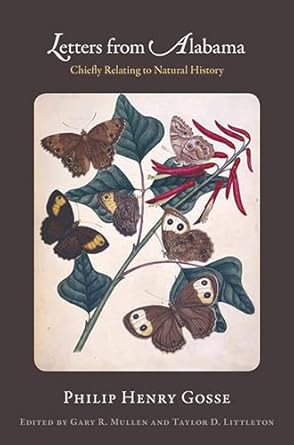
The best source of early natural history for the Black Belt (and Alabama, generally) is the collection of Philip Henry Gosse’s early writings from 1838. This book provides detailed descriptions of Gosse’s travels to the Black Belt and observations therein from 1838. Gosse was a young English naturalist who appreciated the rich flora and fauna of Alabama more than most of its then-inhabitants, and his writings provide a fascinating eyewitness account of that early period of settlement and its peculiar ecology and human history. It is an indispensable resource for anyone interested in the natural history of Central Alabama. I include it here only because it is worthy of collection and not because it is particularly relevant to North Alabama.
ROLLING AND PRAIRIE LANDS.
These lands lie to the southwest of the mountain region with its valleys, as above described, or to the south and west of the broken line that connects the first cascades, or rocky obstructions to navigation in the different rivers, or along and to the south and west of the old shore line of the Gulf of Mexico, as has been defined by the State Geologist. They form a belt of country that runs, in a general way, diagonally across the State. This belt is some thirty miles wide next to the Mississippi line, but narrows towards the east, until it finally comes to a point near the Georgia line. It embraces some 5,915 square miles. These lands do not present any very striking topographical features, as they are comprised of strata of comparative uniformity in hardness, and of strata that are almost level, having only a slight dip to the southwest. These lands are, however, hilly and broken along their upper edge, or the old shore line, where they are cut up by some deep gullies and ravines, and hence have some considerable irregularities of surface. They form the prairie region that is known as the Black Belt, or Canebrake, and are, for the most part, of this region. This prairie region has a gently undulating surface, and a remarkable uniformity in its topography. It is in places covered by a fine forest growth of oak, ash, gum, hickory, etc., though, as a general thing, it is bare of such, and is in cultivation. It is noted for the great fertility and durability of its soils. It produced before the war more of agricultural value than any area of like extent in the United States. It may, some of these days, become worldwide famous for its phosphatic deposits.
From Northern Alabama Historical and Biographical Illustrated p. 10
“At that time [1832 or 1833] the ‘Canebrake’ in Marengo county was but little known. The water falling upon its surface was impeded in its flow by the cane and leaves and limbs which had fallen, and it was believed to be too wet for cotton.”
From Early Settlers of Alabama by Col. James Edmonds Saunders (1899), p. 264