Ecoregions
When choosing native plants for your landscape or garden, you will want to consider your options carefully. People new to native plant gardening are often overwhelmed by the available options of “native plants,” so it is often helpful to narrow a list of hundreds or thousands of species to one that is more specific to an ecoregion. Many native plants have very specific growing requirements, constrained by soil properties, hydrology, heliophily and geology. It is important to understand all these characteristics of a site before selecting native plants to grow there.
A good place to start with plant selection is to identify your Level III ecoregion. In North Alabama, the Level III ecoregions include the Interior Low Plateau and Southwestern Appalachians. Adjacent ecoregions include the Coastal Plain and Valley and Ridge. There are numerous sub-divisions of these ecoregions, but the principal Level IV ecoregions surrounding Huntsville include the Eastern Highland Rim and Cumberland Plateau. The top of the Cumberland Plateau is underlain with erosion-resistant sandstone, which produces very acidic, infertile soils that favor oaks, pines and acid-loving ericaceous plants (mountain laurel, rhododendrons, azaleas, and blueberries). By contrast, the steep slopes of the Cumberland Plateau as well as the Highland Rim has very fertile circum-neutral soils derived from limestone, which is highly prone to erosion and is characterized by karst topography (including springs, salt licks, caves and sinkholes) that favor rich hardwood forests (junipers and redbuds are indicator species on limestone soils). On both the Cumberland Plateau and the Highland Rim, there are areas where the bedrock breaks through the surface, and these areas form unique ecosystems known as cedar glades and sandstone glades that contain many endemic species. Barrens (grasslands that appeared barren compared to heavily forested areas) were also historically present on both the Plateau and Highland Rim and were primarily anthropogenically created by Native Americans (and for a time European settlers) who set fire to the land to create conditions conducive to grazing by large herbivores, including bison and elk.
Additional descriptions of our ecoregions and their plant communities can be found on bplant.
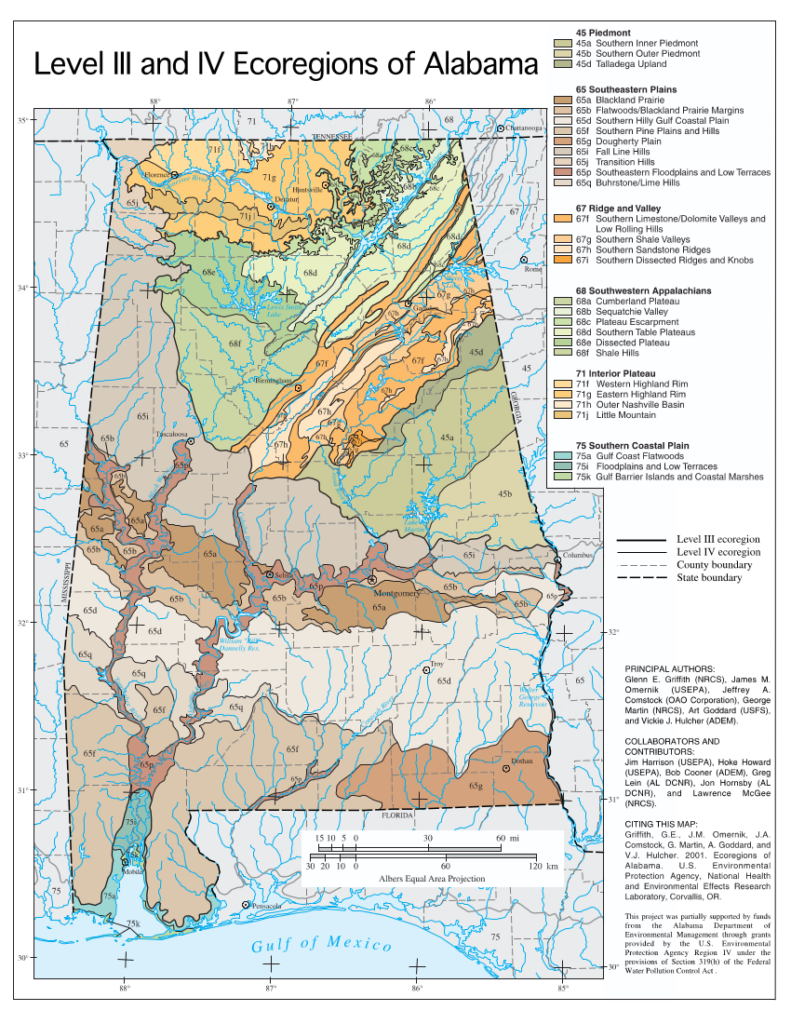
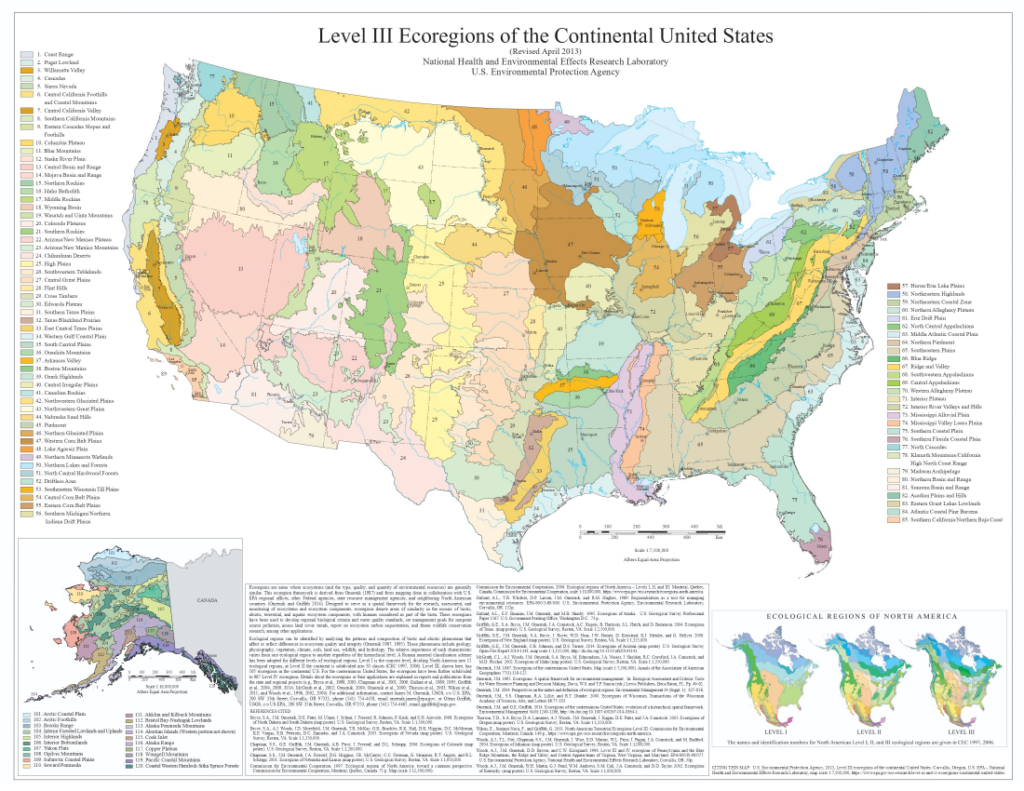
It is important to understand the wider affinities of the Level III Ecoregions. For example, the Interior Low Plateau extends northward through Middle Tennessee and Kentucky into Southern Indiana, Ohio and even Illinois (alluding to its affinities with the grasslands and savannas to the north). The Southwestern Appalachians, including the Cumberland Plateau, extend in a northeastern and southwestern direction into North Central Alabama, Eastern Tennessee & Kentucky. The Level III ecoregions spanning these far-flung states have more in common with each other than the Highland Rim and the Cumberland Plateau have with each other, despite both being adjacent in Huntsville. The diversity of ecoregions in Alabama (as well as its mega-diverse watersheds and role as an ice age refugium) help to explain why Alabama is the #4 state for biodiversity in the U.S.
Geology & Soils
Now that you are familiar with your ecoregion, it is wise to consider the geology and soil characteristics of your specific property. Two excellent free resources to learn about local geology and soils are the free app Rockd and the free resource USGS Web Soil Survey. In Rockd, use the map to toggle to your location, where you can see the local formation closest to the surface along with its composition and underlying stratigraphy (layers of rocks). The USDA’s website is old and a little clunky, but here are the instructions for learning about your soil properties:
- Click the “Start WSS” button (green)
- Under the “Quick Navigation” menu on the left, enter your address
- In the Area of Interest Interactive Map, click one of the AOI tracing tools (square or polygon)
- Trace the outline of your neighborhood and double click when you are done
- Click the “Soil Map” tab to see the typical soils in your area
- Click the “Soil Data Explorer” tab and click the properties that interest you (eg pH)
- Enter any required fields, then click “View Rating”
If you’d like a more customized analysis of your site conditions (especially if your soils are heavily damaged in a new development), you can submit soil samples for analysis to Alabama Extension.
Unfortunately if you live in a new development, your soils may be significantly altered from their original condition. Often what is left is compacted mineral soil that is missing its original organic layer. If your soils are compacted clay, there are a couple of things you should (and should not) do. In general, NEVER add sand, NEVER add repeated fertilizers (eg “weed and feed” for a lawn), DO NOT till the soil, and ALWAYS avoid walking on clay after it rains. You should also add AS MUCH organic matter (particularly leaf litter, but also compost, manure and mulch) to the soil as possible to improve aeration and drainage and reboot the soil biological processes. Some native plants with deep roots (grasses and sunflowers, for example) can greatly increase soil organic matter, improve aeration and even break up hard pan (compacted layers). It takes time to heal damaged soils, so please be patient and consistent with this process, and share your success stories with others. The video below provides some extremely helpful guidelines that illustrates how clay soils can be an asset. Remember, clay soils are a natural feature of our region, and we must learn to love and care for them with wisdom!
Your Clay Soil Isn’t the Problem
Plant Requirements
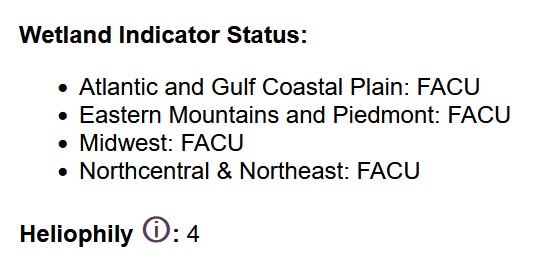
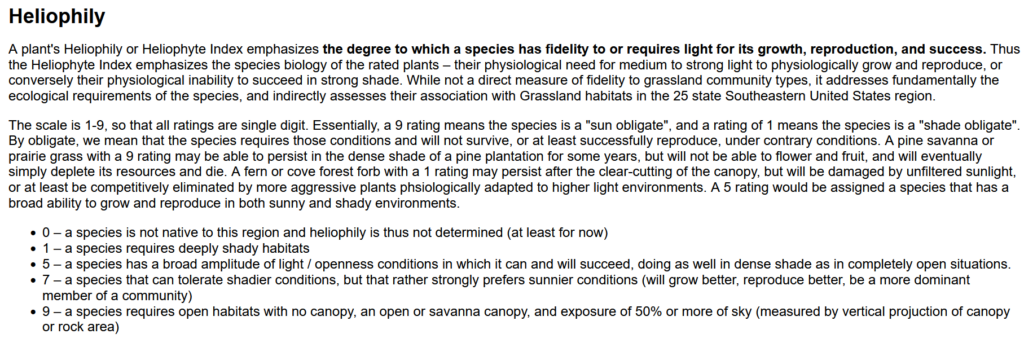
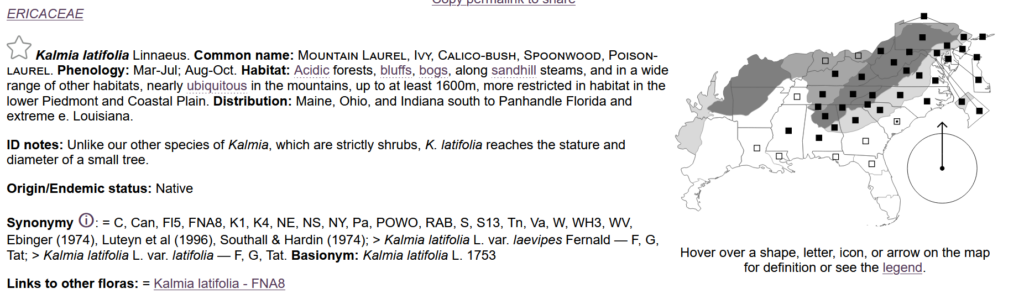
Now that you understand your primary soil characteristics (geology, pH, fertility, particle composition and compaction), you should consider the site exposure. Some plants love full sun, while others will wither away in full sun (defined as >6h sun per day). The amount of sun a plant prefers or requires is known as heliophily. A fantastic resource for learning about heliophily (and the Southeastern flora, generally) is the Flora of the Southeastern United States. Each plant profile has a heliophily rating, as can be seen below for Mountain Laurel (Kalmia latifolia), a charming evergreen shrub that grows on acidic, nutrient poor soils.
Weakley, A.S., and Southeastern Flora Team. 2026. Flora of the southeastern United States Web App. University of North Carolina Herbarium, North Carolina Botanical Garden, Chapel Hill, U.S.A. https://fsus.ncbg.unc.edu/main.php?pg=show-taxon-detail.php&lsid=urn:lsid:ncbg.unc.edu:taxon:{761B4D05-0799-431C-80A5-FA1E7CBC3B96}. Accessed Jun 20, 2026.
Weakley, A.S., and Southeastern Flora Team. 2026. Flora of the southeastern United States Web App. University of North Carolina Herbarium, North Carolina Botanical Garden, Chapel Hill, U.S.A. https://fsus.ncbg.unc.edu/main.php?pg=show-taxon-detail.php&lsid=urn:lsid:ncbg.unc.edu:taxon:{761B4D05-0799-431C-80A5-FA1E7CBC3B96}. Accessed Jun 20, 2026.
Weakley, A.S., and Southeastern Flora Team. 2026. Flora of the southeastern United States Web App. University of North Carolina Herbarium, North Carolina Botanical Garden, Chapel Hill, U.S.A. https://fsus.ncbg.unc.edu/main.php?pg=show-taxon-detail.php&lsid=urn:lsid:ncbg.unc.edu:taxon:{761B4D05-0799-431C-80A5-FA1E7CBC3B96}. Accessed Jun 20, 2026.
The best option for interfacing with the Flora is to purchase the FloraQuest app for the South Central region. This also provides a graphic key, which can help you identify native plants to your ecoregion that meet certain site conditions. While not comprehensive for gardening purposes, it is excellent for providing some recommendations.
In addition to heliophily, you should understand the water needs of your plants. Some desirable native plants are obligate or facultative wetland plants and will not thrive in garden settings without special considerations. However, many gardens have wet areas (under downspouts, along drainage lines, or in man-made ponds) where wetland plants can thrive. The flora provides guides on wetland status for each plant, and an overview of the abbreviations can be found in the Flora’s Introduction. Mountain laurel, for example, is a facultative upland species, meaning it usually found in upland sites, but can occasionally also be found in wetlands.
Now that you know a little bit about your ecoregion and soils, you may be interested to discover which native plants are naturally found in your ecoregion. These are often the best starting point for planting to support local pollinators and wildlife. I highly recommend bplant to find documented native plants in your ecoregion.
Interior Low Plateau Native Plant List
Southwestern Appalachians Native Plant List
This is all just a starting point for finding the best plants for your native garden. There is no requirement in WONA that you be a native plant purist, but always consider the ecological impact of any decision you make to add plants to your landscape. Start with keystone plant genera that will thrive in your soils, and build the ecosystem back from there! On the other hand, if you are lucky enough to inherit a property with soils that are largely intact, then your first priority should be to remove invasive plants (and keep them out!) and allow the soil seed bank to recover.