
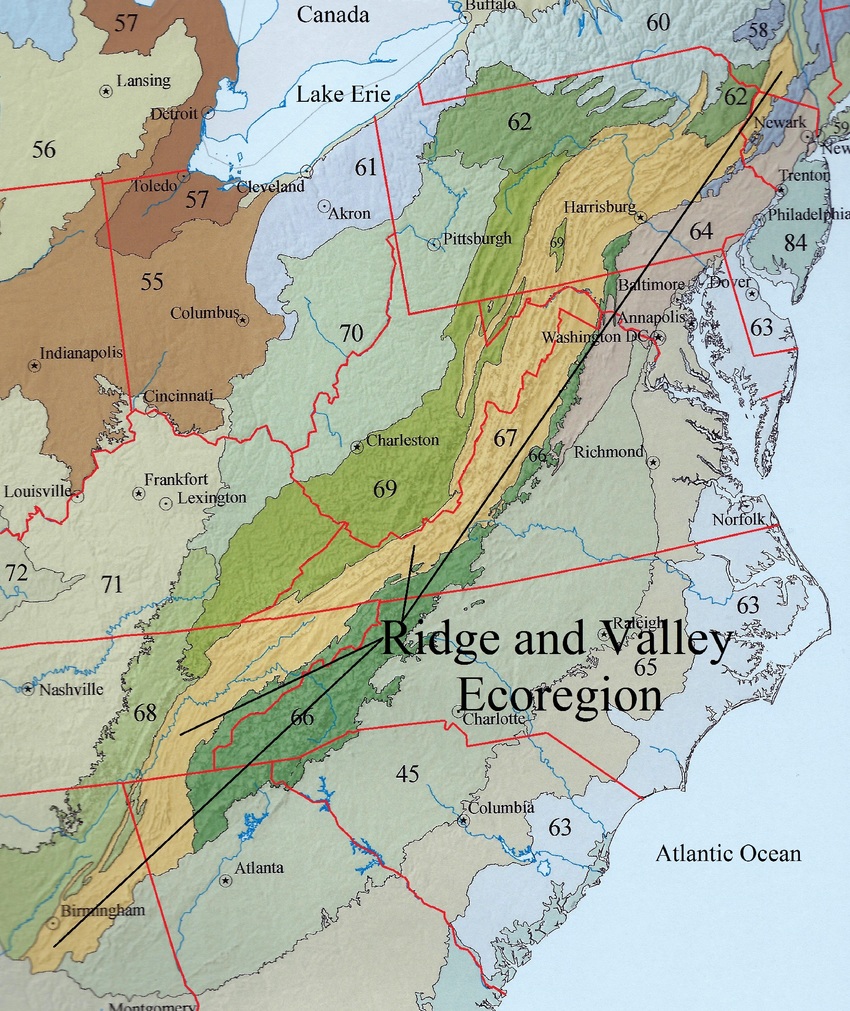
Pennsylvania
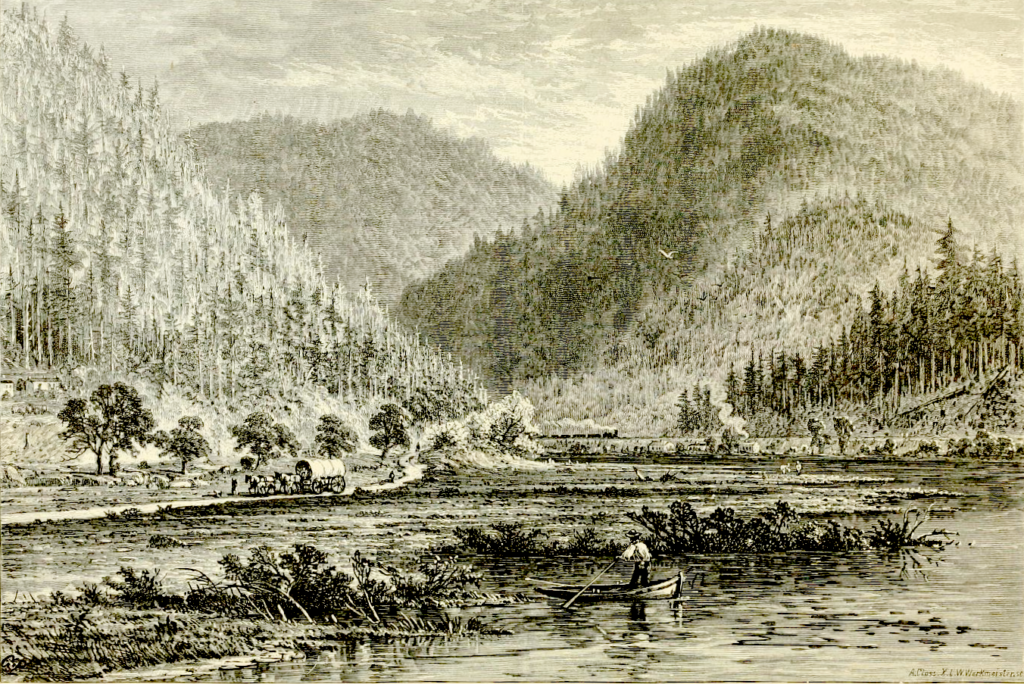
“This day we travelled only six-and-twenty miles, and slept at Fort Littleton, about six miles from Strasburg, at the house of one Colonel Bird, who keeps a good inn. From Shippensburgh the mountains are very flinty, and the soil extremely bad; the trees of an indifferent growth and particularly the white oak [Quercus alba] that grows upon the summit, and the calmia latifolia [Kalmia latifolia, mountain laurel] on the other parts.
The next day we set out very early in the morning to go to Bedford Court House. From Fort Littleton to the river Juniata we found very few plantations; nothing but a succession of ridges, the spaces between which were filled up with a number of little hills. Being on the summit of one of these lofty ridges, the inequality of this group of mountains, crowned with innumerable woods, and overshadowing the earth, it afforded nearly the same picture that the troubled sea presents after a dreadful storm.
Two miles before you come to the river Juniata, the road is divided into two branches, which meet again at the river side. The right leads across the mountains, and the left, which we took, appeared to have been, and may be still the bed of a deep torrent, the ground being wet and marshy. The banks were covered with the andromeda, vaccinium, and more particularly with a species of rhododendrum, that bears a flower of the clearest white; the fibres of the stamina are also white, and the leaves more obtuse, and not so large as the rhododendrum maximum. This singular variation must of course admit its being classed under a particular species. I discovered this beautiful shrub a second time on the mountains of North Carolina. Its seeds were at that time ripe, and I carried some of them over with me to France, which came up exceedingly well. The river Juniata was not, in that part, above thirty or forty fathoms broad, and in consequence of the tide being very low, we forded it; still, the greatest part of the year people cross it in a ferry-boat. Its banks are lofty and very airy. The magnolia acuminata [cucumber magnolia] is very common in the environs it is known in the country by the name of the cucumber tree. The inhabitants of the remote parts of Pensylvania, Virginia, and even the western countries, pick the cones when green to infuse in whiskey, which gives it a pleasant bitter. This bitter is very much esteemed in the country as a preventive against intermittent fevers; but I have my doubts whether it would be so generally used if it had the same qualities when mixed with water.
From the crossing of the river Juniata to Bedford Court House, the country, although mountainous, is still better, and more inhabited, than that we travelled over from Shippensburgh. The plantations, although seldom in sight of each other, are near enough to give a more animated appearance to the country. We arrived at Bedford in the dusk of the evening, and took lodgings at an inn, the landlord of which was an acquaintance of the American ofiicer with whom I was travelling. His house was commodious, and elevated one story above the ground floor, which is very rare in that part of the country. The day of our arrival was a day of rejoicing for the country people, who had assembled together in this little town to celebrate the suppression of the tax laid upon the whiskey distilleries; rather an arbitrary tax, that had disaffected the inhabitants of the interior against the late president, Mr. Adams. The public houses, inns, and more especially the one where we lodged, were filled with the lower class of people, who made the most dreadful riot, and committed such horrible excesses, that is almost impossible to form the least idea of. The rooms, stairs, and yard were strewed with drunken men; and those who had still the power of speech uttered nothing but the accents of rage and fury. A passion for spirituous liquors is one of the features that characterise the country people belonging to the interior of the United States. This passion is so strong, that they desert their homes every now and then to get drunk in public houses; in fact, I do not conceive there are ten out of a hundred who have resolution enough to desist from it a moment provided they had it by them, notwithstanding their usual beverage in summer is nothing but water, or sour milk. They care very little for cyder, which they find too weak. Their dislike to this wholesome and pleasant beverage is the more distressing as they might easily procure it at a very trifling expense, for apple trees of every kind grow to wonderful perfection in this country. This is a remark which I have made towards the east as well as the west of the Alleghany Mountains, where I have known lofty trees spring up from kernels, which bore apples from eight to nine inches in circumference.
…On the following day (the ist of July) we left Bedford very early in the morning. The heat was excessive; the ridges that we had perpetually to climb, and the little mountains that rise between these ridges, rendered the journey extremely difficult; we travelled no more than six-and-twenty miles this day. About four miles from Bedford the road divides into two different directions; we took the left, and stopped to breakfast with a miller who keeps a public house. We found a man there lying upon the ground, wrapt up in a blanket, who on the preceding evening had been bitten by a rattle-snake [Crotalus adamanteus]. The first symptoms that appeared, about an hour after the accident, were violent vomitings, which was succeeded by a raging fever. When I saw him first his leg and thigh were very much swelled, his respiration very laborious, and his countenance turgescent, and similar to that of a person attacked with the hydrophobia whom I had an opportunity of seeing at Charité. I put several questions to him; but he was so absorbed that it was impossible to obtain the least answer from him. I learnt from some persons in the house that immediately after the bite, the juice of certain plants had been applied to the wound, waiting the doctor’s arrival, who lived fifteen or twenty miles off. Those who do not die with it are always very sickly, and sensible to the changes of the atmosphere. The plants made use of against the bite are very numerous, and almost all succulent. There are a great many rattle-snakes in these mountainous parts of Pensylvania; we found a great number of them killed upon the road. In the warm and dry season of the year they come out from beneath the rocks, and inhabit those places where there is water.
On that same day we crossed the ridge which takes more particularly the name of Alleghany Ridges. The road we took was extremely rugged, and covered with enormous stones. We attained the summit after two hours painful journey. It is truly astonishing how the vehicles of conveyance pass over so easily, and with so few accidents this multitude of steep hills or ridges, that uninterruptedly follow in succession from Shippensburgh to Pittsburgh, and where the spaces between each are filled up with an infinity of small mountains of a less elevation.”
From Early Western Travels by Francois Andre Michaux (1803) pp. 142-146
“We passed the Susquehannah, and the Juniata, which comes from the Alleghany Mountains, and flows into it. On the 22nd, at day-break, we were at the little village of Mexico…
..From this place [beyond MifflinTown, PA, coming from Harrisburg] we observed in the valley many robinias [black locust], which grow very high and vigorous, as well on the mountain, which is rather dry, as by the water-side; vines as thick as a man’s arm twine round the trunks, and frequently rise to the very summit. The nettle tree [hackberry] (Celtis) grew in great abundance, and the maples [Acer] were just assuming their red tinge. The picturesque forest is intermingled with Canadian pines [possibly Tsuga canadensis, Eastern hemlock], many of which are quite blighted and withered. The valley now became wilder and more romantic; on the right hand rose a high precipice, covered with bolders, fragments of rock, mouldering trunks, and the finest trees of the country, forming a real wilderness. A very narrow part of the valley, where we watered our horses at an insulated house, bears the name of the Long Narrows; and the steep wooded mountain, on the south bank of the river, is called Blacklog Mountain; it is said to be the haunt of bears and stags..After some time the valley grew more open, and at a wider spot, near the road, which descended towards the defile of James Creek, was a group of lofty and slender robinias, on which a flock of tame turkeys were sitting. These birds resemble in colour the wild ones which are common in this country; they often go into the forests, where they breed, and come home again with their young ones. After passing Kishikokinas Creek, we reached, at a broad part of the valley, the village of Louis Town [Lewistown]..In a district diversified with forests and cultivated fields, we came to Waynesburg, a small town agreeably situated in a valley. The forests began to assume their autumnal tints; the maples [Acer], the dogwood (Cornus Florida), and the sumach [Rhus], were partly red; the walnut [Juglans] trees, and the hickory [Carya], yellow, which gave great variety to the landscape. Near some habitations we observed weeping willows of extraordinary size. The surrounding mountains were covered with forests, into which we penetrated to ascend the first ridge of the Western Alleghanys. The road, which is, for the most part, in bad condition, rose obliquely on the side of a rude picturesque precipice. Except a pheasant, which flew past us, we saw but few living objects. Advancing into the valley we again came to the Juniata, over which the canal is here carried by an aqueduct, supported by four pillars.
At a place where three valleys meet stands the village of Huntingdon, ninety miles from Harrisburg, where we found a tolerably good inn, on an eminence above the banks of the Juniata. From this inn we proceeded, during the night, through high rude tracts and forests, past Alexandria, and at midnight reached Yellow Springs, and then the highest points of this ridge, called the summit, between 2,400 and 3,000 feet above the level of the sea, in the vicinity of Blair’s Gap. This wild mountain region bears hemlock spruce firs [unclear if this refers to a single species or 3 clades] of colossal magnitude, mixed with other timber. The night was clear and cool; towards morning fogs arose from the deep valleys, which at daybreak covered the pine forest through which we descended.”
From Travels in the Interior of North America by Maximilian, Prince of Wied (1843) pp. 132-134
Tennessee
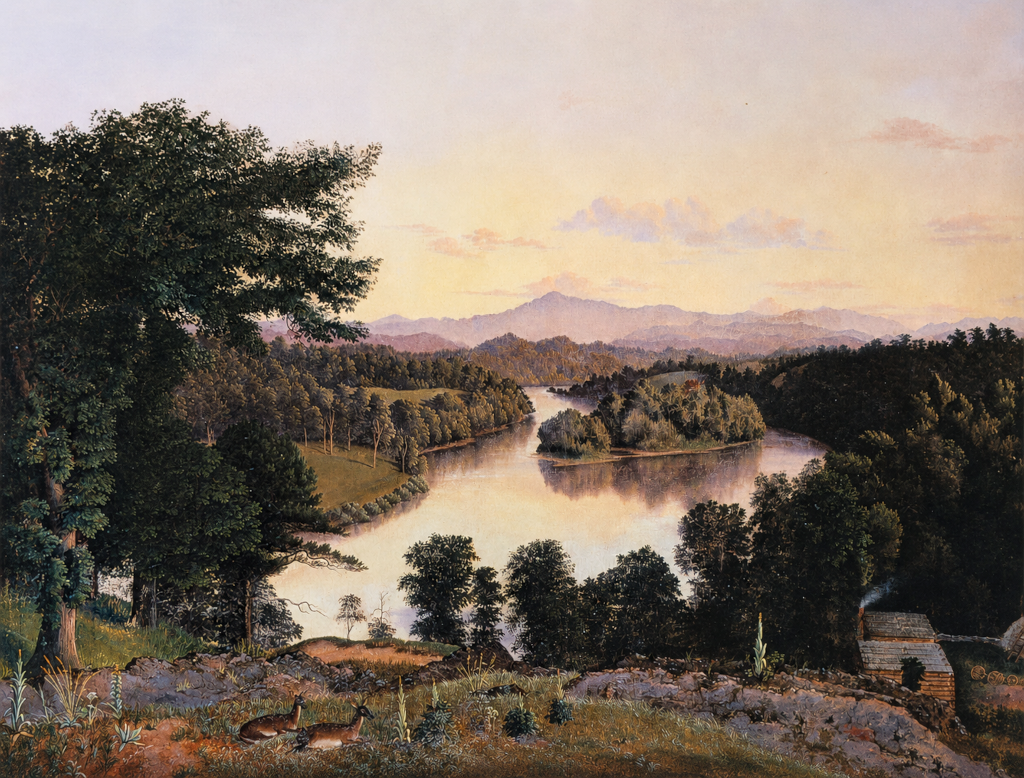
[30th March] “We Camped on Reedy Creek [near the Holston River].
[30th March] We caught two young Buffaloes, one of which we killed, and having cut and marked the other we turn’d him out.
[31st March] We kept down Reedy Creek to Holston where we measured an Elm [likely Ulmus americana] 25 feet round 3 feet from the Ground.
[1st April]…The Sabbath, we saw Perch, Mullets, and Carp in plenty, and caught one of the large Sort of Cat Fish. I marked my Name, the day of the month, and date of the year on Several Beech Trees [Fagus grandifolia].
[2nd April] we left Holston & travelled through small Hills till about Noon, when one of our Horses being choaked by eating Reeds [likely Arundinaria gigantea or river cane] too gredily, we stopped having travelled 7 miles. Our horse being recover’d, we travelled to the Rocky Ridge. I went up to the top, to look for a Pass, but found it so Rocky that I concluded not to Attempt it there. This Ridge may be known by Sight, at a distance. To the Eastward are many small Mountains, and a Buffaloe Road between them and the Ridge. The growth is Pine on the top’ and the Rocks look white at a distance, we went Seven miles this day.
[4th April] We kept under the Rocky Ridge crossing; several small Branches to the head of Holly Creek. we saw many small Licks and plenty of Deer.
[5th April] we went down Holly Creek. There is much Holly [Ilex] in the Low Grounds & some Laurel [Rhododendron maximum] and Ivy [Kalmia latifolia]. About 3 in the afternoon, the Ridge appeared less stony and we passed it, and camped on a small Branch about a mile from the top. my Riding Horse choaked himself this Evening and I drenched him with water to wash down the Reeds, and it answered the End.
[7th April] We rode 8 miles over broken Land. It snowed most of the day. In the Evening our dogs caught a large He Bear, which before we could come up to shoot him had wounded a dog of mine, so that he could not Travel, and we carried him on Horseback, till he recovered.
[8th April] the Sabbath. Still Snow.
[9th April] We travelled to a river, which I suppose to be that which the hunters Call Clinches River from one Clinch a Hunter, who first found it. we marked several Beeches [Fagus grandifolia] on
[10th April] …This afternoon Ambrose Powell was bit by a Bear in his Knee, we rode 7 miles this day.
[20th April] We kept down the Creek 2 miles to the River again. It appears not any wider here than at the mouth of Clover Creek, but much deeper. I thought it proper to Cross the River and began a bark Conoe.”
From Journal of Dr. Thomas Walker by Dr. Thomas Walker (1748) pp. 43-44
“About a mile from West Point we passed through Kingstown, composed of thirty or forty log houses; after that the road runs upwards of eighteen miles through a rugged and flinty soil, although covered with a kind of grass. The trees that occupy this extent grow within twenty or thirty yards of each other, which makes it seem as though this district changes from the appearance of a meadow to that of a forest. After this the soil grows better, and the plantations are not so far apart.”
From Travels to the West of the Allegheny Mountains by Francois Andre Michaux (1805) pp. 265
“On leaving Knoxville the soil is uneven, stony and very indifferent, of which it is an easy thing to judge by the quantity of pines, or pinus mitis [Pinus echinata, shortleaf pine], that are in the forests. We also found there an abundance of Chinquapin oaks, or quercus prinus Chinquapin [oak] [Quercus muehlenbergii], that seldom grow above three feet high, some of which were that year so loaded with acorns that they were bent to the ground. The sorel-tree [sourwood], or andromeda arborea [Oxydendrum arboreum], is also very common. This tree, that rises about forty feet in the mountains, would be one of the most splendid ornaments for our gardens, on account of its opening clusters of white flowers. Its leaves are very acid, and many of the inhabitants prefer them to shumac [Rhus] for dyeing cottons.
I crossed the river Holston at Macby, about fifteen miles from Knoxville; here the soil grows better, and the plantations are nearer together, although not immediately within sight of each other. At some distance from Macby the road, for the space of two miles, runs by the side of a copse, extremely full of young suckers, the highest of which was not above twenty feet. As I had never seen any part of a forest so composed before, I made an observation of it to the inhabitants of the country, who told me that this place was formerly part of a barren, or meadow, which had naturally clothed itself again with trees, that fifteen years since they had been totally destroyed by fire, in order to clear the land, which is a common practice in all the southern states. This example appears to demonstrate that the spacious meadows in Kentucky and Tennessea owe their birth to some great conflagration that has consumed the forests, and that they are kept up as meadows by the custom that is still practised of annually setting them on fire. In these conflagrations, when chance preserves any part from the ravages of the flame, for a certain number of years they are re-stocked with trees; but as it is then extremely thick, the fire burns them completely down, and reduce, them again to a sort of meadow. We may thence conclude, that in these parts of the country the meadows encroach continually upon the forests. The same has probably taken place in Upper Louisiana and New Mexico, which are only immense plains, burnt annually by the natives, and where there is not a tree to be found.
…The road at this place divides into two branches, both of which lead to Jonesborough ; but as I wanted to survey the banks of the river Nolachuky, so renowned in that part of the country for their fertility, I took the right, although it was rather longer, and not so much frequented…Arrived’ on the boundaries of the river Nolachuky, I did not observe any species of trees or plants that I had not seen elsewhere, except a few poplars [Liriodendron tulipifera] and horse-chesnuts [Aesculus, buckeye], which bore a yellow blossom. Some of these poplars were five or six feet in diameter, perfectly straight, and free from branches for thirty or forty feet from the earth.”
From Travels to the West of the Allegheny Mountains by Francois Andre Michaux (1805) pp. 265-269
“East Tennessea, or Holston, is situated between the loftiest of the Alleghany and Cumberland Mountains. It comprises, in length, an extent of nearly a hundred and forty miles, and differs chiefly from West Tennessea [Middle Tennessee] in point of the earth’s being not so chalky, and better watered by the small rivers issuing from the adjacent mountains, which cross it in every part. The best land is upon their borders. The remainder of the territory, almost everywhere interspersed with hills, is of a middling quality, and produces nothing but white [Quercus alba], red [Quercus rubra], black [Quercus velutina], chincapin [Quercus muehlenbergii], and mountain oaks [Quercus montana], &c. intermixed with pines [Pinus]; and, as we have before observed, except the quercus macrocarpa [bur oak], the rest never grow, even in the most fertile places.
…The nature of the soil, somewhat gravelly, appears more adapted for the culture of wheat, rye, and oats; in consequence of which it is more adhered to than in Cumberland.
From Travels to the West of the Allegheny Mountains by Francois Andre Michaux (1805) pp. 265-269
VALLEY LANDS.
If you approach the mountains of East Tennessee from their western slope, taking a direct course eastward, traveling from Cleveland along the road which leads to the copper mines in Polk County, you are constantly uphill and downhill for nearly fifteen miles, intersecting a series of, low parallel ridges. The soil is directly derived from the underlying rock, one of the lowest members of the Silurian formation, and only very small strips of alluvium line the few streamlets which you have to cross. Along this line is also the watershed, between the Tennessee River system and the Coosa River. It belongs mainly to that class of land which, all over the State, is not very favorably known as gravelly hills, from a superficial covering of sharp cherty or dolomitic gravels of all sizes, generally small, but often also protruding in dykelike masses. Magnesian and siliceous rocks, no matter to which geological age they may belong, are, all the world over, the most unavailing mineral constituents of soil, and, for the lack of alkali and phosphates, are soon exhausted by crops which consume much of these elements. The generally thin covering of humus supports a meager herbage, and cattle have to be on their feet all the while in defense against starvation. Black-jack oaks [Quercus marilandica], Spanish oak [Quercus falcata, southern red oak], black oak [Quercus velutina], sourwood [Oxydendrum arboreum], dogwood [Cornus florida], slim chestnuts [Castanea dentata], loblolly pine [Pinus taeda], scrub pine [likely Pinus virginiana], and here and there a yellow pine [Pinus echinata, shortleaf pine] which has escaped the ax, make up the forest, which, throughout this region, is stripped of the merchantable timber. I have, myself, within thirty-five years, witnessed the rise and fall of this empire. The short space of time which passed between the first harvest and hopeless abandonment had not yet prostrated all the dead timber girdled in the first clearing, when, the returns became too small to pay for the expense of cultivation. Stunted sassafras [Sassafras albidum] and persimmon [Diospyros virginiana], here and there a loblolly pine [Pinus taeda], sumacs (Rhus glabra and copallina), are the growth by which regenerating nature tries to reclaim those ruined lands. The herbage consists generally of very humble plants; the buttonweed (Diodia teres) [Hexasepalum teres], Virginia plantain (Plantago Virginica), the flowering spurge (Euphorbia corollota), butterfly weed (Asclepias tuberosa), two species of broom grass (Andropogon Virginicus and scoparius) [Anatherum virginicum, broomsedge & Schizachyrium scoparium, little bluestem], the foxtail grass (Setaria glauca), the poverty grass (Aristida dichotoma), the common evening primrose (Oenothera biennis), the *mullein (*Verbascum thapsus, *non-native), the never-failing ragweed (Ambrosia artemisiefolia), a few solidagos [goldenrod] and asters (Aster ericoides and dumosus) [Symphytrichum ericoides, heath aster & Symphyotrichum dumosum, long-stalked aster], constitute the larger herbs. In places the ground is spread over by the prostrate low blackberry (Rubus trivialis), or cinquefoil (Potentilla Canadensis), while the high blackberry (Rubus villosus) [possibly Rubus allegheniensis] replaces former fence rows. Cattle find an insufficient support from browsing on the Japan bush clover (Lespedeza striata) [Kummerowia striata], *white and yellow clover (*Trifolium repens and procumbens, *both non-native), and about two nutritious grasses, the crop grass (Panicum digitaria) [Paspalum distichum, joint paspalum], and a species of paspalum. The botanist finds but few rarer species to compensate him for his exertions, and rejoices to find himself at last in full sight of the mountains, in descending the eastern slope of a ridge which borders the Ocoee River. This broad mountain stream, swiftly gliding over his pebbly bed, is skirted by a stately and diversified growth of timber—Herculean sycamores [Platanus occidentalis] and massive cottonwoods [Populus deltoides], immense lindens [Tilia americana] and poplars [Liriodendron tulipifera], slippery [Ulmus rubra] and white elms [Ulmus americana], ashes [Fraxinus], white walnut [Juglans cinerea], and box elder [Acer negundo] of stately growth. The water oak [Quercus nigra] and willow oak (Quercus aquatica and Quercus phellos), with elegant outline and glistening color of foliage, are contrasted by the chalk-white trunks of the gray birch (Betula lutea) [Betula alleghaniensis, yellow birch], with ever-tremulous foliage, on delicate sprigs. Now.and then a holly (llex opaca), [mountain] silver-bell tree (Halesia tetraptera), and an umbrella tree (Magnolia umbrella) [Magnolia tripetala] present themselves as outliers from the upper regions. Crossing the river, the romantic hamlet, Parksville, is soon reached, the gateway to the great mountains, opening between two mighty pillars, the Chilhowee Mountain to the left or north side, and the Round Mountain to the right or south side. Before reaching the mill dam, the last ledges of chert and dolomite are passed, and quarzite and siliceoargillaceous conglomerates are the country rocks. Narrow but rich bottoms, encompassed by high and steep mountain sides, the latter heavily timbered, give room for small and scattered farms, well cared for and successfully managed.
MOUNTAIN FLORA.
The lower mountain flora is spreading around on all sides, clothed in deeper green or gaudier colorings. As we ascend the river, which gushes with deafening roar from shoal to shoal, we discern how every submerged rock is densely coated with a rough,wool-like growth, an inch or two long, threadlike, the flowers the size of pin heads, the mountain river weed (Podostemon abrotanovdes), pondweeds float in long streamers (Patamogeton hybridus, Potamogeton Clayton). An endless variety of shrubbery constitutes the undergrowth. The Kalmia (Kalmia latifolia) [mountain laurel], worthy companion to the great [rhododendron] mountain laurel (Rhododendron maximum), and four azaleas, equally beautiful (the fragrant clammy azalea), merit the highest praise and are very abundant. Various other kinds of the heath family, with white and bell-shaped flowers and evergreen foliage, are characteristic features of the scenery. Foremost, the dense masses of Leucothoe Catesbeai [Leucothoe fontenasiana, doghobble], a tall shrub with wand-shaped, recurved branches and dense pendulous racemes, exhaling the odor of chestnut flowers; Leucothoé recurva [Eubotrys recurva, mountain fetterbush], the Andromeda floribunda [Pieris floribunda, mountain andromeda], and the [mountain] white alder (Clethra acuminata), either as bush or small tree, all belong to this type.
A singular and unparalleled display is reserved for the untiring botanist if he climbs to the highest cliffs of the Chilhowee, from whence at one glance he can survey the whole valley of East Tennessee until his eye meets, in the smoky distance, the rectilinear course of Walden’s Ridge [on the Cumberland Plateau]. At an elevation of about 2,500 feet he descries along vertical cliffs of Potsdam sandstone, dense groves of the fringe tree (Chionanthus Virginica), in greater vigor and abundance of flowers than he had ever before witnessed. Several rare ferns grow in the crevices, such as the woolly-leafed Cheilanthes (Chil. tomentosa) [Myriopteris tomentosa, wooly lipfern], grayish green on the upper surface and rusty eolored underneath; the Cheilanthes vestita [Myriopteris lanosa, hairy lipfern], of similar habit, but not quite so attractive; the neat little Asplenium Trichomanes [maidenhair spleenwort] and Asplenium montanum [mountain spleenwort]. Polpyodium vulgare [likely Polypodium virginianum, common rock polypody] and incanum [possibly Pleopeltis michauxi, resurrection fern], and some larger species of Phegopteris‘and Aspidium abound. Orchids of rare beauty nestle in the deep mold—Bletia aphylla [Hexalectris spicata, crested coralroot], Goodyera pubescens [downy rattlesnake orchid], Pogonia ophioglossoides [rose pogonia] and [Isotria] verticillata [large whorled pogonia], Cypripedium spectabile [reginae], acaule and pubescens [showy, pink, large yellow lady’s slippers].
From The Flora of Tennessee and a Philosophy of Botany by Augustin Gattinger (1901), pp. 13-15
Alabama
Editor’s Note: The following abridged account provides insights into early Valley and Ridge history in Alabama. It is copied using the original historical language.
“My father took up his land [in Calhoun County, AL] under the treaty of 1832. The country was beautiful and well wooded, and the streams were clear as crystal. They remained so until the whites got control of the land and stirred up the soil by cultivation, breaking the turf which had been undisturbed for ages.”
…”The Cherokees were less fond of near neighbors than the Creeks, and didn’t live in villages, but in scattered houses, like the whites. Their houses were of better grade than those of the Creeks. The Cherokees had rudely made settees on which they spread buffalo skins and bear skins and on which they often slept. I remember no chimneys among the Creeks, they did most of their cooking out of doors. They had iron pots to boil things in, and they baked their bread in earth ovens: corn bread, of course, for there was little wheat in Alabama then.
When the corn has just passed the ‘milk’ stage they used to grate it into a sort of coarse meal, which they made into hominy. When the corn was hard, it was beaten in mortars, the women doing the work, of course. They didn’t eat much corn bread when game—elk, deer, and wild turkey—were plenty; they lived mostly on meat then, using practically no vegetable food at all. Panthers were plentiful enough there then, too, and the Indians [sic] killed them often; don’t remember that they ever ate panther meat, but I can’t imagine why they shouldn’t have done so, for they ate dogs and liked the meat.”
…”The Indian men had guns and used to shoot with powder and ball, but the small boys had only bows and arrows. Their bows were made of hickory [Carya], or honey locust [Gleditsia triacanthos]—the latter were best—and bowstrings of deer sinews, twisted, which made the toughest kind of cords. The arrows were made of cane, the tips being hardened and sharpened by fire. I remember no metal or flint arrowheads, but a carefully and skillfully roasted cane arrow-point would kill a fish in the water, a squirrel in a tree or a bird in the air.”
…”All the Indian children that I knew well were expert canoeists. There were no bark canoes in Alabama in my day. They were all dugouts, made, preferably, out of poplar [likely Liriodendron tulipifera] logs. I can’t say that they were graceful craft—I don’t remember as to that—but I do remember that they traveled well, and that they had high ends—prow and stern—to make them cut the water right.
There was plenty of grass there then. Practically the entire country was wooded, but the woods were open, the trees growing in clumps, with lots of room between them for the grass. It grew like prairie grass and had a ‘blue’ stem, though it wasn’t ‘bluegrass,’ or at all like it. It was very nutritious, and it kept the white men’s horses and cattle in good conditions, as well as the Indians’ ponies. To-day there isn’t a spear of that kind of grass in all that country.”
Section 3 The Courier-Journal, Louisville, Sunday Morning, August 12, 1906, written about Alabama in the 1830s-40s (p. 5)
Arkeechee, the Son of Foshatchfixico
“The name Foshatchfixico,” said the Senator, “means White Bird Without a Heart. Arkeechee was a fine little boy. One day he went out gathering blackberries. A rattlesnake bit him and he died and his father’s grief was deep and bitter.”
…”Foshatchfixico’s home,” continued Senator, “was worth seeing. He lived on a little patch of ground on a beautiful stream which rose in a spring not very far away and was clear as all the streams were then in Alabama.
Section 3 The Courier-Journal, Louisville, Sunday Morning, August 12, 1906, written about Alabama in the 1830s-40s (p. 5)
“On the 1st of January, 1833, when the writer first came into the County, the settlements were sparse. The Indians [sic] had only sold their land the March previous. No assignments of reservations had yet been made. Indeed the process of preparation under the Treaty, such as the survey of the land and taking the Census of the Indians [sic], designating heads of families by towns, was not fully complete. There was no security if settlements beyond a squatter’s claim “Improvements.” The Indians [sic] were generally in the undisturbed possession of their homes, and their laws and customs in force. The County was open, the annual burning of the woods by the Indians [sic] kept down the undergrowth, and really to a stranger riding through it looking as far as the eye could see, crossing the beautiful, clear streams of water with which it abounds, the impression was altogether favorable and the prospect encouraging.
…The Indian [sic] trails were adopted whenever practicable but there was little difficulty in finding a wagon way, the forests were so open. There were few fields opened by the whites beyond a “deadening” and a few acres enclosed…”
From the Northeast Alabama Settlers (1970) pp. 7, 9, via a quotation from A Brief History of Calhoun County, Alabama via the Jacksonville Republican, April 2, 1870
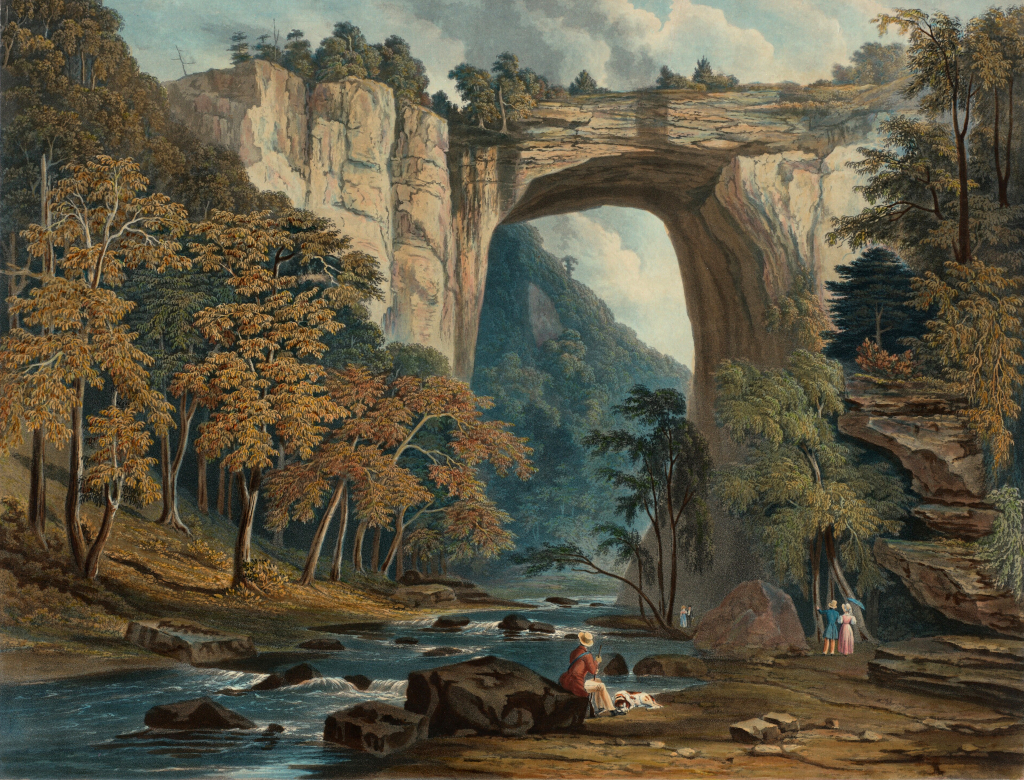
“MOUNTAIN REGION.
The extreme southern spurs of the Appalachian chains belong, with their western and eastern frontiers, to two distinct members of this mountain system. Their differences in topographical and stratigraphical conditions affect visibly the distribution and localization of species in the sections traversed by them.
RANGES OF HILLS OF THE METAMORPHIC AND OLDER PALEOZOIC STRATA.
Physiographical features and climate. — The spurs which enter the State at its eastern boundary are the continuation of the most easterly of the Alleghenian ranges, and are composed of metamorphic crystalline rocks skirted by the oldest sedimentary strata. They extend from the Coosa River to the Tallapoosa and include the most deviated parts of the State. The valleys reach an extreme elevation of about 1,000 feet above sea level, and the highest summits of the ridges reach an altiitude of from 2,000 to 2,400 feet above the Gulf of Mexico. These ridges rise abruptly from the valleys and above the lower hills; their steep flanks are covered with the sharp-edged fragments of the siliceous rocks which crown their crests with bold cliffs.
Xerophile forests. — The most prominent and characteristic feature in the vegetation of this subdivision of the mountain region is the xerophile forests of long-leaf pine [Pinus palustrus] which cover the arid rocky ridges to an elevation of 2,000 feet, as observed on the Chehawhaw Mountain, the highest in the State. These pine forests are open, almost entirely bare of undergrowth; only in the depressions on the flanks of the mountains a stunted growth of black-jack [Quercus marilandica] makes its appearance. At its vertical limit of distribution the pine is suddenly replaced by mountain oak [Quercus montana, chestnut oak], chestnut [Castanea dentata], andpignut hickory [Carya glabra]. Whenever on the summits of the pine-clad ridges at lower levels soil conditions more favorable to deciduous tree growth prevail the pine is obliged to give way to the hardwood trees. The pine timber on these mountains is somewhat stunted; the body of the trees is short and more or less knotty, and the old trees are frequently affected by dry rot, caused by the mycelium of polyporous fungi. It is little esteemed for lumber, but largely consumed for charcoal. There are, however, found exceptional tracts, with a timber growth unrivaled in density and perfection. Such heavily timbered forests of long-leaf pine [Pinus palustris] have been observed, for instance, at Hollins, in Clay County. They extend for miles over a narrow valley and along the rounded foothills of the higher ridges which rise abruptly above them on either side. These particular tracts of forest are not surpassed in yield and quality of timber by the best pine timber lands elsewhere east or west of the Mississippi River, the trees showing most vigorous growth and remarkable uniformity in size and averaging from 20 to 24 inches in diameter breast high. By actual measurement they were found to be of a total height of from 110 to 120 feet, the greatest height growth of the species on record.
…The sapwood in none of these trees exceeded 2 inches in thickness. A loblolly pine [Pinus taeda] felled on the border of the brooklet watering the valley measured 25 inches in diameter across the stump and was found to be scarcely 50 years old.
The herbaceous vegetation on these pine-clad hills is of essentially the same character as that found on the uplands of the Central pine belt, denoting a dry soil. The hidden cause of such perfection in the development of the longleaf pine [Pinus palustris] on a soil apparently as unpromising as any of the rolling pine barrens was clearly revealed by the examination of the subsoil. The argillaceous schist underlying the sandy surface was found completely decomposed, transformed into a friable loam rich in plant food and sufficiently porous to permit the slow percolation of the surface water and its unhindered access to the long taproot of the pine.
Open forests of longleaf pine [Pinus palustris] responding to conditions similar to those prevailing on the flanks of the Talladega Mountains or Blue Ridge of Alabama, already mentioned, cover the lower cherty ridges in Calhoun County, and the isolated peaks south of Talladega known as the Alpine Mountains, which rise to a height of 1,500 to 2,000 feet above the sea. These pine forests of the metamorphic highlands and of the Cambrian hills on their outskirts have in many localities become important since the development of the iron industry in these districts. During the past twenty-five years extensive areas have been denuded of their forests to yield the large supplies of charcoal demanded by this industry. Characteristic herbaceous species here found are:
Cracca virginiana [Tephrosia virginiana, Virginia goat’s-rue], Eupatorium aromaticum [E. aromatica, small-leaved white snakeroot], Cracca spicata [Tephrosia spicata, spiked hoarypea], Solidago odora [licorice goldenrod], and others [Solidago spp.], Lespedeza hirta [silvery lespedeza], Sericocarpus tortifolius [twisted-leaf white-topped aster], Lespedeza repens [smooth trailing lespedeza], Gaylussacia dumosa [southern dwarf huckleberry], Meibomia spp. [Desmodium spp.], Vaccinium stamineum [common deerberry], Eupatorium album [white-bracted thoroughwort].
Heavy forests of longleaf pine [Pinus palustris] cover the lower hills toward the Coosa River and the adjacent deposits of sands and gravels of the valley from Renfroe to Kymulga and to the banks of the Coosa River. A similar timber belt follows the drifted deposits from Gadsden, Etowah County, through Cherokee County and for a short distance beyond the Alabama and Georgia State line. The timber resources of these forests in the basin of Coosa River have furnished the supplies for an active lumber industry during the last twenty-five years. They are, however, rapidly becoming exhausted.
Wherever a richer and deeper soil covers the heights, the slopes of the mountains, and the lower hills, deciduous trees predominate, though rarely the shortleaf pine [Pinus echinata] makes its appearance. The deciduous forests of those metamorphic mountains and Coosa hills differ only slightly from the xerophile forests of the same character in other divisions of the mountain region. Notable is the greater scarcity of tulip and cucumber trees, shagbark and pale-leaf hickory, elms, and lindens, which abound in other parts. On the rocky heights above 900 to 1,000 feet the following prevail:
Quercus prinus [Quercus montana] (mountain oak) [chestnut oak], Quercus digitata [Quercus falcata] (Spanish oak) [southern red oak], Quercus marilandica (black jack), Quercus minor [Quercus stellata] (post oak), Quercus velutina (black or yellow oak) .
More rarely occur:
Quercus alba (white oak), Castanea dentata (chestnut), Hicoria glabra [Carya glabra] (pignut hickory).
The chestnut [Castanea dentata], originally one of the most frequent trees of these forests, is at present rarely found in perfection. The older trees mostly show signs of decay, and the seedlings, as well as the coppice growth proceeding from the stump, are more or less stunted. It is asserted by the old settlers that this tree is dying out all over the mountain region, where at the beginning of the second half of the century it was still found abundant and in perfection. Wild [black] cherry (Prunus aerotina) is only found here and there in the richest spots, and red plum (Prunus americana) rarely along the banks of streams. In the mesophile forests of the bottom lands, as elsewhere north of the maritime belt, cow oak [swamp chestnut oak] (Quercus michauxii), Texas oak[?] (Quercus texana), willow oak (Quercus phellos) and hornbeam (Carpinus caroliniana) prevail. Mountain silverbell (Mohrodendron carolinum) [Halesia carolina], redbud (Cercis canadensis), hard maple (Acer saccharinum barbatum), catalpa (Catalpa catalpa) [Catalpa speciosa or C. bignonioides], and dogwood (Cornus florida) follow the rich slopes fronting the streams; water oak (Quercus nigra L. (Q. aquatica Walt.)) ascends to the upper valley of Talladega Creek in Clay County (1,000 feet); various hawthorns (Crataegus flava, C. coccinea and C. crus-galli) and Southern crabapple (Pyrus angustifolia) [Malus angustifolia] frequent the openings and borders of the woodlands, and swamp dogwood (Cornus sp.) the wet margins of streams. Rosa carolina [carolina rose] was found on the Delta divide near the Idaho gold mine, in Clay County, the only locality for this rose known in the State. The American hazelnut (Corylus americana) in the forests of mountains in Clay and Cleburne counties frequently forms the dense brushy undergrowth. The frost grape (Vitis cordifolia) [Vitis vulpina], the most frequent of grapevines in this division, along the water courses covers shrub and tree with its festoons.
Xerophile herbaceous associations. — The flora of the pine-clad mountain slopes and the pine forests of the lower arid hills is decidedly of a xerophile character, denoting a sterile if not barren soil. Coarse grasses (Andropogon furcatus, A. scoparius, and Erianthus alopecuroides) cover sparingly the steep declines with an association of numerous plants of the pea family and Compositae, all more or less in common with other parts of the mountain region. On a visit to the Chehawhaw Mountain, the Blue Mountains, and the Alpine Mountains, in Talladega County, in the latter part of September there were observed of Viciaceae and Caesalpiniaceae (Leguminosae):
Meibomia rugosa[?], Lespedeza frutescens [violet lespedeza], Meibomia marylandica [Desmodium marilandicum, Maryland tick-trefoil], Lespedeza virginica [Virginia lespedeza], Meibomia obtusa [Desmodium obtusum, stiff tick-trefoil], Lespedeza hirta [hairy lespedeza], Meibomia rigida [Desmodium obtusum, stiff tick-trefoil], Lespedeza capitata [bush clover], Meibomia laevigata (rare) [Desmodium laevigatum, smooth tick-trefoil], Amorpha virgata [Amorpha fruticosa, tall indigo-bush], Meibomia glabella [tall tick-trefoil], Cracca virginiana [Tephrosia virginiana, Virginia goat’s-rue), Meibomia michauxii, Phaseolus polystachys [Phaseolus polystachios, wild bean], Meibomia arenicola [Desmodium lineatum, matted tick-trefoil], Cassia chamaecrista [Chamaecrista fasciculata, partridge-pea], Lespedeza nutallii [Lespedeza x nuttallii].
Of Carduaceae (Compositae) were observed:
Lacinaria scariosa squarrulosa [Liatris squarrulosa, blazing star], Silphium compositum [Carolina rosinweed], Lacinaria graminifolia [Liatris virgata or L. elegantula], Chrysopsis gramlnifolia [Pityopsis graminifolia], Eupatorium album [white-bracted thoroughwort], Chrysopsis mariana [Maryland goldenaster], Eupatorium aromaticum [Ageratina aromatica, small-leaved white snakeroot], Aster undulatus [wavyleaf aster], Parthenium integrifolium [common wild quinine], Aster undulatus diversifolius, Solidago odora [licorice goldenrod], Aster camptosorus [Symphyotrichum shortii, Short’s aster], Solidago nemoralis [eastern gray goldenrod], Aster patens [Symphyotrichum patens], Sericocarpus bifoliatus [Sericocarpus tortifolius, twisted-leaf white-topped aster], Aster sagittiifolius [Symphyotrichum drummondii or S. urophyllum], Sericocarpus asteroides [Sericocarpus caespitosus], Aster laevis [Symphyotrichum laeve, smooth blue aster].
These are all characteristic of open situations on the sterile rocky ridges. The asters were of stunted growth. On these summits two conditions prevail, namely, rocky ridges without much soil supporting a xerophile or rupestrian flora, and depressions with a moist deeper soil supporting a mesophile flora.
With the disappearance of the long-leaf pine the deciduous-leaved trees make their appearance, the same which also form largely the tree covering of the lower mountain ridges, with their dry but more generous soil. The flora becomes more varied and types characteristic of these rocky heights more numerous. On their cliff-bound brow Prunus serotina neo-montana [Prunus alabamensis, Alabama black cherry] makes its appearance. This variety of the wild cherry is at once distinguished from the type by its low stature, scarcely exceeding 25 or 30 feet; by the stem, which is somewhat crooked with the bark rough; the wide-spreading slender branches, which are slightly drooping; its broader, thick leaves, with a fine close pubescence beneath, and its rigid horizontally spreading racemes, the berries ripening in August. This tree was first observed in Alabama, in 1892, on the summit of the Alpine Mountains, near the signal station (1,900 feet), on the same range near Renfroe, nearly 1,000 feet lower, and on the summit of Chehawhaw Mountain, 2,400 feet. On the exposed cliffs forming the escarpment of the last Lonicera flava [yellow honeysuckle] was found, traiiing abundantly over the rocks, associated with Rubus villosus (R. canadensis authors) [thornless blackberry] and Smllax rotundifolia [common greenbriar]. It is also found on the lower ridges of the Alpine Mountains, near Renfroe, at an elevation of about 1,000 feet, and confined to a few localities on the eastern Alleghenian ranges in South Carolina and Georgia at similar altitudes.Prunus injucunda [Prunus umbellata, hog plum], a low, straggling shrub lately described from northwestern Georgia, and Vitis bicolor [Vitis aestivalis var bicolor, silverleaf grape] or Le Conte’s grape, are not infrequently met with on Chehawhaw Mountain, as well as on other summits of the metamorphic region (Alpine Mountains, 1,900 feet) and on the highest of the Coosa hills (Anniston, 1,000 feet). Le Conte’s grape is recognized at first sight by the long stems of a bright reddish-brown (rufous) color stretching from rock to rock and overhanging the cliffs, the leaves sharply lobed, with deep narrow sinuses, pubescent beneath, the berries in compact rather oval clusters, purplish black without bloom, juicy, and sweet, ripening in the latter part of September. Robinia hispida [bristly locust] and Rosa humilis [Rosa carolina?, Carolina rose?] are common on these rocks. Amorpha virgata [Amorpha fruticosa, tall indigo-bush] and Viburnum acerlfolium [maple-leaf viburnum] prefer slight declivities with a dry but somewhat less rocky soil. Among the other xerophile rupestrian associations, on the summit of Chehawhaw Mountain rock-tripe, a large lichen (Umbilicaria), covers with its black thalloid frond the bare crags, and forms a striking feature; it has also been observed to cover the rocks on the crest of Lookout Mountain (De Kalb County, 1,800 to 2,000 feet altitude), and is characteristic of the southeastern Alleghany ranges north to Pennsylvania. Of the few ferns frequenting these arid heights, Cheilanthes tomentosa [Myriopteris tomentosa, wooly lipfern] is the most common. The long stipes of the fronds lie deeply buried among the smaller fragments of the rocks, where the fibrous roots, protected from the sun, find the needed supply of moisture. Dryopteris marginalis [marginal woodfern] is rarely found in the sheltered rocky clefts. The coarse Andropogoneae, already named, under the scanty shade of mountain oaks [chestnut oaks] [Quercus montana], chestnuts [Castanea dentata], and pignut hickory [Carya glabra], completely hide the ground with their luxuriant growth. The fine tufts of Stenophyllus capillaris [Bulbostylis capillaris, common hairsedge], with Talinurn teretifolium [Phemeranthus teretifolius, Appalachian rock-pink], cover the flat expanses of the rocks, bare of any other vegetation. Silene stellata [starry campion] and Anychia dichotoma [Paronychia canadensis, Canada whitlow-wort] prefer the shaded rocky shelves. Steironema tonsum [southern loosestrife], through the abundance of its bright golden flowers, is the most conspicuous among the herbs. This ornament of the cliffs, extending northward to the mountains of Kentucky, has also been observed on the open hills of the Delta divide (Clay County, altitude 1,600 feet). Lacinaria graminifolia [Liatris pilosa, sandhills blazing-star], in dense tufts formed by its confluent tuberous root-stocks, covers the sunny rocks throughout this subdivision, while the following, more or less common throughout the southern extent of the Appalachian chain, are frequently met with in open rocky woodlands:
Campanula divaricata [southern harebell], Solidago ererta [slender goldenrod], Dasystoma flava [Aureolaria flava, smooth oak-leech], Brachychaeta sphacelata [Solidago sphacelata, limestone goldenrod], Solidago bicolor [white goldenrod], Gerardia tenuifolia asperula [Agalinis tenuifolia, slenderleaf agalanis].
Wherever the ridges spread out into wider expansions forming broad uplands, now denuded of their original forest growth and mostly subjected to cultivation, a xerophile campestrian flora has taken possession, with Compositae as its prominent feature. Such plains extend through the metamorphic region of South Carolina and Georgia to its southern limit in Alabama, with an elevation of from 1,600 feet (Clay County, about Delta) and 1,200 feet (Cleburne County, Chulafinnee) down to 860 feet in Lee County (Auburn). The borders of fields and woods, meadows and pastures, appear to be emphatically the home of goldenrods [Solidago], rosin weeds [Silphium], sunflowers [Helianthus], and Rudbeckias [black-eyed susan], besides numerous species of other genera of the same tribes as Heliopsis, Verbesina, and Coreopsis. The following species, common on the plains of the western Alleghenian area, inhabit the open throughout the Carolinian area from the lower Alleghenies to the Mississippi:
Solidago neglecta [Solidago uliginosa, bog goldenrod], Solidago nemoralis [eastern gray goldenrod], Solidago erecta [slender goldenrod], Solidago bicolor [white goldenrod], Silphium terebinthinaceum [prairie dock], Silphium asperrimum, Silphium intermedium, Silphium dentatum, Silphium trifoliatum [Silphium asteriscus var. trifoliatum], Silphium laevigatum [Silphium asteriscus var. latifolium], Helianthus microrephalus [small-headed sunflower], Helianthus hirsutus [hairy sunflower], Helianthus hirsutus trachyphyllus, Helianthus tracheliifolius [Helianthus decapetalus, forest sunflower], Helianthus strumosus [roughleaf sunflower], Helianthus schweinitzii, Helianthus divaricatus [woodland sunflower], Helianthus atropurpureus [Helianthus atrorubens, Appalachian sunflower], Helianthus tomentosus [Helianthus resinosus, resinous sunflower], Rudbeckia triloba [common three-lobed coneflower], Rudbeckia heliopsidis [sunfacing coneflower], Rudbeckia spathulata, Verbesina aristata [coastal plain crownbeard], Heliopsis helianthoides (H. laevis) [eastern sunflower-everlasting], Heliopsis minor [Heliopsis gracilis, smooth oxeye], Coreopsis verticillata [Anacis verticillata, threadleaf coreopsis], Aster vimineus foliosus [Symphyotrichum racemosum, small white aster], Aster lateriflorus [Symphyotrichum lateriflorum, starved aster], Hieracium venosum [veiny hawkweed], Hieracium paniculatum [leafy hawkweed], Hieracium marianum [Maryland hawkweed], Hieracium scribneri [Hieracium x scribneri].
Mesophile plant associations. — The highest sunmiits are frequently watered by nimuerous springs, giving rise to grassy swales and lively brooklets. In the almost perpetually damp soil of the first prevail:
Osmunda cinnamomea [Osmundastrum cinnamomeum, cinnamon fern], Scleria caroliniana [Scleria pauciflora var. caronliana, carolina nutrush], Habenaria ciliaris [Platanthera ciliaris, yellow fringed orchid], Angelica villosa [Angelica venenosa, deadly angelica], Solidago arguta [forest goldenrod], Solidago odora inodora [licorice goldenrod?].
The damp banks of the brooks are shaded with a varied vegetation of shrubs and small trees of which the following are examples:
Kalmia latifofla [mountain laurel], Ilex opaca [American holly], Amelanchier canadensis [eastern serviceberry], Aronia arbutifolia [red chokeberry], Xolisma ligustrina [Lyonia ligustrina, he-huckleberry], Hydrangea arborescens cordata [smooth hydrangea].
A dwarfed form of the sweet birch (Betula lenta) was found on the cliffs near the brink where a brooklet on Chehawhaw Mountain leaps over the precipitous escarpment. This tree, a species of noble dimensions in its home in the Alleghenian life area, finds here, reduced to a small shrub, its southern limit. Azalea viscosa glauca [Rhododendron viscosum, swamp azalea], with Zanthorhiza apiifolia [Xanthorhiza simplicissima, yellowroot], frecjuent throughout the mountains and Coast plain, prefer the moistened rocks near the brink. In the open valleys from 1,000 to 2,000 feet above sea level — as, for example, in the Shinbone Valley and Talladega Valley in Clay County — the following associations of mesophile herbaceous plants have been observed.
Inhabiting the damp margins of water courses and the borders of low woods are found the following:
Cyperus flavescens [yellow flatsedge], Steironema ciliatum [fringed loosestrife], Polygonum sagittatum [Persicaria sagittata, arrowleaf tearthumb], Lobelia syphilitica [great blue lobelia], Impatiens biflora [Impatiens capensis, orange jewelweed], Lobelia inflata [indian-tobacco], Impatiens fulva [Impatiens capensis, orange jewelweed], Vernonia fasciculata [smooth ironweed], Oxalis grandis [great yellow wood-sorrel], Eupatorium maculatum amoenum [Eutrochium purpureum, purple-node joe-pye-weed], Parnassia asarifolia [Appalachian parnassia], Rudbeckia laciniata [common cutleaf coneflower], Onagra biennis [Oenothera biennis, common evening-primrose], Helianthus tomentosus [Helianthus resinosus, resinous sunflower], Ludwigia alternifolia [alternate-leaved seedbox], Coreopsis tripteris [Anacis tripteris, tall coreopsis], Gentiana saponaria [soapwort gentian], Verbesina alternifolia [common wingstem], Phlox maculata [meadow-phlox], Polymnia uvedalia [bearsfoot], Phlox paniculata [garden phlox], Carduus altissimus [Cirsium altissimum, tall thistle].
In the open bottom lands, with their meadows and pastures, the following grasses and other glumaceous plants form the bulk of the vegetation:
Paspalum boscianum [bull paspalum], Panicum polyanthes [Dichanthelium polyanthes, small-fruited witchgrass], Paspalum laeve, *Syntherisma sanguinale [*Digitaria sanguinalia, northern crab grass *non-native, *Panicum agrostidiforme [*Steinchisma laxum, lax panic grass *non-native], Muhlenbergia diffusa [Muhlenbergia schreberi, nimble-will], Panicum elongatum [Coleataenia pulchra, tall flat panic grass], *Eleusine indica [*goose grass *non-native], Panicum rostratum [Coleataenia anceps, beaked panic grass], Sieglingia seslerioides [Tridens flavus, redtop], Panicum clandestinum [Dichanthelium clandestinum, deer-tongue witchgrass], Carex lurida [sallow sedge], Panicum commutatum [Dichanthelium commutatum, Ashe’s witchgrass], Carex vulpinoidea [fox sedge], Panicum latifolium [Dichanthelium latifolium].
On the borders of fields with many of the above are found:
Cassia marylandica [Senna marilandica, Maryland wild senna], Physalis angulata [smooth ground-cherry], Cassia chamaecrista [Chamaecrist fasciculata, partridge-pea], *Physalodes physalodes [*Nicandra physalodes,apple-of-peru *non-native], Cassia multipinnata [Chamaecrista nictitans, common sensitive-plant], Diodia teres [Hexasepalum teres, poorjoe], Polygala curtisii [Senega curtissii, Curtiss’ Milkwort], Diodia virginica [Diodia virginiana,large buttonweed], Ipomoea hederacea [ivyleaf morning-glory ^of uncertain origin], Coreopsis pubescens [common hairy coreopsis], Gerardia tenuifolia [Agalinis tenuifolia, slenderleaf agalinis].”
From the Plant Life of Alabama by Charles Mohr (1901) pp 58-65
“Vegetation of the Lower Coosa hills, fertile valley lands, and flatwoods. — On the extremely rugged area which forms the western outskirts of this region and the watershed between the Coosa and Tallapoosa rivers, xerophile plant associations prevail almost exclusively. The steep hills of siliceous cherts and obdurate sandstone, which reach scarcely an elevation of 1,000 or 1,200 feet, support an inferior growth of the upland oaks named before, and pignut hickory [Carya glabra], with the longleaf pine [Pinus palustris] scantily interspersed between the hardwood trees and stunted sassafras [Sassafrass albidum] and persimmon [Diospyros virginiana], with sumac (Rhus copallina, R. glabra) for the undergrowth. Among the Associations of herbaceous xerophile plants, which cover the exposed slopes and brows of these hills, the pea family with its bush clovers [Lespedeza], tick-trefoils [Desmodium], etc., is most numerously represented in species as well as in individuals, while the Carduaceae present a number of golden asters [Chrysopsis], golden-rods [Solidago], and blue asters [likely Symphyotrichium], common throughout the mountain regions. Characteristic species are:
Lespedeza hirta [hairy lespedeza], Lespedeza capitata [round-headed lespedeza], Meibomia bracteosa [Desmodium cuspidatum, large-bracted tick-trefoil], Strophostyles helvola [annual sand bean], Lespedeza frutescens [violet lespedeza], Cracca virginiana [Tephrosia virginiana, Virginia goat’s-rue], Lespedeza virginica [Virginia lespedeza], Psoralea pedunculata [Orbexilum pedunculatum, Western Sampson’s-snakeroot], Lespedeza nuttallii [Lespedeza x. nuttallii], Chrysopsis mariana [Maryland golden-aster], Meibomia obtusa [Desmodium obtusum, stiff tick-trefoil], Chrysopsis graminifolia [Pityopsis graminifolia], Meibomia rigida [Desmodium obtusum], Solidago ovata etc., Meibomia marilandica [Desmodium marilandicum, Maryland tick-trefoil], Aster undulatus [Symphyotrichium undulatum, wavyleaf aster], Meibomia glabella [Desmodium glabellum, tall tick-trefoil], Aster patens [Symphyotrichium patens, clasping aster].
On the summit of the ridges between Shoal Creek, east of St. Clair County, at an altitude of about 1,000 feet, Ilex monticola [Ilex montana, mountain holly] and Butneria fertilis (Calycanthus glaucus) [Calycanthus floridus, sweet-shrub], both at home on the Alleghenian ranges from about New York to South Carolina, are strangely associated with the Carolina ash (Fraxinus platycarpa) [Fraxinus caroliniana] from the swamps of the Coastal plain, here inhabiting the wet banks of brooks, and form an interesting group of mesophile shrubs. In rocky but somewhat rich soil on these ridges various species of blueberries abound beneath the hardwood trees, especially Vaccinium vacillans [Vaccinium pallidum, hillside blueberry], a low, bushy form of V. corymbosum [highbush blueberry], and V. melanocarpum [V. stamineum, deerberry], the so-called wild gooseberry, remarkable for its large fruit. The berries of the last are of the size of a small garden gooseberry, of a shining plum purple, almost black color, juicy and palatable, and eagerly consumed by man and animals. This shrub, from 2.5 to nearly 4 feet high, when in bloom is at once recognized by the abundance of its strictly racemose flowers, and when bending under the burden of its fruit presents a pretty sight. The berries ripen in the latter part of July. It is sparsely distributed over other parts of the mountain region, and occurs also in the Ozark Hills of the same geological formation in southwestern Missouri.
Where the floor of the Coosa rests upon the Silurian dolomites and subcarboniferous limestones, and the same strata form the first terraces of the hills, the soil is highly fertile. The flora is rich in the number of herbaceous species, belonging to many families and partly of campestrian and partly of sylvestrian character, and it stands in strong contrast with the flora of the arid rocky hills. In early spring Hepatica hepatica [hepatica] and Syndesmon thalictroides [Thalictrum thalictroides, rue-anemone] adorn the shelves. The mesophile association of herbs, mostly perennials, is particularly attractive during later spring and the earlier part of the summer, on account of the bright flowers of the Indian pink (Spigelia marilandica). the scarlet flower of the catchfly (Silene virginica), the purple flowers of Phlox amoena [hairy phlox], P. maculata [meadow phlox], and P. divaricata [eastern blue phlox], the dazzling orange of the butterfly weed (Asclepias tuberosa), the pink of Monarda fistulosa [eastern bergmanot], and M. russelliana [white beebalm], the blue of Scuttelaria versicolor [Scutellaria ovata var. ovata, heartleaf skullcap] and Phacelia bipinnata [Phacelia bipinnatifida, purple phacelia], and the golden flowers of Senecio balsamitae [Packera paupercula, northern meadow groundsel], S. earlei [Packera anonyma, Appalachian ragwort], and Coreopsis auriculata [mouse-eared coreopsis], while later in the season Solidago amplexicaulis [Solidago auriculata, eared goldenrod], S. latifolia [broadleaved goldenrod], S. curtissii [Curtis’s goldenrod], and S. caesia axillaris [Solidago caesia, axillary goldenrod] enliven these low hills.
The perfectly level tracts of a cold, gray, impervious soil, a perfect mire during the season of rain and a hard crusty mass torn by many fissures while baking in the summer’s sun, form a peculiar feature in the topography and flora of the Coosa Valley. These flats extend for many miles in the main valley where the impervious Cambrian slates form its floor. They are for the greater part covered with a low forest of dwarfed trees, black jack [Quercus marilandica], Texas oak [Quercus texana?, Nuttall’s oak?], post oak [Quercus stellata] scarcely over 20 feet high, with equally stunted loblolly [Pinus taeda] — more rarely short-leaf [Pinus echinata] and scrub pines [likely Pinus virginiana] — scattered among them. These dwarfed woods are rendered truly impenetrable by the multitude of shrubby hawthorns (Crataegus crus-galli, C spathulata, C. apiifolia), Southern crab apple [Malus angustifolia], persimmon [Diospyros virginiana], and black gum (Nyssa multiflora) [Nyssa sylvatica], entangled with the tough vines of bamboo briers (Smilax bona-nox, S. laurifolia) and forming a perfect maze of green. In the bare openings the following form the very open vegetation upon the ashy gray flats:
Rosa humilis [Rosa carolina, Carolina rose], Cracca virginiana [Tephrosia virginiana, Virginia goat’s-rue], Kneiffia suffruticosa [Oenothera fruticosa, sundrops], Coreopsis crassifolia [Coreopsis lanceolata, longstalk coreopsis], Asclepias variegata [redring milkweed], Juncus acuminotus debilis [Juncus debilis, weak rush], Apocynum cannabinum [hemp dogbane].
The last of these is the most frequent. Rosa humilis [Rosa carolina, Carolina rose] is here reduced to a height of 6 to 10 inches.
No grasses or cyperaceous plants inhabiting a damp soil are met with, a fact readily accounted for when the sharp extremes of wet and dry to which these flats are subjected and the total absence of decayed vegetable matter are considered.”
From the Plant Life of Alabama by Charles Mohr (1901) pp 66-68
Acknowledgements:
R. I. Slaton provided valuable contributions to the reconstructed natural history of the Alabama Valley and Ridge. Mr. Slaton is an amateur history researcher and botanist from Piedmont, AL, with an interest in local history and ecology.