Mid-Atlantic (Virginia, Maryland)
“Land may be purchased, within twenty miles of Washington, at from ten to twenty dollars an acre. Most of it has been once in cultivation, and, having been exhausted in raising tobacco, has been, for many years, abandoned, and is now covered by a forest growth. Several New Yorkers have lately speculated in the purchase of this sort of land, and, as there is a good market for wood, and the soil, by the decay of leaves upon it, and other natural causes, has been restored to moderate fertility, have made money by clearing and improving it. By deep plowing and limeing, and the judicious use of manures, it is made very productive..”
From the A Jouney in the Seabord Slave States by Frederick Law Olmsted, p. 13 (1856)
“Dec. 16 th. From Washington to Richmond, Virginia, by the regular great southern route…Not more than a third of the country, visible on this route, I should say, is cleared; the rest is mainly a pine forest. Of the cleared land, not more than one quarter seems to have been lately in cultivation; the rest is grown over with briars and bushes, and a long, coarse grass of no value.
..A good many substantial old plantation mansions are to be seen; generally standing in a grove of white oaks [Quercus alba], upon some hill-top.”
From the A Jouney in the Seabord Slave States by Frederick Law Olmsted, pp. 16-17 (1856)
“The grounds about the Capitol [Richmond, VA] are naturally admirable, and have lately been improved with neatness and taste. Their beauty and interest would be greatly increased if more of the fine native trees and shrubs of Virginia, particularly the holly and the evergreen magnolias, were planted in them. I noticed these, as well as the Irish and palmated ivy, growing, with great vigor and beauty, in the private gardens of the town. On some high, sterile lands, of which there are several thousand acres, uninclosed and uncultivated, near the town, I saw a group of exceedingly beautiful trees, having the lively green and all the lightness, gracefulness and beauty of foliage, in the Winter, of the finest deciduous trees. I could not believe, until I came near them, that they were what I found them to be — our common red cedar (Juniperus Virginiana). I have frequently noticed that the beauty of this tree is greatly affected by the soil it stands in; in certain localities, on the Hudson river, for instance, and in the lower part of New Jersey, it grows in a perfectly dense, conical, cypresslike form. These, on the other hand, were square-headed, dense, flattened at the top, like the cedar of Lebanon, and with a light and slightly drooping spray, deliciously delicate and graceful, where it cut the light. They stood in a soil of small quartz gravel, slightly bound with red clay. In a soil of similar appearance at the North, cedars are usually thin, stiff, shabby, and dull in color. I notice that they are generally finer here, than we often see them under the best of circumstances; and I presume they are better suited in climate.”
From the A Jouney in the Seabord Slave States by Frederick Law Olmsted, p. 23 (1856)
“[From Petersburg, VA] First, we picked our way from the store down to the brook, through a deeply corrugated clay-road; then there was the swamp, with the fallen trees and thick underwood, beaten down and barked in the miry parts by wagons, making a road for themselves, no traces of which could we find in the harder, pebbly ground. At length when we came on to drier land, and among pine trees, we discovered a clear way cut through them, and a distinct road before us again; and this brought us soon to an old clearing, just beginning to be grown over with pines, in which was the old cabin of rotten logs,..
Soon after this, we reached a small grove of much older and larger pines than we had seen before, with long and horizontally stretching branches, and duller and thinner foliage..
..I could remember hardly anything after this, except a continuation of pine trees, big, little, and medium in size, and hogs, and a black, crooked, burnt sapling, that we had made believe was a snake springing at us and had jumped away frorn and then we had gone on at a trot — it must have been some time ago, that — and then I was paying attentions to Jane, and finally my thoughts had gone wool-gathering, and we must have traveled some miles out of our way and — ‘never mind’ said Jane, lifting her head, and turning in the direction we had been going, ‘I don’t think it’s any great matter if we are lost; such a fine day — so long since I’ve been out; if you don’t care, I’d just as lief be lost as not; let’s go on and see what we shall come to.’
‘Old fields’ — a coarse, yellow, sandy soil, bearing scarce anything but pine trees and broom-sedge. In some places, for acres, the pines would not be above five feet high — that was land that had been in cultivation, used up and “turned out,” not more than six or eight years before; then there were patches of every age; sometimes the trees were a hundred feet high. At long intervals, there were fields in which the pine was just beginning to spring in beautiful green plumes from the ground, and was yet hardly noticeable among the dead brown grass and sassafras bushes and blackberry– vines, which nature first sends to hide the nakedness of the impoverished earth.
We then arrived at a grove of tall oak trees, in the midst of which ran a brook, giving motion to a small grist-mill.
..It presently led me up a slope out of the oak woods into a dark evergreen forest; and though it was a mere bridle-path, it must have existed, I thought, before the trees began to grow, for it was free of stumps, and smooth and clean as a garden walk, and the pines grew thickly up, about four feet apart, on each side of it, their branches meeting, just clear of my head, and making a dense shade. There was an agreeable, slightly balsamic odor in the air; the path was covered with a deep, elastic mat of pine leaves, so that our footstep could hardly be heard; and for a time we greatly enjoyed going along at a lazy, pacing wralk of Jane’s. It was noon-day, and had been rather warmer than was quite agreeable on the open road, and I took my hat off, and let the living pine leaves brush my hair. But, after a while, I felt slightly chilly; and when Jane, at the same time, gave a little sympathizing caper, I bent my head down, that the limbs might not hit me, until it nearly rested on her neck, dropped my hands and pressed my knees tightly against her.
..Out of the cool, dark-green alley, at last, and soon with a more cautious step, down a steep, stony declivity, set with deciduous trees — beech, ash, oak, gum — ‘gum,’ beloved of the ‘minstrels.’ [sic] A brawling shallow brook at the bottom, into which our path descended, though on the opposite shore was a steep high bank, faced by an impenetrable brake of bush and briar.
..For more than a mile we continued following up the brook, which was all the time walled in by insurmountable banks, overhung by large trees. Sometimes it swept strongly through a deep channel, contracted by boulders; sometimes purled and tinkled over a pebbly slope; and sometimes stood in broad, silent pools, around the edges of which remained a skirt of ice, held there by bushes and long, broken water-grasses.
..After this, we soon came to pine woods again. Jane was now for leaving the brook. I let her have her own way, and she soon found a beaten track in the woods. It certainly was not the ” straight road” we had been directed to follow; but its course was less crooked than that of the brook, and after some time it led us out into a more open country, with young pines and inclosed fields.”
From the A Jouney in the Seabord Slave States by Frederick Law Olmsted, pp. 63-68 (1856)
“I have described, perhaps with tedious prolixity, what adventures befell me, and what scenes I passed through in my first day’s random riding, for the purpose of giving an idea of the uncultivated and unimproved — rather, sadly worn and misused — condition of some parts, and I judge, of a very large part, of all Eastern Virginia, and of the isolated, lonely, and dissociable aspect of the dwelling places of a large part of the people.
Much the same general characteristics pervade the Slave States, everywhere, except in certain rich regions, or on the banks of some rivers, or in the vicinity of some great routes of travel and transportation, which have occasioned closer settlement or stimulated public spirit. For hours and hours one has to ride through the unlimited, continual, all-shadowing, all-embracing forest, following roads, in the making of which no more labor has been given than was necessary to remove the timber which would obstruct the passage of wagons; and even for days and days he may sometimes travel, and see never two dwellings of mankind within sight of each other; only, at long distances, often several miles asunder, these isolated plantation patriarchates. If a traveler leaves the main road to go any distance, it is not to be imagined how difficult it is for him to find his way from one house to any other in particular; his only safety is in the fact that, unless there are mountains or swamps in the way, he is not likely to go many miles upon any wagon or horse track without coming to some white man’s habitation.”
From the A Jouney in the Seabord Slave States by Frederick Law Olmsted, p. 87 (1856)
Carolinas
“Tho’ in ‘the beginning of February some few Trees and smaller Plants decorate the Woods with their Blossoms, yet the Spring makes but slow Progress till the Beginning of April, when it advances suddenly with frequent Rains.
In May, June and July, it rains not often but vehemently, with ‘much Lightning, and very loud Thunder, which produces numerous Effects of its Vehemence on Trees split from Top to Bottom; but as the Country is not populous the terrible Effects of these destructive Phenomena happen not very often on the Inhabitants.
At the latter End of July or August it rains in great Quantities usually a Fortnight or three Weeks, overflowing all the Savannah and lower Ground, at which time there appears, wild Fowls of various Sorts, particularly of the wading Kinds, which retire at the Fall of the Water.
Usually once in about Seven Years these Rains are attended with violent Storms and Inundations, which commonly happen about the time of the Hurricanes that rage so fatally amongst the Sugar Islands, between the Tropicks, and seem to be agitated by them or from the same Cause, but are much mitigated in their Force by the time they reach Carolina; and tho’ they affect all the Coast of Florida, yet the further North they proceed, so much the more they decrease in their Fury, Virginia not having often much of it, and North of that still less. Tho’ these Hurricanes are seldom so violent as in the more Southern Parts, yet in September 1713, the Winds raged so furiously that it drove the Sea into Charles-town, damaging much the Fortifications, whose Resistance it was thought preserved the Town.’ Some low scituated Houses not far from the Sea were undermined and carried away with the Inhabitants; Ships were drove from their Anchors far within Land, particularly a Sloop in North Carolina was drove three Miles over Marshes into the Woods. Another in like Manner was drove on Land, and wedged in between two Trees, the Hull of which in that Scituation I saw some Years after, and to the best of my Memory the Keel was ten or twelve Feet above the Ground: This last was in Ilathera, one of the Bahama Islands.
In Woods of Pine-Trees are frequently seen Glades or Openings, occasioned by the Fall of Trees, which lie prostrate one Way, by which is formed a straight and regular Avenue an hundred Feet wide, more or less, and some Miles long: These are likewife the Effects of violent Gusts of Wind.
Those Parts of Carolina near the Sea are not always exempt from Fogs, but the upper Parts of the Country are seldom otherwise than serene.
In February and March the Inhabitants have a Custom of burning the Woods, which causes such a continual Smoke, that not knowing the Cause, it might be imagined to proceed from Fog, or a natural Thickness in the Air: Likewise the Smoke of the Tar-Kilns contribute not a little to deceive Strangers, and possesses them with an ill Opinion of the Air of Carolina: Add to these, an annual Custom of the Indians [sic] in their Huntings, of setting the Woods on Fire many Miles in Extent.
…Many, or most Part of the Trees and Shrubs in Carolina, retain their Verdure all Winter, tho’ in most of the low and herbacious Plants, Nature has required a Respite ; so that the Grass, and what appears on the Ground, looks withered and rusty, from October to March.
…THE whole CoaSt of Florida, particularly Carolina, is low, defended from the Sea by Sand-banks, which are generally two or three hundred Yards from low Water Mark, the Sand rising gradually from the Sea to the Foot of the Bank, ascending to the Height of fourteen or sixteen Foot. These Banks are cast up by the Sea, and serve as a Boundary to keep it within its Limits. But in Hurricanes, and when strong Winds set on the Shore, they are then overflowed, raising innumerable Hills of loose Sand further within Land, in the Hollows of which, when the Water subsides, are fre‘quently left infinite Variety of Shells, Fish, Bones and other refuse of the Ocean. The Sea on these Coasts seldom makes any suddain or remarkable Revolution, but gets and loses alternately and gradually.
…Great Winds often blow away the Sand two or three Feet deep, and expose to View, Numbers of Shells and other Things, that has lain buried many Months, and sometimes Years.
At Sullivans Island, which is on the North Side of the Entrance of Charles Town Harbour, the Sea on the West Side has so incroached (tho’ most defended, it being on the contrary Side to the Ocean) that, it has gained in three Years Time, a Quarter of a Mile laying prostrate, and swallowing up vast Pine, and Palmeto-Trees. By fuch a Progress, with the Assistance of a few Hurricanes, it probably, in some few Years may wash away the whole Island, which is about six Miles in Circumference.
At about half a Mile back from the Sand-banks before-mentioned, thé Soyl begins to mend gradually, producing Bays, and other Shrubs; yet till at the Distance of some Miles, it is very sandy and unfit for Tillage, lying in small Hills, which appear as if they had been formerly some of those Sand-Hills formed by the Sea, tho’ now some Miles from it.
Most of the Coast of Florida and Carolina, for many Miles within Land, consists of low Islands, and extenfive Marshes, divided also by innumerable Creeks and narrow muddy Channels, thro’ which only Boats, Canoes, and Periagua’s can pass.
These Creeks, or rather Gutters, run very intricately through the Marshes, by which in many Places a Communication is necessitated to be cut from one Creek to another, to shorten the Passage, and avoid those tedious Meanders.
These inland Passages are of great Use to the Inhabitants, who without being exposed to the open Sea, travel with Safety in Boats and Periagua’s; yet are sometimes necessitated to cross some Rivers and Sounds, eight of ten Miles wide, or go far about. The further Parts of these Marshes from the Sea, are confined by higher Lands, covered with Woods, through which by Intervals, the Marsh extends in narrow Tracts higher up the Country, and contracts gradually as the Ground rises: These upper Tracts of Marsh-Land, by their advantageous Situation, might with finall Expence be drained and make excellent Meadow-Land, the Soyl being exceeding good. But so long as such spacious Tracts of higher Lands lie uncultivated, and continue of no other Use than for their Cattle to range in, such Improvements are like to lie neglected, and the Marshes, which is a confiderable Part of the Country, remain of little or no Use.
The Soyl of Carolina is various, but that which is generally cultivated consists principally of three Kinds, which are distinguished by the Names of Rice Land, Oak and Hiccory Land, and Pine barren Land: Rice Land is most valuable, though only productive of that Grain, it being too wet for any thing else. The Scituation of this Land is various, but always low, and usually at the Head of Creeks and Rivers, and before they are cleared of Wood are called Swamps, which being impregnated by the Washings from the higher Lands, in a Series of Years are become vastly rich, and deep of Soyl, confifting of a sandy Loam of a dark brown Colour. These Swamps, before they are prepared for Rice, are thick, over-grown with Underwood and lofty Trees of mighty Bulk, which by excluding the Sun’s Beams, and preventing the Exhalation of these stagnating Waters, occasions the Land to be always wet, but by cutting down the Wood is partly evaporated, and the Earth better adapted to the Culture of Rice; yet great Rains, which usually fall at the latter Part of the Summer, raises the Water two or three Feet, and frequently cover the Rice wholly, which nevertheless, though it usually remains in that State for some Weeks, receives no Detriment.
The next Land-in Esteem is that called Oak and Hiccory-Land; those Trees, particularly the latter, being observed to grow mostly on good hand. This Land is of most Use, in general producing the best Grain, Pulse, Roots, and Herbage, and is not liable to Inundations; on it are also found the best Kinds of Oak [Quercus] for Timber, and Hiccory [Carya], an excellent Wood for Burning. This Land is generally light and sandy, with a mixture of Loam.
The third and worst Kind-of Land is the Pine barren Land, the Name implying its Character. The Soil is a light sterril Sand, productive of little else but Pine-Trees, from which notwithstanding are drawn beneficial Commodities, of absolute Use in Shiping, and other Uses, such as Masts, Timber, &c. Pitch, Tar, Rosin and Turpentine. One third Part of the Country is, I believe, of this Soil.
Though what is already said may suffice for a general Description of the inhabited Lands of Carolina, and of which the greatest Part of the Soil consists, yet there are some Tracts interspersed of a different Nature and Quality; particularly Pine-Lands are often intermixed with narrow Tracts of low Lands, called Bay-Swamps, which are not confined by steep Banks, but by their gradual Sinking seem little lower than the Pine-Land through which they run. In the middle of these Swamps the Water stands two or three Feet deep, shallowing gradually on each Side. Their Breadth is unequal, from a Quarter to half a Mile, more or less, extending in Length several Miles. On this wet Land grows a Variety of Evergreen Trees and Shrubs, most of them Aquaticks, as the Alcea Floridana [Gordonia lasianthus, Loblolly-bay], Red Bay [Persea borbonia], Water-Tupelo [Nyssa biflora], Alaternus, Whorts, Smilax [green-brier], Cistus Virg. or the upright Honysuckle [Rhododendron viscosum, swamp azalea], Magnotia lauri [Magnolia virginiana, sweet-bay], folio, &c.
The Swamps so filled with a Profusion of fragrant and beautiful Plants give a most pleasing Entertainment to the Senses, therein excelling other Parts of the Country, and by their Closeness and Warmth in Winter are a Recess to many of the Wading and Water-Fowls. This Soil is composed of a blackish sandy Ioam, and proves good Rice-Land, but the Trouble of grubbing up and clearing it of the Trees and Underwood has been hitherto a Discouragement to the Culture of it.
Another kind of Land may be observed more sterril than that of Pine barren Land; this Land is rejected, and not capable of Cultivation, and produces nothing but shrubby Oaks, bearing Acorns at the Height of two Feet; I think it is called Shrubby Oak-Land.”
From The Natural History of Carolina, Florida and the Bahama Islands by Mark Catesby (1731) pp. ii-iv
“The low country of the two Carolinas extends from the borders of the sea for a hundred and twenty or a hundred and fifty miles, widening as it gets towards the south. The space that this extent embraces presents an even and regular soil, formed by a blackish sand, rather deep in parts, in which there are neither stones nor flints; in consequence of which they seldom shoe their horses in that part of the United States. Seven-tenths of the country are covered with pines of one species, or [longleaf pine] pinus palustris, which, as the soil is drier and lighter, grow loftier and not so branchy. These trees, frequently twenty feet distant from each other, are not damaged by the fire that they make here annually in the woods, at the commencement of spring, to bum the grass and other plants that the frost has killed. These pines, encumbered with very few branches, and which split even, are preferred to other trees to form fences for plantations. Notwithstanding the sterility of the land where they grow, they are sometimes interspersed with three kinds of oaks; viz. the quercus nigra [probably Quercus velutina, black oak], the quercus catasbaei [Quercus laevis, scrub or turkey oak], and the quercus obtusiloba [Quercus stellata, post oak]. The wood of the two first is only fit to bum, whilst that of the other is of an excellent use, as I have before remarked.
The Pine Barrens are crossed by little swamps, in the midst of which generally flows a rivulet. These swamps, from ten to forty fathoms broad, are sometimes more than a mile in length, and border on others, more spacious and marshy, near the rivers. Each have different degrees of fertility, clearly indicated by the trees that grow there exclusively, and which are not to be found in the upper country [Piedmont]. Thus the chesnut oak, or quercus prinus palustris [Quercus michauxii, swamp chestnut oak], the magnolia grandiflora [Southern magnolia], the magnolia tripetala [umbrella magnolia], the nyssa biflora [swamp tupelo], &c. flourish only in swamps where the soil is of a good quality, and contmually cool, moist, and shady. In some parts of these same swamps, that are half the year submerged, where the earth is black, muddy, and reposes upon a clayey bottom, the acacia-leaved cypress, the gleditsia monosperme [Gleditsia aquatica, water locust], the lyric oak [Quercus lyrata, overcup oak], and the bunchy nut-tree, the nuts of which are small, and break easily between the fingers. The aquatic oak [possibly Quercus nigra, water oak], the red maple [Acer rubrum], the magnolia glauca [Magnolia virginiana, sweet-bay magnolia], the liquidambar stiracyflua [sweet gum], the nyssa villosa [Nyssa sylvatica, black gum], the Gordonia lasyanthus [loblolly-bay], and the laurus Caroliniensis [Persea borbonia, red-bay], cover, on the contrary, exclusively the nan’ow swamps of the Pine Barrens.
The Spanish beard [spanish moss], tillandsia asneoides, a kind of moss of a greyish colour, which is several feet in length, and which grows in abundance upon the oaks and other trees, is again a plant peculiar to the low country.
In those districts where there are no pines, the soil is not so dry, deeper, and more productive. We found there white oaks, or quercus alba [white oak], aquatic oaks, or quercus aquatica [possibly Quercus nigra, watar oak], chesnut oaks, or quercus prinus palustris [Quercus michauxii, swamp chestnut oak], and several species of nut-trees. The whole of these trees are here an index of the greatest fertility, which does not take place in the western country, as I have before observed.
The best rice plantations are established in the great swamps, that favour the watering of them when convenient.”
From Early Western Travels by Francois Andre Michaux (1803) pp. 301-303
“Sunday, June 10th – With feelings of varied nature I left for the first time that Home [Charleston, SC] and those dear to me, from which I had never before been separated, to commence a long, and I hope interesting journey…Mr. C. and [my]self were the only passengers in the stage.. the road turnpike cut through a pinewood as far as the eye can see with but little variety, just beyond Goosecreek bridge saw a splendid avenue of oaks which could not fail to impress the mind with an ideal of ancestral dignity…”
From the Journal of Juliann Conner folder 2, p. 1 (1827)
“The Great Dismal is about thirty miles long and ten miles wide on an average; its area about 200,000 acres. And the little Dismal, Aligator, Catfish, Green, and other smaller swamps, on the shores of Albemarle and Pamlico, contain over 2,000,000 acres. A considerable part of this is the property of the State of North Carolina, and the proceeds of sales from it form the chief income of the department of education of that Commonwealth.
..Much of the larger part of the “Great Dismal” was Originally covered by a heavy forest growth. All the trees indigenous to the neighboring country I found still extensively growing, and of full size within its borders. But the main production, and that which has been of the greatest value, has been of cypress and juniper [Atlantic white cedar]; (the latter commonly known as white cedar, at the North). From these two, immense quantities of shingles have been made. The cypress also affords ship-timber, now in great demand, and a great many rough poles of the juniper, under the name of “cedar rails,” are sent to New York and other ports, as fencing material, (generally selling at seven cents a rail,) for the farms of districts that have been deprived of their own natural wood by the extension of tillage required by the wants of neighboring towns or manufactories.”
From the A Jouney in the Seabord Slave States by Frederick Law Olmsted, pp. 150-151 (1856)
“They almost invariably have excellent health, as do also the white men engaged in the business. They all consider the water of “the Dismals” to have a medicinal virtue, and quite probably it is a mild tonic. It is greenish in color, and I thought I detected a slightly resinous taste upon first drinking it. Upon entering the swamp also, an agreeable resinous odor, resembling that of a hemlock forest, was perceptible.”
From the A Jouney in the Seabord Slave States by Frederick Law Olmsted, pp. 155 (1856)
“The country from Portsmouth to Gaston, eighty miles, partly in Virginia, and partly in North Carolina, is almost all pine forest, or cypress swamp; and on the little land that is cultivated, I saw no indication of any other crop than maize. The soil is light and poor.”
From the A Jouney in the Seabord Slave States by Frederick Law Olmsted, p. 315 (1856)
“I was now fairly in the Turpentine region of North Carolina. The road wras a mere opening through a forest of the longleafed pine; the trees from eight to eighteen inches in diameter, with straight trunks bare for nearly thirty feet, and their evergreen foliage forming a dense dark canopy at that hight, the surface of the ground undulating with long swells, occasionally low and wet. In the latter case, there was generally a mingling of deciduous trees and a water-course crossing the road, with a thicket of shrubs. The soil sandy, with occasionally veins of clay; the latter more commonly in the low ground, or in the descent to it. Very little grass, herbage, or under-wood; and the ground covered, except in the road, with the fallen pineleaves. Every tree, on one, two, or three sides, was scarified for turpentine. In ten miles, I passed half a dozen cabins, one or two small clearings, in which corn had been planted, and one turpentine distillery, with a dozen sheds and cabins clustered about it.
After dark, I had some difficulty in keeping the road, there being frequent forks, and my only guide the telegraph wire. I had to cross three or four brooks, which were now high, and had sometimes floated off the logs which, in this country, are commonly placed, for the teamsters, along the side of the road, where it runs through water. I could generally jump from stump to stump ; and, by wading a little at the edges in my staunch Scotch shooting-boots, get across dry-shod. Where, however, the water was too deep, I always found, by going up or down stream, a short way, a fallen trunk across it, by which I got over.
I met the driver returning with two fresh horses; and at length, before eight o’clock, reached a long one-story cabin, which I found to be Mrs. Barclay’s. It was right cheerful and comforting to open the door, from the dark, damp, chilly night, into a large room, filled with blazing light from a great fire of turpentine pine,..
As soon as I was warm, I was taken out to supper: seven preparations of swine’s flesh, two of maize, wheat cakes, broiled quails, cold roast turkey, coffee, and tea.
…The country, the same undulating pine forest, the track tortuous among the trees, which frequently stood so close that it required some care to work between them. Often we made detours from the original road to avoid a fallen tree, or a mire-hole, and all the time we were bouncing over protruding roots and small stumps. There was but little mud, the soil being sand, but now and then a deep slough. In one of these we found a wagon, heavily laden, stuck fast,”
From the A Jouney in the Seabord Slave States by Frederick Law Olmsted, pp. 325-329 (1856)
“In the region in which the true turpentine-trees grow, indeed, there is no soil suitable for growing cotton; and it is only in the swampy parts, or on the borders of streams flowing through it, that there is any attempt at agriculture. The farmer, in the forest, makes nothing for sale but turpentine, and, when he cultivates the land, his only crop is maize; and of this, I was often told, not more than five bushels from an acre is usually obtained…
The turpentine forest is from thirty to eighty miles wide, and extends from near the north-line of North Carolina to the Gulf of Mexico. Until lately, even in North Carolina, the business of collecting turpentine has been confined to such parts of the forest as were situated most conveniently to market — the value of the commodity not warranting long inland transportation. Recently, the demand has increased, owing, probably, to the enlarged consumption of spirits of turpentine in “burning fluids;” and the business has been extended into the depths of the forest. It is yet thought a hazardous venture to start the business where more than thirty miles of wagoning is required to bring the spirits of turpentine to a rail-road, or navigable water.”
From the A Jouney in the Seabord Slave States by Frederick Law Olmsted, pp. 338 (1856)
“The character of the scenery [in South Carolina] was novel to me, the surface very flat, the soil a fine-grained, silvery white sand, shaded by a continuous forest of large pines, which had shed their lower branches, so that we could see from the coach-top, to the distance of aquarter of a mile, everything upon the ground. In the swamps, which were frequent and extensive, and on their borders, the pines gave place to cypresses, with great pedestal trunks, and protuberant roots, throwing up an awkward dwarf progeny of shrub cypress, and curious bulbous-like stumps, called “cypress knees.” Mingled with these were a few of our common deciduous trees, the white-shafted sycamore, the gray beech, and the shrubby black-jack oak, with broad leaves, brown and dead, yet glossy, and reflecting the sun-beams. Somewhat rarely, the red cedar, and, more frequently than any other except the cypress, the beautiful holly. Added to these, there was often a thick undergrowth of evergreen shrubs. Vines and creepers of various kinds grew to the tops of the tallest trees, and dangled beneath and between their branches, in intricate net-work. The tylandria [Tillandsia usneoides, Spanish moss] hung in festoons, sometimes several feet in length, and often completely clothed the trunks, and every branch of the trees in the low ground. It is like a fringe of tangled hair, of a light gray pearly color, and sometimes produces exquisite effects when slightly veiling the dark green, purple and scarlet of the cedar, and the holly with their berries. The mistletoe also grew in large, vivid, green tufts, on the ends of the branches of the oldest and largest trees. A small, fine and wiry, dead grass, hardly perceptible, even in the most open ground, from the coach tops, was the only sign of herbage. Large black buzzards were constantly in sight, sailing slowly, high above the tree-tops. Flocks of larks, quails, and robins were common, as were also doves, swiftly flying in small companies. The redheaded woodpecker could at any time be heard hammering the old tree-trunks, and would sometimes show himself, after his rattat, cocking his head archly, and listening to hear if the worm moved under the bark. The drivers told me that they had, on previous days, as they went over the road, seen deer, turkeys, and wild *hogs [*invasive].”
From the A Jouney in the Seabord Slave States by Frederick Law Olmsted, pp. 382-384 (1856)
“As soon as comfortable quarters, and means of conveyance are extensively provided, at not immoderately great expense, there must be a great migration here [Charleston, SC] every winter. The climate and the scenery, as well as the society of the more wealthy planters’ families, are attractive, not to invalids alone, but even more to men and women who are able to enjoy invigorating recreations. Nowhere in the world could a man, with a sound body and a quiet conscience, live more pleasantly, at least, as a guest, it seems to me, than here where I am. Opening the window, I found a clear, brisk air, but without frost — the mercury standing at 35° F. There was not a sign of winter, except that a few cypress trees, hung with seed, attached to pretty pendulous tassels, were leafless. A grove which surrounded the house was all in dark verdure; there were green oranges on trees nearer the window; the buds were swelling on a jessamine-vine, and a number of camelia-japonicas were in full bloom; one of them, at least seven feet high, and a large, compact shrub, must have had several hundred blossoms on it. Sparrows were chirping, doves cooing, and a mocking-bird whistling loudly…Two lads, the sons of my host, had returned the night before from a “marooning party,” with a boat-load of venison, wild fowl and fish, and at dinner this evening there were delicacies which are not to be had in perfection, it is said, anywhere else than on a rice-plantation. The woods and waters around us abound, not only with game, but with most interesting subjects of observation to the naturalist and the artist. Everything encourages cheerfulness, and invites to healthful life.
..But I must tell how I got here, and what I saw by the way.
A narrow belt of cleared land — ” vacant lots” — only separated the town from the pine-forest — that great broad forest which extends uninterruptedly, and merely dotted with a few small corn and cotton-fields, from Delaware to Louisiana.
..There was very little land in cultivation within sight of the road, however; not a mile of it fenced, in twenty, and the only houses were log-cabins. The soil varied from a coarse, clean, yellow sand, to a dark, brown, sandy loam. There were indications that most of the land had, at some time, been under cultivation — had been worn out, and deserted.
…In the afternoon, I left the main road, and, towards night, reached a much more cultivated district. The forest of pines still extended uninterruptedly on one side of the way, but on the other was a continued succession of very large fields, of rich dark soil — evidently reclaimed swamp-land — which had been cultivated the previous year, in Sea Island cotton, or maize. Beyond them, a flat surface of still lower land, with a silver thread of water curling through it, extended, Holland-like, to the horizon. Usually at as great a distance as a quarter of a mile from the road, and from a half mile to a mile apart, were the residences of the planters — large white houses, with groves of evergreen trees about them…
..On either side, at fifty feet distant, were rows of old live oak trees, their branches and twigs slightly hung with a delicate fringe of gray moss, and their dark, shining, green foliage, meeting and intermingling naturally but densely overhead. The sunlight streamed through and played aslant the lustrous leaves, and fluttering, pendulous moss ; the arch was low and broad; the trunks were huge and gnarled, and there was a heavy groining of strong, rough, knotty branches. I stopped my horse and held my breath; for I have hardly in all my life seen anything so impressively grand and beautiful. I thought of old Kit North’s rhapsody on trees; and it was no rhapsody — it was all here and real: ‘Light, shade, shelter, coolness, freshness, music, dew, and dreams dropping through their umbrageous twilight — dropping direct, soft, sweet, soothing, and restorative from heaven.’
..At the upper end was the owner’s mansion, with a circular court-yard around it, and an irregular plantation of great trees; one of the oaks, as I afterwards learned, seven feet in diameter of trunk, and covering with its branches a circle of one hundred and twenty feet in diameter.”
From the A Jouney in the Seabord Slave States by Frederick Law Olmsted, pp. 410-412, 416-418 (1856)
“It is so lovely here [Mulberry Plantation in Sumter County, SC] in spring. The giants of the forest — the primeval oaks, water-oaks [Quercus nigra], live-oaks [Quercus virginiana], willow-oaks [Quercus phellos], such as I have not seen since I left here — with opopanax, violets [Viola], roses [Rosa], and yellow jessamine [Gelsemium sempervirens], the air is laden with perfume. Araby the Blest was never sweeter.”
From the A Diary from Dixie by Mary Boykin Chestnut, p. 308 (1864, published 1906)
“In our drive of about three miles to Mulberry [Sumter County, SC], we were struck with the wealth of forest trees along our way for which the environs of Camden are noted. Here is a bridge completely canopied with overarching branches; and, for the remainder of our journey, we pass through an aromatic avenue of crab-trees [Malus spp.] with the Yellow Jessamine [Gelsemium sempervirens] and the Cherokee rose, entwining every shrub, post, and pillar within reach and lending an almost tropical luxuriance and sweetness to the way.”
From the A Diary from Dixie by Mary Boykin Chestnut, p. xvii (1864, published 1906)
Tennessee
“WEST TENNESSEE.
The Tennessee River very nearly indicates in its northern course a geological division, flowing, as it does, along an ancient Devonian and Silurian shore line. A few miles west and parallel with the river rises the eastern escarpment of an undulating plateau of from only 200 to 300 feet elevation above the waters of the Tennessee River. This irregular table-land slopes gradually toward the Mississippi River and terminates there in another bluff, which rises about 200 feet over the floods of the Mississippi. The eastern portion of this area is composed of cretaceous deposits, and the western portion is composed of tertiary and post-tertiary deposits, either sands or soft cretaceous shale. Solid, often ferruginous [containing iron], sandstones appear at the surface, scattered in incoherent masses.
We behold no longer limpid streams, rippling over rocky bottoms, sided by cliffs and bluffs. Instead of them, we find lagoons and swampy borders, stretching along muddy-looking waters of sluggish streams.
From distance already, before crossing the Tennessee River, we are in sight of towering cypresses [Taxodium distichum]. While a thousand miles east from here they yet occupy the shore line of the Atlantic, here the shore line has receded to the Gulf and left the cypress behind. Their dimensions are truly enormous. The far-spreading roots emerge like sharp-backed ridges from the brownish lagoon, gradually creeping up and girding with buttresslike projections the many-angled column. A perpendicular shaft ascends to a height of from 120 to 150 feet and then spreads in a flat or hemispherical crown. Such I have seen, in 1864-70, near Johnsonville. Cypress swamps are along both big rivers, and many other extensive swamps and swampy lands are along every water course—the most, perhaps, along Big Sandy. It may, therefore, be expected that a great many more aquatic species and such as inhabit marshy lands exist in this region than in either East or Middle Tennessee. My own experience is, however, limited and restricted to one point on the Mississippi River—the regions of Brownsville, Humboldt, McKenzie, Hollow Rock, and Johnsonville,‘in which places I have made interesting collections.
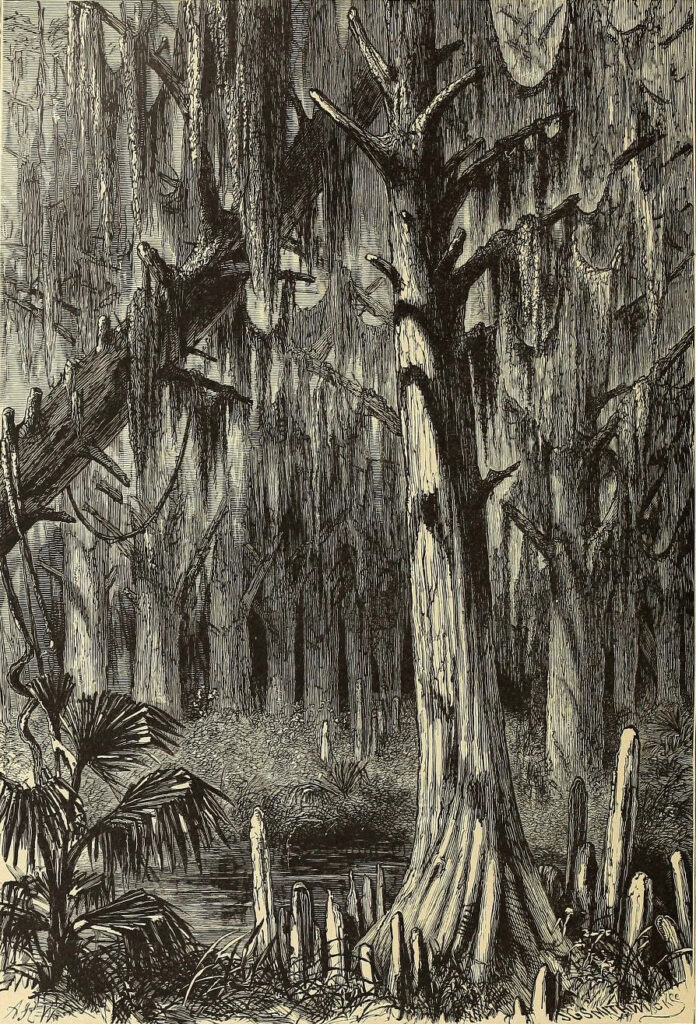
In the cypress swamps and boggy lowlands we find the planer tree, or water elm (Planera aquatica); the cypress (Taxodium distichum), the stateliest of our timber trees; the swamp locust (Gleditschia monosperma) [Gleditsia aquatica, water loust]; the tupelo gums (Nyssa sylvatica and Nyssa aquatica); the mountain sweet pepper bush (Clethra acuminata), so frequent in the mountains of East Tennessee, but rare in Middle and West Tennessee; the swamp white oak (Quercus bicolor), the black alder (llex verticillata) [winterberry], the swamp [possum-haw] holly (Ilex decidua), intertwined with the climbing [American] bittersweet (Celastrus scandens), and the supple-jack (Berchemia volubilis) [B. scandens]. Two buckthorns (Rhamnus Caroliniana and Rhamnus lanceolata) [Frangula carolinaina, Carolina buckthorn; Endotropis lanceolata, lance-leaved buckthorn] are also very frequent in the bottoms. One of the showiest shrubs of this region, the lately-discovered Hypericum lobocarpum [five-lobe St.-John’s-wort], which would make a splendid adornment of every garden, grows copiously around Hollow Rock. It makes a flat-topped bush from six to eight feet high. In the swamps float the water shields (Brasenia peltata and Cabomba Caroliniana) [Brasenia schreberi, water-shield; fanwort], while the water chinquapin [American lotus] (Nelumbo lutea) rears its big, peltate foliage and large, sulphur yellow flowers high above the brownish waters of the lagoon.
Of other frequent aquatics I may only mention the Limnanthemum lacunosum [Nymphoides cordata, little floating heart], Ranunculus multifidus [*non-native], Utricularia biflora [longspur creeping-bladderwort]. Species of Lemna, Wolffia, and the neat Azolla cast a green veil over the quiet pools. The Indian rye [wild rice] (Zizania aquatica), a tall grass, which the Indians used to harvest, using the grains for meal, is here in its proper sphere, and its tall heads look down upon patches of sword lilies, Iris cuprea [Iris fulva?, copper iris], and Iris hexagona [anglepod blue-flag]; and all the swampy flats are filled with Scirpus debilis, Carices, and Rhynchosporas.
On higher grounds congregate Dalea alopecuroides [Dalea leporina, hare’s-foot dalea], Galium Arkansanum [Trichogalium arkansanum, hairy-flower Arkansas bedstraw], Eryngium prostratum [creeping eryngo], Marshallia lanceolata [Marshallia obovata], Ambrosia bidentata [lanceleaf ragweed], Helenium tenuifolium [Helenium amarum, bitterweed], Senecio lobatus [Packera glabella, butterweed], Hydrolea affinis [H. uniflora], Verbena stricta [hoary vervain], Polypremum procumbens [rustweed], Stillingia sylvatica [Queen’s-delight], Lithospermum angustifolium [L. incisum, fringed puccoon], Habenaria virescens [likely Platanthera flava, southern rein orchid], Juncus militaris [bayonet rush], Spartina cynosuroides [giant cordgrass], Aristida ramosissima [S-curve three-awn].
From the suburbs of Memphis I received the elegant Erogrostis oxylepis [red lovegrass]. On the sandy shores of the Mississippi River abounds a species of horsetail, the Equisetum robustum [E. praeltum, tall scouring-rush], and the invidious burgrass that sticks to clothing and spoils the vlieses of the sheep with its sticky spikes. (Cenchrus tribuloides [dune sandspur])”
From The Flora of Tennessee and a Philosophy of Botany (1901) by Augustin Gattinger, pp. 24-26
Georgia
“I sat off early in the morning for the Indian trading-house, in the river St. Mary, and took the road up the N. E. side of the Alatamaha to Fort-Barrington. I passed through a well-inhabited district, mostly rice plantations, on the waters of Cathead creek, a branch of the Alatamaha. On drawing near the fort, I was greatly delighted at the appearance of two new beautiful shrubs, in all their blooming graces. One of them appeared to be a species of Gordonia [Franklinia alatamaha, Franklinia], but the flowers are larger, and more fragrant than those of theGordonia Lascanthus [Gordonia lasianthus,loblolly-bay], and are sessile; the seed vessel is also very different. The other was equally distinguished for beauty and singularity; it grows twelve or fifteen feet high, the branches ascendant and opposite, and terminate with large panicles of pale blue tubular flowers, specked on the inside with crimson; but what is singular, these panicles are ornamented with a number of ovate large bracteæ, as white, and like fine paper, their tops and verges stained with a rose-red, which, at a little distance, has the appearance of clusters of roses, at the extremities of the limbs: the flowers are of the Cl. Pentandria monogynia [likely this refers to Pinckneya pubens/bracteata, fever-tree]; the leaves are nearly ovate, pointed and petioled, standing opposite to one another on the branches.
After fifteen miles riding, I arrived at the ferry, which is near the site of the fort. Here is a considerable height and bluff on the river…I saw large, tall trees of the Nyssa coccinea [Nyssa ogeche, ogeche lime], si. Ogeeche, growing on the banks of the river. They grow in the water, near the shore. There is no tree that exhibits a more desirable appearance than this, in the autumn, when their fruit is ripe, and the tree divested of its leaves; for then they look as red as scarlet, with their fruit, which is of that colour also. It is of the shape, but larger than the olive, containing an agreeable acid juice. The leaves are oblong lanceolate and entire, somewhat hoary underneath; their upper surface of a full green, and shining; the petioles short, pedunculis multifloris. The most northern settlement of this tree, yet known, is on Great Ogeeche, where they are called Ogeeche limes, from their acid fruit being about the size of limes, and their being sometimes used in their stead.
Being safely landed on the opposite bank, I mounted my horse, and followed the high road to the ferry on St. Ille, about sixty miles south of the Alatamaha, passing through an uninhabited wilderness. The sudden transition from rich cultivated settlements, to high pine forests, dark and grassy savannas, forms in my opinion no disagreeable contrast; and the new objects of observation in the works of nature soon reconcile the surprised imagination to the change. As soon as I had lost sight of the river, ascending some sand-hills, I observed a new and most beautiful species of Annona [pawpaw], having clusters of large white fragrant flowers; and a diminutive but elegant Kalmia [laurel or myrtle]. The stems are very small, feeble, and for the most part undivided, furnished with little ovate pointed leaves, and terminate with a simple racemi, or spike of flowers, salver formed, and of a deep rose red. The whole plant is ciliated. It grows in abundance all over the moist savannas, but more especially near ponds and bay-swamps. In similar situations, and commonly a near neighbour to this new Kalmia, is seen a very curious species of Annona. It is a very dwarf, the stems seldom extending from the earth more than a foot or eighteen inches, and are weak and almost decumbent. The leaves are long, extremely narrow, almost lineal. However, small as they are, they retain the figure common to the species, that is, lanceolate, broadest at the upper end, and attenuating down to the petiole, which is very short; their leaves stand alternately, nearly erect, forming two series, or wings, on the arcuated stems. The flowers, both in size and colour, resemble those of the Antrilobe, and are single from the axillæ of the leaves on incurved pedunculi, nodding downwards. I never saw the fruit. The dens, or caverns, dug in the sand-hills, by the great land-tortoise, called here Gopher [tortoise, Gopherus polyphemus], present a very singular appearance: these vast caves are their castles and diurnal retreats, from whence they issue forth in the night, in search of prey. The little mounds, or hillocks of fresh earth, thrown up in great numbers in the night, have also a curious appearance.”
Travels Through North and South Carolina, Georgia, East and West Florida, the Cherokee Country, the Extensive Territories of the Muscogulges, or Creek Confederacy, and the Country of the Chactaws by William Bartram (1773-1777), Chapter III
“In our progress from the sea coast, we rise gradually, by several steps or ascents, in the following manner: first, from the sea coast, fifty miles back, is a level plain, generally of a loose sandy soil, producing spacious high forests, of Pinus tæda [loblolly pine], P. lutea [?], P. squarrosa, P. echinata [shortleaf pine], 1. Quercus sempervirens [Quercus virginiana, live oak], 2. Quercus aquatica [Quercus nigra, water oak], 3. Q. phillos [Q. phellos, willow oak], 4. Q. tinctoria [Quercus velutina, black oak], 5. Q. dentata [uncertain, but possibly Quercus hemisphaerica, Darlington oak], 6. Q. prinos [possibly Quercus bicolor, swamp white oak], 7. Q. alba [white oak], 8. Q. sinuata [Quercus falcata, southern red oak], 9. Q. rubra [red oak], Liriodendron tulipifera [tulip-poplar], Liquidambar styraciflua [sweet gum], Morus rubra [red mulberry], Cercis tilia, Populus heterophylla, Platanus occidentalis [American sycamore], Laurus sassafras [Sassafras albidum, sassafras], Laurus Borbonia [Tamala borbonia, red-bay], Hopea tinctoria [Symplocos tinctoria, horse-sugar], Fraxinus excelsior [likely Fraxinus americana, white ash], Nyssa [gum], Ulmus [elm], Juglans exaltata, Halesa [silverbells], Stewartia [camellia]. Nearly one third of this vast plain is what the inhabitants call swamps, which are the sources of numerous small rivers and their branches: these they call salt rivers, because the tides flow near to their sources, and generally carry a good depth and breadth of water for small craft, twenty or thirty miles upwards from the sea, when they branch and spread abroad like an open hand, interlocking with each other, and forming a chain of swamps across the Carolinas and Georgia, several hundred miles parallel with the sea coast. These swamps are fed and replenished constantly by an infinite number of rivulets and rills, which spring out of the first bank or ascent; their native trees and shrubs are, besides most of those already enumerated above, as follow: Acer rubrum [red maple], Nyssa aquatica [water tupelo], Chionanthus [fringe-tree], Celtis [hackberry], Fagus sylvatica [Fagus grandifolia, American beech], Sambricus [Sambucus, elderberry]; and the higher knolls afford beautiful clumps of Azalea nuda and Azalea viscosa [Rhododendron viscosum, swamp azalea], Corypha palma, Corypha pumila, and Magnolia grandiflora [southern magnolia]; besides, the whole surface of the ground between the trees and shrubs appears to be occupied with canes (Arundo gigantea) [Arundinaria gigantea] entangled with festoons of the floriferous Glycine frutescens [Wisteria frutescens, American wisteria], Bignonia sempervirens [Gelsemium sempervirens, Carolina jessamine], Glycine apios [Apios americana, groundnut], Smilax [green-brier], various species, Bignonia crucigera [Bignonia capreolata, cross-vine], Bign. radicans [Campsis radicans, trumpet-creeper], Lonicera sempervirens [coral honeysuckle], and a multitude of other trees, shrubs, and plants less conspicuous; and, in very wet places, Cupressus disticha [Taxodium distichum, bald-cypress]. The upper soil of these swamps is a perfectly black, soapy, rich earth, or stiff mud, two or three feet deep, on a foundation or stratum of calcareous fossil, which the inhabitants call white marle; and this is the heart or strength of these swamps; they never wear out or become poor, but, on the contrary, are more fertile by tillage; for when they turn up this white marle, the air and winter frosts causing it to fall like quicklime, it manures the surface: but it has one disadvantage, that is, in great droughts, when they cannot have water sufficient in their reservoirs to lay the surface of the ground under water, it binds, and becomes so tough as to burn and kill the crops, especially the old cleared lands; as, while it was fresh and new, the great quantity of rotten wood, roots, leaves, &c. kept the surface loose and open. Severe droughts seldom happen near the sea coast.
We now rise a bank of considerable height, which runs nearly parallel to the coast, through Carolina and Georgia; the ascent is gradual by several flights or steps for eight or ten miles, the perpendicular height whereof, above the level of the ocean, may be two or three hundred feet (and these are called the sand-hills) when we find ourselves on the entrance of a vast plain, generally level, which extends west sixty or seventy miles, rising gently as the former, but more perceptibly. This plain is mostly a forest of the great long-leaved pine (P. palustris Linn.) the earth covered with grass, interspersed with an infinite variety of herbaceous plants, and embellished with extensive savannas, always green, sparkling with ponds of water, and ornamented with clumps of evergreen, and other trees and shrubs, as Magnolia grandiflora [southern magnolia], Magnolia glauca [Magnolia virginiana, sweet-bay], Gordonia [loblolly-bay], Ilex aquifolium [American holly], Quercus [oaks], various species, Laurus Borbonia [Tamala borbonia, red-bay], Chionanthus [fringe-tree], Hopea tinctoria [Symplocarpos tinctoria, horse-sugar], Cyrilla [titi], Kalmia angustifolia [likely Kalmia carolina, Carolina bog-myrtle], Andromeda [bog-rosemary], varieties, Viburnum, Azalea, Rhus vernix [Toxicodendron vernix, poison-sumac], Prinos [Ilex, hollies], varieties, Fothergilla [witch-alder], and a new shrub of great beauty and singularity; it grows erect, seven or eight feet high; a multitude of erect stems arise from its root; these divide themselves into ascendant branches, which are garnished with abundance of narrow lanceolate obtuse pointed leaves, of a light green, smooth and shining. These branches, with their many subdivisions, terminate in simple racemes of pale incarnate flowers, which make a fine appearance among the leaves; the flowers are succeeded by desiccated triquetrous pericarpi, each containing a single kernel [Cliftonia monophylla, black-titi].
The lowest sides of these savannas are generally joined by a great cane swamp, varied with coppices and hommocks of the various trees and shrubs already mentioned. In these swamps several rivulets take their rise, which drain them and the adjoining savannas, and thence meandering to the rivers through the forests, with their banks decorated with shrubs and trees. The earth under this level plain may be described after the following manner: the upper surface, or vegetative mould, is a light sandy loam, generally nine inches or a foot deep, on a stratum of cinereous coloured clay, except the sand-hills, where the loose sandy surface is much deeper upon the clay; stone of any sort, or gravel, is seldom seen.
The next ascent, or flight, is of much greater and more abrupt elevation, and continues rising by broken ridges and narrow levels, or vales, for ten or fifteen miles, when we rest again on another extensive nearly level plain of pine forests, mixed with various other forest trees, which continues west forty or fifty miles farther, and exhibits much the same appearance with the great forest last mentioned; its vegetable productions nearly the same, excepting that the broken ridges by which we ascend to the plain are of a better soil; the vegetative mould is mixed with particles of clay and small gravel, and the soil of a dusky brown colour, lying on a stratum of reddish brown tough clay. The trees and shrubs are, Pinus tæda [loblolly pine], great black Oak [Quercus nigra, water oak], Quercus tinctoria [Quercus velutina, black oak], Q. rubra [red oak], Laurus, Sassafras, Magnolia grandiflora [southern magnolia], Cornus Florida [flowering dogwood], Cercis [redbud], Halesia [silverbell], Juglans acuminata [unclear], Juglans exaltata [likely Carya ovata, shagbark hickory], Andromeda arborea [Oxydendrum arboreum, sourwood]; and, by the sides of rivulets (which wind about and between these hills and swamps, in the vales) Styrax latifolia [possibly Styrax grandifolia, big-leaf snowbell], Ptelea trifoliata [wafer-ash], Stewartia, Calycanthus [sweet-shrub], Chionanthus [fringe-tree], Magnolia tripetala [umbrella magnolia], Azalea and others.
Thus have I endeavoured to give the reader a short and natural description of the vast plain lying between the region of Augusta and the sea coast; for from Augusta the mountainous country begins (when compared to the level sandy plain already passed), although it is at least an hundred and fifty miles west, thence to the Cherokee or Apalachian mountains; and this space may with propriety be called the hilly country, every where fertile and delightful, continually replenished by innumerable rivulets, either coursing about the fragrant hills, or springing from the rocky precipices, and forming many cascades; the coolness and purity of which waters invigorate the air of this otherwise hot and sultry climate.”
Travels Through North and South Carolina, Georgia, East and West Florida, the Cherokee Country, the Extensive Territories of the Muscogulges, or Creek Confederacy, and the Country of the Chactaws by William Bartram (1773-1777)
“During this recess from the high road of my travels, having obtained the use of a neat light cypress canoe, at Broughton Island, a plantation, the property of the Hon. Henry Laurens, esq. I stored myself with necessaries for the voyage, and resolved upon a trip up the Alatamaha.
I ascended this beautiful river, on whose fruitful banks the generous and true sons of liberty securely dwell, fifty miles above the white settlements.
How gently flow thy peaceful floods, O Alatamaha! How sublimely rise to view, on thy elevated shores, yon Magnolian groves, from whose tops the surrounding expanse is perfumed, by clouds of incense, blended with the exhaling balm of the Liquidambar [seet-gum], and odours continually arising from circumambient aromatic groves of Illicium [anise shrub], Myrica [Morella, wax-myrtle], Laurus, and Bignonia.
When wearied, with working my canoe against the impetuous current (which becomes stronger by reason of the mighty floods of the river, with collected force, pressing through the first hilly ascents, where the shores on each side present to view rocky cliffs rising above the surface of the water, in nearly flat horizontal masses, washed smooth by the descending floods, and which appear to be a composition, or concrete, of sandy lime-stone) I resigned my bark to the friendly current, reserving to myself the controul of the helm. My progress was rendered delightful by the sylvan elegance of the groves, cheerful meadows, and high distant forests, which in grand order presented themselves to view. The winding banks of the river, and the high projecting promontories, unfolded fresh scenes of grandeur and sublimity. The deep forests and distant hills re-echoed the cheering social lowings of domestic herds. The air was filled with the loud and shrill hooping of the wary sharp-sighted crane. Behold, on yon decayed, defoliated Cypress tree, the solitary wood pelican [Mycteria americana, wood stork], dejectedly perched upon its utmost elevated spire; he there, like an ancient venerable sage, sets himself up as a mark of derision, for the safety of his kindred tribes. The crying-bird, another faithful guardian, screaming in the gloomy thickets, warns the feathered tribes of approaching peril; and the plumage of the swift sailing squadrons of Spanish curlews (white as the immaculate robe of innocence) gleam in the cerulean skies.”
Travels Through North and South Carolina, Georgia, East and West Florida, the Cherokee Country, the Extensive Territories of the Muscogulges, or Creek Confederacy, and the Country of the Chactaws by William Bartram (1773-1777)
“This day’s journey was for the most part over high gravelly ridges, and on the most elevated hills appeared emerging out of the earth, rocky cliffs of a dark reddish brown colour; their composition seemed to be a coarse, sandy, ferruginous concrete, but so firmly cemented as to constitute a perfect hard stone or rock, and appeared to be excavated or worn into cavities and furrows by the violence of the dashing billows and rapid currents of the ocean, which heretofore probably washed them; there were however strata or veins in these rocks, of a finer composition and compact consistence, and seemed ponderous, rich iron ore. A little depth below the sandy gravelly surface lies a
stratum of very compact reddish yellow clay and fragments of ochre. The trees and shrubs common on these gravelly ridges are as follows, Diospyros [persimmon], Quercus rubra [northern red oak], Q. nigra, Q. tinctoria [Quercus velutina] or great Black Oak, Q. alba [white oak], Q. lobata [Quercus stellata], post White Oak, Q. incana [bluejack oak], foliis ovalibus integerrimis subtus incanis, Pinus lutea, Pinus tæda [loblolly pine], foliis geminatis et trinis, strobilo ovato brevi, cortice rimoso, Pinus palustris [longleaf pine], foliis trinis longissimis, strobilo elongato, Cornus Florida [flowering dogwood], Andromeda arborea [Oxydendrum arboreum, sourwood], Nyssa sylvatica [black gum], Juglans hickory, Prunus padus [probably Prunus serotina, black cherry], &c. Of herbacaæ, Solidago [goldenrod], Eupatorium [boneset], Sylphium [Silphium, cup-plant], Rudbeckia [black-eyed Susan], Gerardia [Agalinis], Asclepias [milkweed], Agave Virginica [Manfreda virginica, false-aloe], Eryngium [rattlesname master], Thapsia [likely Thaspium trifoliatum, purple meadow parsnip], Euphorbia [spurge], Polymnia [leafcup], &c.
In the course of this day’s journey we crossed two considerable rivulets, running swiftly over rocky beds. There is some very good land on the gradual descents of the ridges and their bottoms bordering on creeks, and very extensive grassy savannas and cane meadows always in view on one hand or the other. At evening we came to camp on the banks of a beautiful creek, a branch of Great Ogeche, called Rocky Comfort, where we found excellent accommodations, here being pleasant grassy open plains to spread our beds upon, environed with extensive cane meadows, affording the best of food for our quadrupeds.
The next day’s journey led us over a level district; the land generally very fertile and of a good quality for agriculture, the vegetable surface being of a dark, loose, rich mould, on a stratum of stiff reddish brown clay. Crossing several considerable creeks, branches of the Ocone, North branch of the Alatamaha; at evening, July 1st, encamped on the banks of the Ocone, in a delightful grove of forest trees, consisting of Oak, Ash, Mulberry, Hickory, Black Walnut, Elm, Sassafras, Gleditsia, &c. This flourishing grove was an appendage of the high forests we had passed through, and projected into an extensive, green, open, level plain, consisting of old Indian fields and plantations, being the rich low lands of the river, and stretching along its banks upwards to a very great distance, charmingly diversified and decorated with detached groves and clumps of various trees and shrubs, and indented on its verge by advancing and retreating promontories of the high land.
…Next day we travelled about twenty miles farther, crossing two considerable creeks named Great and Little Tobosochte [Tobesofkee Creek and Echeconee Creek near Macon, GA]; and at evening encamped close by a beautiful large brook called Sweet Water, the glittering wavy flood passing along actively over a bed of pebbles and gravel. The territory through which we passed from the banks of the Oakmulge to this place, exhibited a delightful diversified rural scene, and promises a happy, fruitful and salubrious region, when cultivated by industrious inhabitants; generally ridges of low swelling hills and plains supporting grand forests, vast Cane meadows, savannas and verdant lawns.
Travels Through North and South Carolina, Georgia, East and West Florida, the Cherokee Country, the Extensive Territories of the Muscogulges, or Creek Confederacy, and the Country of the Chactaws by William Bartram (1773-1777)
Alabama
“A large part of Alabama has yet a strikingly frontier character. Even from the State-house, in the fine and promising town of Montgomery, the eye falls in every direction upon a dense forest, boundless as the sea, and producing in the mind the same solemn sensation.
..Several of the larger towns, like Montgomery, remarkable in the midst of the wilderness which surrounds them, for the neatness and tasteful character of the houses and gardens which they contain, are in a considerable degree, made up of the residences of gentlemen who own large plantations in the hotter and less healthful parts of the State.”
From the A Jouney in the Seabord Slave States by Frederick Law Olmsted, pP. 574-575 (1856)
“Outside of the forest the shrubs rarely aggregate into an independent “bush”‘ formation of such extent as to make an impression upon the physiognomy of the vegetation and to form a proper plant association. In the coast region, however, the following species form to a limited extent thickets more or less free from larger trees:
Myrica cerifera (wax myrtle), Rhododendron spp. (azalea), Myrica inodora (wax myrtle [odorless bayberry]), Pieris nitida [Lyonia lucida] (andromeda [shining fetterbush]), llex cassine (dahoon holly), Leucothoe axillaris (andromeda [coastal dog hobble]), Ilex vomitoria (yaupon holly), Kalmia latifolia (mountain laurel), Osmanthus americanus (American olive), Vaccinium and Gaylusaccia spp. (huckle-berry, whortle-berry), Illicium floridanum (sweet illicium [Florida anise]), Symplocos tincioria (horse sugar), Vaccinium arboreum (farkle-berry).
Bosquets of groundsels (Baccharis halimifolium) with marsh elder (Iva frutescens) dot here and there the salt marshes of the seashore. The arborescent grasses of the bamboo tribe, the so-called cane, represented in eastern North America by Arundinaria macrosperma and A, tecta, form by their spread over wide areas a most peculiar and prominent feature in the vegetation of the State, known as canebrakes. The big cane, attaining not rarely a height of from 20 to 30 feet, occupies the more or less overflowed alluvial river banks. The so-called reed or switch cane, of smaller size, forms the impenetrable undergrowth of the forests of the humid and fresh soil depressions, and is most prevalent in the Cretaceous plain [blackbelt], designated as the canebrake region.
From the Plant Life of Alabama by Charles Mohr (1901), p 45
LOUISIANIAN AREA OR FLORA
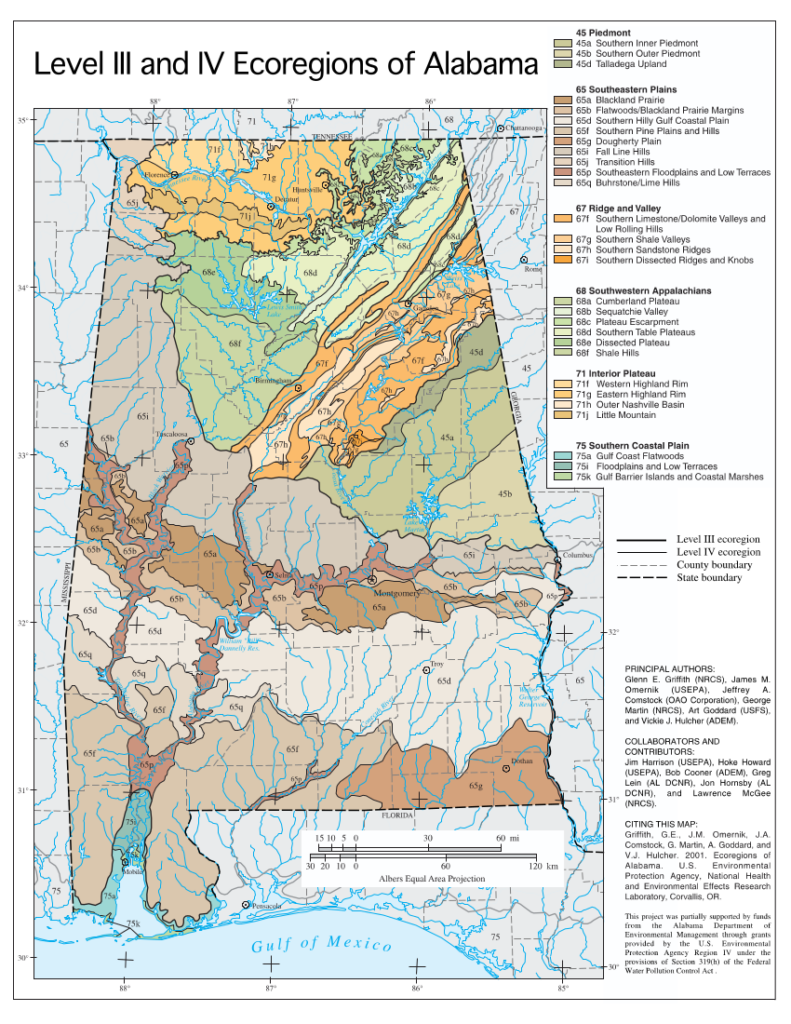
“Descending from the hills of the older (Paleozoic) formations, consisting of the extreme southern members of the Appalachian mountain system, the Austroriparian or Louisianian area of the Lower Austral life zone is reached. This area within the State is thus coterminous with the vast Coastal plain. The elevation of this plain scarcely exceeds at any point 350 feet above sea level, and in its gradual decline to the Gulf shore presents great uniformity in its topography. Undisturbed by local influences due to great differences in elevation, the distribution of heat here follows the lines of latitude. In consequence the climate does not run to extremes…”
“The heat during the warmest season is tempered by the Gulf breezes prevailing from forenoon to late in the afternoon. The vapor-laden currents from the Gulf in their unhindered sweep over the plain discharge their moisture quite evenly throughout the year.
It has been shown that many of the plants frequent throughout the Carolinian area and types characteristic of the southern exposures of the Alleghany Mountains find their southern limit of vegetation on the hills bordering upon the coastal plain. A similar limitation has also been pointed out for a number of shrubs and trees, clearly marking the border line between the Upper and Lower Austral life zones. This zonal border, marked by trees strictly confined to the Louisianian area of the Lower Austral zone throughout its extent from east to west, not only in Alabama, but from the Atlantic coast to the eastern border of the Southwestern arid plains, deviates but slightly from the line of latitude 32 deg 30′, and is clearly indicated by the northwestern limit of the following species:
Magnolia foetida (Magnolia grandiflora L.) ([southern] magnolia), Quercus laurifolia (laurel oak), Quercus lyrata (overcup oak), Hicoria myristicaeformis [Carya myristiciformis] (nutmeg hickory), Quercus catesbaei [Quercus laevis] (turkey oak), Hicoria aquatica [Carya aquatica] (bitter pecan), Pinus glabra (Southern spruce pine)
The evergreens, consisting of pines on the light siliceous soils and of broad-leaved species in the mesophile forest, predominate largely over the deciduous forest growth, and the frequency of types identical with tropical forms, or closely allied to them, impress upon the vegetation of this life area the character of the subtropical regions…
From the Plant Life of Alabama by Charles Mohr (1901), p 95
REGION OF THE CENTRAL PINE BELT
Physiographic features, — A belt of sands and pebbles crosses the State almost centrally in a southeastern and northwestern direction and separates the Paleozoic formation from the more recent sedimentary (Mesozoic) strata. This belt, varyng from about 10 to a little over 35 miles in width, extends from Russell County to a short distance west of Tuscaloosa County, where, with a sudden bend toward the north, it merges into the Lower Hills, which are clad with a mixed forest of short-loaf pine and upland hard-wood trees. Between the water courses the undulating surface frequently spreads out into more or less level table-lands.
Xerophile and mesophile forests — Wherever the sandy loam forming the surface soil becomes deeper, the long-leaf pine is associated with post oak, Spanish oak, black oak, black-jack, pignut, and mockernut hickory, and where the more siliceous soil prevails the long-leaf pine alone forms continuous forests of a heavy timber growth, which furnish the supplies demanded by the active lumber industry established along the railroad lines traversing this belt.
Entering this region at the northern border, the turkey or barren oak and the blue jack make their appearance and are frequent companions of the long-leaf pine of the dry pine barrens farther south; and of evergreen shrubs and trees, which line the streams throughout the maritime pine belt, the sweet Illicium [Florida anise] (Illicium floridanum) ti-ti (Cliftonla monophylla) and red bay (Persea carolina [Persea borbonia]) are here met with. The limbs of the large trees, shading their banks, are now invested with the somber gray drapery of Spanish moss, and this, together with the appearance of the dwarf or blue palmetto (Sabal adansonii [Sabal minor]) and arborescent lilies [Yuccas] (Yucca alnfolia, Y. filamentosa) indicates that the subtropical region of the State has been entered. On the southern border of this central pine belt, in localities with a fresh moist soil, the magnolia is found from Russell County, at the eastern confine of the State, to Prattville and to York Station on the western boundary. The northern limit of the Southern spruce pine (Pinus glabra) proceeds very nearly along the same line.
Xerophile and mesophile herbaceous plant associations, — The following herbaceous plants of the Louisianian area find their northern limit in this region and are but occasionally found to obtrude beyond it upon the adjacent lower hills. Belonging to xerophile associations are:
Paspalum ciliatum, Paspalum dasyphyllum [*Dallis grass, nonnative], Panicum nashianum [Dichanthelium portoricense, Nash’s witchgrass], Muhlenbergia trichopodes [Muhlenbergia expansa, Savanna hairgrass], Eragrostis hirsuta [bigtop lovegrass], Gymnopogon ambiguus [Eastern skeleton grass], Cyperus filiculmis [Southeastern flatsedge], Cyperus ovularis [Cyperus echinatus, round-headed flatsedge], Commelina nudiflora [Murdannia nudiflora, naked-stem dewflower], Commelina virginica [Virginia dayflower], Bradburya virginica [Centrosema virginianum, spurred butterfly pea], Meibomia stricta [Desmodium strictum, pineland tick-trefoil], Breweria humistrata [Stylisma humistrata, southern dawnflower], Clinopodium (Calamintha) carolinianum [Clinopodium georgianum, Georgia calamint], Verbena caroliniana [Verbena carnea, Carolina vervain], Vernonia graminifolia [Ironweed..?], Solidago petiolaris [downy goldenrod], Lacinaria elegans [Liatris elegans, pinkscale gayfeather]
Belonging to mesophile associations:
Paspalum praecox [early crown grass], Paspalum dilatatum [*Dallis grass, nonnative], Panicum melicarium, Fuirena squarrossa hispida [hairy umbrella sedge], Rynchospora axillaris [Rhynchospora cephalantha, small bunched beaksedge], Carex verrucosa, Carex debilis pubera [white-edged sedge], Carex baileyi [Bailey’s sedge], Kobresia odorata, Xyris iridifolia [irisleaf yellow-eyed-grass], Xyris torta [twisted yellow-eyed-grass], Xyris caroliniana [pineland yellow-eyed-grass], Smilax laurifolia [laurel-leaf greenbriar], Atamasco (Zephyranthes) atamasco [Zephyranthes atamsco, common atamasco-lily], Pogonia divaricata [Cleistesiopsis oricamporum, small dragonhead pogonia], Gyrostachys praecox, Amsonia ciliata [sandhill bluestar], Jacquemontia tamnifolia [common jacquemontia], Breweria humistrata [Stylisma humistrata, southern dawnflower], Brintonia discoidea [Solidago discoidea, rayless mock-goldenrod]
From the Plant Life of Alabama by Charles Mohr (1901), pp 96-97
MARITIME PINE REGION.
The great belt of long-leaf pine [Pinus palustris] forest, which extends almost without interruption from southeastern Virginia over the coast region of the Atlantic States to the lowlands of the Mississippi River, adjoins on its southern border the Central Prairie belt.
UPPER DIVISION OF THE COAST PINE BELT OR REGION OP MIXED TREE GROWTH.
Physiographical features. — In the upper part of this pine belt, from South Carolina to eastern Mississippi, a mixed growth of pine and broad-leaved evergreen trees alternates with belts or rather strips of pure long-leaf pine forest. In Alabama this region of cone-bearing and broad-leaved evergreen and deciduous trees is confined within the limits of the older Tertiary strata, which in this State cover about one-half of the area of the Coast Pine belt, although the beds of drifted sands and gravels of a more recent formation overlie the older rocks in large areas. In its climatic conditions this region differs but slightly from the foregoing. Its floral character is difficult to define. Broadly stated, it consists in the increased frequency of types which are at home in the Louisianian area, and in distinction from regions farther north, of a tree growth in which, though otherwise similar, the long-leaf pine [Pinus palustris] in its highest development predominates. Equally difficult is the establishment of the limits of this floral region. It has been already mentioned that the tree growth in the eastern part of the Central Prairie region is scarcely to be distinguished from the forest flora of this region. Toward the west the border is more clearly outlined by the hilly uplands of the lowest Tertiary strata rising above the Cretaceous plain. The southern border of this region is frequently overlapped by the pure forests of long-leaf pine of the lower division of the Coast Pine belt, and it can be defined on stratigraphical grounds only by being identified with the lines which mark the most southern outcrops of the underlying Tertiary rocks. Defined on this basis the area in question contains about 9,000 square miles, occupying the following counties or portions of counties: Parts of Sumter; all or nearly all of Choctaw, Clarke, Monroe, Butler, Conecuh; portions of Covington, Montgomery, Bullock, Barbour, Pike, and nearly all of Coffee, Dale, and Henry. Along its northern border where the lignitic strata prevail the uplands rise to an elevation at the highest of about 400 feet above tide water, spreading out into table-lands of greater or less width, not rarely interrupted by steep ridges where the lowest Tertiary strata offered greatest resistance to erosion. The highest ridges are frequently capped with the sands and gravels of the Lafayette formation, which are under cover of the long-leaf pine, as are likewise the rugged hills of flinty clay stones and siliceous rocks of the buhrstone strata which traverse the central part of this region in a southeasterly and northwesterly direction, sloping toward the east. East of Patsaliga Creek the hills become less prominent, the softer strata of the Eocene Tertiary spread out into undulating table-lands, and the generous brown soil supports the mixed growth of xerophile and mesophile woody species, evergreen and deciduous, characteristic of the region. Toward the south the surface becomes less broken. East of the Alabama River the drifted deposits form broad table-lands between the streams, occasionally inclosing more or less extensive tracts with the calcareous strata of the Middle Tertiary for the surface rock, very similar in their soil and vegetation to the post-oak prairies of the preceding region [black belt]. In Dale County and westward to the State line beds of white sand (Ozark sands) overspread the loamy sands and gravels, rendering the soil arid and sterile.
West of the Alabama River, in the southern part of Clarke and Choctaw counties, calcareous strata form the surface rock over large areas identical in their soil conditions and the character of their vegetation with the isolated tracts farther east just mentioned.
Xerophile forests. — The rocky ridges of the Buhrstone, or those capped with the more recent drifted strata, are covered with magnificent forests of long-leaf pine which are nowhere surpassed in their timber wealth within the range of this tree. This applies particularly to the forests which cover the hills between the Alabama and Tombigbee rivers. By careful estimates made upon a number of plots, selected at random, the yield of a single acre will vary from 10,000 to 18,000 feet and over of merchantable timber. In these forests, which grow from a deep warm soil consisting of sandy loams, dogwood [Cornus/Benthamidia] and black jack [Quercus marilandica] form the scanty undergrowth. The rocky crests and most abrupt declivities of the highest of these hills afford but a scanty foothold to the pine. The rocky ground is sparingly covered by the following shrubs, all of them bushes, except the last, which is a creeper branching from the base:
Vaccinium stamineum (deerberry), Viburnum acerifolium (maple-leaved arrowwood) [maple-leaf viburnum], Gaylussacia dumoaa (dwarf huckleberry), Vaccinium myrsinites (bilberry) [southern evergreen blueberry], Smilax bona-nox forma pandurata (bamboo brier) [maritime catbriar]
Forests of long-leaf pine [Pinus palustris] predominate wherever the older rocks are deeply hidden under the sands and gravels, and where this region passes imperceptibly into the pine uplands of the Lower Division of the Maritime Pine belt. The herbaceous plant associations in these pine forests do not differ from those forming the soil cover in open pine forests of the adjoining Lower Pine belt.
Xerophilw herbaceous plant association. — In the parts where the ration of the decomposing limestone strata upon decaying vegetable matter has produced soil conditions similar to those which prevail in the Central Prairie region (which includes the more or less calcareous layers of the post oak prairies and cedar hammocks, the plant associations bear the same campestrian character. In Monroe and Clarke counties are found the same tall Compositae, together with various plants from other families, which are characteristic of that region. The following species are examples:
Helianthus tomentosus [Helianthus resinosus, resinous sunflower], Lithospermum tuberosum [southern stoneseed], Helianthus hirsutus [hairy sunflower], Phacelia purshii [Miami-mist], Silphium laciniatum [compass-plant], Verbena canadensis [Glanularia canadensis, rose verbena], Silphium asperrimum [silphium], Acuan (Desmanthus) brachycarpum, Silphium laevicaule [Silphium dentatum], Morongia horridula, Lepachys pinnata
None of the above are met with farther south except the last two which extend to the coast plain. Of xerophile and mesophile plants inhabiting shaded rocky dells and banks, the following find here their southern limit:
Hepatica hepatica [Hepatica acutiloba and/or Hepatica americana, Hepatica], Panax quinquefolia [Panax quinquefolius, American ginseng], Anemone decapetala [Anemone berlandieri, eastern prairie anemone], Collinsonia canadensis [richweed], Ranunculus recurvatus [hooked buttercup], Houstonia caerulea [Quaker ladies]
On the damp rocks which line the narrow channels of brooks deep cut into the limestone strata, the maidenhair fern (Adiantum capillaris-veneris) occupies every crevice. Toward the southern confines of this region the following, which grow also in the adjoining region, are found:
Sida elliottii [coastal plain sida], Clinopodium carolinianum [Clinopodium georgianum, Georgia calamint], Callirhoe papaver [woods poppy-mallow], Koellia albescens [Pycnanthemum albescens, white mountain-mint], Scutellaria canescens punctata [Scutellaria incanan var. punctata, skullcap], Stokesia laevis [Stokes aster].
On the limestone bluffs inclosing the bed of the Alabama River instance near Claiborne, Dirca palustris [leatherwood], a shrub from the Alleghenian area, finds in deeply shaded situations its extreme southern outpost Philadelphus inodorus [Appalachian mock-orange] with Ptelea trifoliata [hoptree] and the river grape (Vitis riparia) are also found on the bare ledges of these bluffs on the opposite site sides of the river. In the southwestern part of this region where the calcareous prairie soils are mixed with the light loams, the cedar [Juniperus virginiana] once formed a large portion of the timber growth, making a feature analogous to the cedar hammocks of the Central Prairie region. The cedar hammocks of this region are at present, however, nearly all under cultivation, and the few still covered with cedar are rapidly being stripped of their valuable timber, mostly for use as pencil wood.
In the eastern extension of this region the loose Ozark sands form the arid surface soil, spreading over a large part of western Florida and southern Georgia. These are covered by very open pine barrens, and the latter are inhabited by a number of peculiar herbaceous species. Most widely diffused and abundant are:
Aristida strida, Koellia nuda, Panicum xanthospermum, Ceranthera linifolia, Eriaogonum tomentosum, Chrysopsis hyssopifolia, Coleosanthus cordatus, Eupatorium leptophyllum. Eupatorium tortifolium. Eupatorium coronipifolium, Eupatorium lecheaefolium
Aristida stricta (wire grass) will be spoken of later as an inhabitant of the Lower Pine belt. These and other species common to this region and the dry pine barrens farther south form a scanty covering for the barren sands.
Mesophile forests. — On the lower flanks of the ridges and on the lower hills of the Central Pine region the short-leaf pine mingles with the long-leaf species and with the frequently named upland oaks and hickories, chinquapin (Castanea pumila) and basswood (Tilia heterophylla). As the declivities merge into the narrow valleys with a fresher soil more retentive of moisture, mesophile species gradually gain the upper hand. Representative trees are:
Magnolia foetida (magnolia) [Magnolia grandiflora, southern magnolia], Pinus glabra (Southern spruce pine), Magnolia macrophylla (large-leaf cucumber-tree) [bigleaf magnolia], Quercus nigra (water oak), Quercus laurifolia (laurel oak), Fagus americana (beech)
There is a variety of shrubs in the openings and along the borders of the forest, among which are:
Styrax grandifolia (large-leaved storax bush) [Styrax grandifolius, bigleaf storax], Aesculus pavia (red buckeye), Ilex longipes (holly) [Georgia holly], lllicium floridanum (sweet illicium) [Florida anise], Butneria (Caiycanthus) florida [Illicium floridanum] (Carolina allspice, lowland calycanthus), Aesculus parviflora (white-flowered buckeye) [bottlebrush buckeye], Chionanthus virginica [Chionanthus virginicus] (fringe tree) .
The first of these is frequent in the Louisianian area from North Carolina to Liouisiana. In these mesophile forests the same species of the liana formation which prevail in the Central Prairie region are equally frequent. To the small shrubby climbers are to be added Clematis catesbaei [Clematis catesbyana, coastal virgin’s-bower], rare from lower South Carolina to Florida and known in Alabama only from the vicinity of Suggsville, Clarke County; C. reticulata [netleaf leatherflower], infrequent from South Carolina to Texas; C. crispa [marsh clematis], frequent on low, damp banks southward to the coast plain; and, finally, the yellow [Carolina] jessamine (Gelsemium), in damp and dry situations throughout the Maritime Pine belt.
Mesophile amd paludial forests of the lowlands. — The lowlands of the flood plain of the Alabama and Tombigbee rivers and of their larger tributaries are heavily timbered. Their first terrace, overflowed only in the times of the heaviest freshets, is covered with a valuable hardwood timber growth of cow oak [Quercus michauxii, swamp chestnut oak], Spanish oak [Quercus falcata, southern red oak], Texas or Southern red oak [Quercus falcata], white ash [Fraxinus americana], honey locust [Gleditsia triacanthos], and mockernut hickory [Carya tomentosa], destined to furnish large supplies for the future. On the almost perpetually submerged banks of both of these rivers a fine timber growth of bald cypress [Taxodium distichum] frequently forms brakes of considerable extent, occasiooally accompanied by the tupelo gum [Nyssa sylvatica].
It can be safely asserted that fully one-half of the area of this region is under cover of the long-leaf pine [Pinus palustris], and that in their timber wealth these forests surpass by far the pine forests of the lower division of the Maritime Pine belt. From estimates made in various districts it appears that fully 6,000 feet of merchantable timber can be with safety assumed as the average yield per acre.
Mesophile herbaceous plant associations. — The following herbaceous plants, extending hither from the mountain region, find here their southern limits:
Calycocarpum lyoni [cupseed], Frasera earolinensis [American columbo], Cebatha [Nephroia] carolina [carolina moonseed], Physalis ciliosa [Physalis arenicola, sandhill ground-cherry], Cypripedium hirsutum, Physalis virginian[a] [Virginia ground-cherry], Arisaema dracontium [green dragon]
Vincetoxicum baldwinii [Odontostephana baldwiniana, white spinypod], one of the rarest of Southern plants, elsewhere known only from a few localities in middle Georgia and Texas, and Thalictrum debile [trailing meadowrue] are thus far known in Alabama only in this region.
LOWER DIVISION OF THE COAST PINE BELT, OR LOWER REGION OP LONGLEAF PINE.
Physiographical features and climate.
As the Tertiary strata disappear under the heavy beds of sands and gravels of more recent formations, the topography of the country becomes more uniform, the broad ridges spread out into slightly undulating table-lands, which become somewhat broken in their descent to the drainage channels. The rolling pine uplands rise gradually to a height of from 220 to 300 feet above the flat woods and marshes and alluvial forests of the tide-water region. Where the level table-lands, devoid of surface drainage, are underlaid by impervious clays, spongy bogs surround the heads of water courses. On the rolling uplands with a porous siliceous soil the copious rainfall is readily absorbed, giving rise to innumerable springs, the feeders of the numerous limpid brooks and creeks by which this region is traversed. The area of the lower pine region is estimated to embrace a little over 7,000 square miles, including the following counties and parts of counties: Geneva, part of Covington, Escambia, part of Monroe, and all of Baldwin, Mobile, and Washington…
THE ROLLING PINE UPLANDS OR DRY PINE BARRENS
Xereophile forests. — On the hills and broad swells of the table-lands the long-leaf pine reigns supreme. The high forest is almost bare of undergrowth and its monotony is frequently unbroken for long distances, no other trees or shrubs appearing among the tall trunks of the pine, which spread their gnarled limbs at a height of from 40 to 65 feet above the ground. It is only in the accidental openings of the forest that a second growth of the predominating species takes posses sion of the ground, which, if interfered with by human agency, is replaced by black jack [Quercus marilandica] and Spanish oaks [Quercus falcata, southern red oak], not rarely accompanied by the dogwood (Cornus florida) and the glandular summer haw (Crataegus elliptica) [Crataegus aestivalis, mayhaw]. This last of which is a pretty tree from 20 to 25 feet high. It ranges from South Carolina to Mississippi, and in Alabama appears to be confined to this region. On the sterile ridges deeply covered with the mantle of loose white sands, which hide the sandy loams of the La Fayette strata, the long-leaf pine [Pinus palustris] becomes stunted and is more or less replaced by the barren or turkey oak and blue jack, trees rather below medium size, often dwarfed and scrubby; and among the latter are dispersed —
Vaccinium stamineum [common deerberry], Gaylussacia dumosa [southern dwarf huckleberry], Vaccinium myrsinites [southern evergreen blueberry], Asimina parviflora [small-flowered pawpaw], Vaccinium myrsinites glaucus, Ceratiola ericoides [florida rosemary].
The last of these shrubs, representing the Empetraceae, which generally inhabit the boreal zone, resembles in its foliage and habit a large heather (Erica). It is truly characteristic of the arid pine barrens from Florida and adjacent parts of Georgia to Mississippi, and in Alabama it reaches its northern limit of vegetation near the northern border of the Maritime Pine belt. The pine forests are open, the crowns of the trees scarcely touching one another. Owing to the poorly timbered ridges of scrubby oaks and the extensive swampy or boggy flats equally unfavorable to the development of a heavy timber growth, the timber standing in the lower division of the Coast Pine belt is considerably less in proportion to area than that found in the upper division.
On the bettor class of pine lands the quality of the timber is scarcely surpassed, as evinced by a close investigation of the timber resources of the rolling pine uplands near Wallace, Escambia County, which can be considered a typical district.
The forests of long-leaf pine of this Lower Pine region furnish principally the enormous supplies of timber used by the sawmills situated in the tide-water region of Alabama and western Florida, with Mobile and Pensacola for the chief points of export, and they are also the source of the resinous products which find their market at Mobile. The depletion of their timber wealth with no heed given to their maintenance, and their destruction by the barbarous methods practiced in the extraction of their resinous product, together with the ravages of the fires which one season after another destroy the seedlings and the youngest timber, and with the injuries inflicted by herds of domestic animals which roam through these forests, not only are exhausting their present resources, but will inevitably and within a comparatively short time result in their extermination, notwithstanding the fact that in no other region within the wide range of distribution of the long-leaf pine are the conditions more favorable for the spontaneous reproduction of this most valuable timber tree.
Xerophile herbaceous plant associations. — Thanks to the abundant and evenly distributed rainfall, the floor of these open pine forests is covered with a carpet of grasses and other herbs, mostly perennials, which, under the mild climate of this zone, retains its verdure for the greatest part of the year. The grasses vastly predominate in the number of individuals, and in the diversity of forms they are scarcely exceeded by the species of the pea and composite families. The great bulk of the grasses consists of types of a Southern distribution, the majority being confined to the Louisianian area. But a small number reach the Carolinian area, and those only along the seacoast. The following are noteworthy species:
Andropogon tener [Schizochyrium tenerum, slender bluestem], Gymnopogon brevifolius [pineland skeleton grass], Paspalum setaceum [thin paspalum], Chrysopogon nutans linnaeanis [Sorghastrum nutans, yellow indiangrass], Paspalum floridanum [Florida paspalum], Chrysopogon elliottii [Sorghastrum elliottii, slender indiangrass], Paspalum ciliatifolium [Paspalum setaceum var. ciliatifolium, fringeleaf paspalum], Paspalum plicatulum [brownseed paspalum], Panicum filiforme [Dichanthelium filiramum, hairy needle-leaved witch grass, Paspalum bifidum {P. racemulosum Nutt) [pitchfork paspalum], Panicum lanuginosum [one of the Dichanthelium species, witchgrass], Paspalum dasyphyllum [Paspalum setaceum], Panicum pauciflorum, Paspalum difforme [Paspalum floridanum, Florida paspalum], Panicum sphaerocarpon [Dichanthelium sphaerocarpon, round-fruited witchgrass], Anthenantia villosa [green silkyscale], Panicum pubescens [one of the Dichantheliums], Panicum angustifolium [Dichanthelium angustifolium, narrowleaf witchgrass], Panicum neuranthum [Dichanthelium neuranthum, nerved witchgrass], Aristida purpurascens [arrowfeather], Panicum arenicola [Dichanthelium arenicoloides, sandy woods witchgrass], Andropogon argyraeus [Anatherum ternarium, splitbeard bluestem], Panicum nashianum [Dichanthelium portoricense, Nash’s witchgrass], Danthonia sericea [silky oat-grass], Aristida simplicifolia [likely referring to Aristida simpliciflora, southern three-awn], Gymnopogon ambiguus [eastern skeleton grass], Aristida stricta [Aristida beyrichiana, southern wiregrass].
Of the above species Gymnopogon brevifolius [pineland skeleton grass] is a typical species of the Louisianian area, characteristic of dry pine barrens from North Carolina to eastern Texas, and Panicum neuranthum [Dichanthelium neruanthum, nerved witchgrass] extends to the West Indies. Aristida stricta [Aristida beyrichiana], or wire-grass, is extremely abundant in the coast region of South Carolina, Georgia, Florida, and the counties of Alabama east of the Perdido River, along the Florida State line, known as the ‘wire-grass counties,” where on the loose white Ozark sand it almost alone forms the grassy covering.
The following are of wide continental range east of the Rocky Mountains, extending to the Carolinian area, the first being the most abundant species of the dry pine barrens:
Andropogon scoparius, Chrysopogon avenaceus, Sporobolus junceus, Sporobolus longifolius, Sporobolus neglectus, Sporobolus vaghiniflorus
The following representatives of the Cyperaceae are found among the xerophile plant associations, mostly of the Louisianian area:
Cyperus martindalii. Cyperus retrofractus, Rynchospora grayii, Rynchospora intermedia, Scleria ciliata, Scleria elliottii, Stenophyllus cicliatifolius, Carex festucacea, Carex muhlenbergii, Juncus torreyi.
The xerophile species of other families associated with these glumaceous plants are for the largest part at home in the Louisianian area. Fully two-thirds of the numerous Leguminosae and Compositae occurring in this region are confined to that area. Omitting the common species of wide distribution, the following, named in the succession ol their flowering, give character to the xerophile herbaceous associations of the rolling pine uplands. As the first harbingers of spring, appeal before and in the beginning of February:
Houstonia rotundifolia [Houstonia procumbens, creeping bluet], Epigaea repens [trailing arbutus], Viola palmata [southern three-lobed violet], Viola septemloba [southern coastal violet]
These are succeeded by:
Helianthemum carolinianum [Crocanthemum carolinianum, carolina sunrose], Astragalus villosus [bearded milkvetch], Lupinus diffiusus [blue sandhill lupine], Iris vema [dwarf iris], Chrysogonum virginianum [green-and-gold, according to Weakley there are 3 species, and this would most likely be C. australe], Oxalis recurva [one of the native Oxalis], Oxalis filipes [O. dillenii or O. florida], Ascyrum pumilum [Hypericum suffruticosum, pineland St. John’s-wort], Phlox pilosa [var] detonsa [gulf coast phlox], Phlox amoena [hairy phlox], Lupinus nuttallii [Lupinus perennis var. gracilis, southern sundial lupine], Limodorum parviflorum (Calopogon parviflorus Lindl.) [Calopogon barbatus, bearded grass-pink], Chrosperma muscaetoxicum [Amianthium muscitoxicum, fly-poison], Zygadenus angustifolius [Stenanthium densum or S. texanum, crow-poison], Penstemon hirsutus [northeastern beardtongue], Gyrostachys (Spiranthes) praecox [grass-leaved ladies-tresses], Gyrostachys gracilis [possibly Spiranthes lacera var. gracilis, souther slender ladies-tresses], Lachnocaulon anceps [common bogbuttons], Asclepias humistrata (A, amplexicauli Michx.) [fleshy milkweed], Asclepias michauxii [Michaux’s milkweed], Tetragonotheca helianthoides [squarehead/pineland-ginseng], Jatropha stimulosa [Cnidoscolus stimulosus, spurge-nettle], Scuttelaria pilosa, Polygala nana [candyroot], Kneiffia linearis [Oenothera linifolia, flaxleaf sundrops], Stillingia sylvatica [queen’s-delight], Schwalbea americana [chaffseed], Sabbatia angustifolia [Sabatia brachiata, narrowleaf rose-pink], Helianthemum ramuliflorum [Crocanthemum canadense, canada rockrose].
During the summer months:
Buchnera elongata [Buchnera floridana, savanna bluehearts], Physalis virginiana [Virginia ground-cherry], Erythrina herbacea [coral-bean], Euphorbia corollata angustifolia [eastern flowering spurge], Euphorbia floridana [Florida spurge], Zornia bracteata [viperina], Stylosanthes biflora hispidissima [pencil-flower], Galactia erecta (G. sessilifolia) [erect milkpea], Euphorbia humistrata [spreading sandmat], Rhynchosia simplicifolia [Rhyncosia reniformis, dollarweed], Croton puncatum [Croton punctatus, silverleaf croton], Cracca smallii [Tephrosia x intermedia], Cracca hispidula [Tephrosia hispidula, sprawling hoarypea], Cracca spicata flexuosa [Tephrosia spicata, spiked hoarypea], Cracca chrysophylla [Tephrosia chrysophylla, sprawling goat’s-rue], Chrysobalanus obtusifolius [likely Geobalanus oblongifolius, gopher-apple], Rhynchosia galactoides [Pitcheria cytisoides, royal snoutbean], Psoralea canescens [Pediomelum canescens, eatern prairie-turnip], Galactia volubilis [McRee’s milkpea], Galactia volubilis mississippiensis, Galactia floridana [Florida milkpea], Lespedeza repens [smooth trailing lespedeza], Lespedeza virginica [Virginia lespedeza], Hibiscus aculeatus [savanna hibiscus], Koellia albescens [Pycnanthemum albescens, white mountain-mint], Ceranthera Iinearifolia [Dicerandra fumella, smoky balm], Dasystoma pedicularia [Aureolaria pedicularia, annual oak-leech], Ruellia ciliosa humilis [sandhill wild-petunia], Ruellia pedunculata [Ruellia pinetorum or Ruellia purshiana, pineland or Pursh’s wild-petunia], Verbena carolina [Verbena carnea, Carolina vervain], Vemonia graminifofia, Chrysopsis graminifolia [Pityopsis graminifolia], Chrysopsis hyssopifolia [hyssopleaf goldenaster], Coreopsis major [Anacis major, woodland coreopsis], Solidago odora [licorice goldenrod], Sericocarpus bifoliatus [Seriocarpus tortifolius, twisted-leaf white-topped aster], Silphium asterisctis angustatum, Meibomia rotundifolia [Desmodium rotundifolium, roundleaf tick-trefoil], Meibomia stricta [Desmodium strictum, pineland tick-trefoil].
Of the above Euphorbia floridana [Florida spurge] ranges from western Florida to the Escambia River; Ceranthera linearifolia [Dicerandra fumella, smoky balm] from lower Georgia westward to the Tensas River, Baldwin County; Ruellia pedunculata [Ruellia pinetorum or Ruellia purshiana, pineland or Pursh’s wild-petunia] from western Louisiana to the western edge of Alabama; Chrysopsis hyssopifolia [hyssopleaf goldenaster] from the arid sand hills of western Florida to the eastern shore of Mobile Bay. In the autumn the dry pine barrens are adorned with their richest floral display, the forests being then brilliant with the purple spikes of the blazing stars (Lacinaria) [Liatris], the blue of asters and salvia, the scarlet of Clinopodium coccineum [scarlet calamint] and the gold of Chrysopsis [goldenaster] and Solidago [goldenrod], not to mention others. The following are the prevailing species:
Lacinaria gracilis [Liatris gracilis, slender blazing-star], Lacinaria elegans [common elegant blazing-star], Lacinaria scariosa [Liatris scariosa, northern blazing-star], Aster concolor [Symphyotrichum concolor, eastern silvery aster], lonactis linariifolius [Ionactis linariifolia, stiff-leaved aster], Aster adnatus [Symphyotrichum adnatum, scale-leaf aster], Aster patens tenuiculmis [Symphyotrichum patens, clasping aster], Trilisa odoratissima [vanillaleaf], Salvia azurea [azure sage], Clinopodium coccineum (Calamintha coccinea Gray) [scarlet calamint], Chrysopsis trichophylla, Solidago petiolaris [downy goldenrod], Solidago puberula pulvererulenta [Solidago pulverulenta?], Afzelia cassinoides (Seymeria tenuifolia) [Seymeria cassinoides, yaupon blacksenna], Afzelia pectinata [Seymeria pectinata, comb seymeria], Kuhnisfera pinnata [Dalea pinnata], Eupatorium aromaticum [Ageratina aromatica, small-leaved white snakeroot], Eupatorium coronopifolium [Eupatorium compositifolium, coastal dog-fennel], Eupatorium leptophyllum [limesink dog-fennel], Kuhnia kuhnia [Brickellia eupatoroides, eastern kuhnia], Helianthus radula [rayless sunflower], Lechea minor [thymeleaf pinweed], Lechea tenuifolia [narrowleaf pinweed], Lechea villosa [Lechea mucronata, hairy pinweed], Lechea leggettii [Lechea pulchella, southern hairy pinweed].
Clinopodium coccineum, the scarlet basil, is a low undershrub with dazzling flame-colored flowers, ranging from the sandy ridges of western Florida to the dry hills which front the eastern shore of the Mobile Bay and the coast plain near Mobile; also found in Mississippi. Helianthus radula [rayless sunflower] is a truly characteristic plant of these pine uplands. The pinweeds (Lechea) are the homely representatives of the Cistus family.
Pine-barren flats and Hydrophytic plant associatians.
Toward the northern limit of this region the oldest strata of the Post-Tertiary (Neocene) beds of loose sands and compact more or less aluminous clays approach or attain the surface. The higher swells of the table-lands covered by the porous sands and gravels include level tracts of badly drained barrens underlaid by the older strata, flooded after every heavy rain, droughty during hot and dry weather. On these flats Cuban pine [Pinus elliottii, slash pine] is thinly scattered and here reaches its northern limit of vegetation, at a distance of about 60 miles from the seashore.
Excepting the ink berry (Ilex glabra) scarcely any tree or shrub shades the ground; but a small number of grasses find a place among the coarse herbs forming the cover of the extremely poor soil of these flats. The bulk of the herbaceous vegetation consists of a few abundant mesophile species. The following are representatives species:
Andropogon vlrginicus [Anatherum virginicum, smooth bluestem], Sabbatia dodecandra [large marsh rose-pink], Anthaenantia rufa [Anthenantia rufa, purple silky-scale], Helenium brevifolium [shortleaf sneezeweed], Paspalum glabratum [Paspalum floridanum, Florida paspalum], Rhexia mariana [Maryland meadow-beauty], Panicum polyanthes [Dichanthelium polyanthes, small-fruited witchgrass], Rhexia siricta [Rhexia virginica, Virginia meadow-beauty], Sabbatia campanulata [slender marsh-pink], Cynoctonum sessilifolium [Mitreola sessilifolia, small-leaved mitrewort].
There are also a number of paludial species with xerophile adaptations; that is, they are provided with strong, deeply embedded rootstocks to retain the needed supply of moisture during periods of hot and dry weather, and with rigid leaves of greatly reduced surface to prevent excessive transpiration. Among such plants may be mentioned species of Xyris [yellow-eyed grass] and round rushes. In exposed shallow pools and ditches Sagittarias (Sagittaria chapmani, S. cycloptera) [Sagittaria chapmanii, Chapman’s arrowhead & Sagittaria graminea, grassleaf arrowhead] having rigid scapes and narrow stiff leaves are most frequent, the latter frequently reduced to narrow phyllodia. On the base of the pine-clad ridges bordering the flats Habenaria cristata [Platanthera cristata, crested fringed orchid] and Psoralea slimplex [Orbexilum simplex, leather-root] are not infrequently observed, the spindle-shaped or top-shaped roots of the latter deeply buried in the sand, where it is constantly moistened by springs.
In many localities the declivities of the table-lands are perpetually wet with the water which oozes from the porous silicious strata immediately overlying the impervious clay, and the depressions inclosed by them are frequently covered with a dense carpet of peat mosses, interwoven with the long filiform rhizomes of beak rushes, spike rushes, and one nut rush, the following being species:
Sphagnum macrophyllum, Rynchospora rariflora [few-flower beaksedge], Sphagnum imhricatum cristatum, Rhynchospora oligantha [feather-bristle beaksedge], Sphagnum recurvum, Eleocharis acicularis [needle spikerush], Rhynchospora pusilla [dwarf beaksedge], Eleocharis tuberculosa [large-tubercled spikerush], Rynchospora plumosa [plumed beaksedge], Scleria caroliniana [Carolina nutrush].
With these are associated creeping club moss (Lycopodlum alopecuroides) [foxtail bog-clubmoss] and many species of the paludial plants found also on the flats and in the swamps of the coast plain, including insectivorous sundews [Drosera], bladder worts [Urircularia], and pitcher plants [Sarracenia]. Characteristic species are:
Limodorum pallidum [Calopogon pallidus, pale grass-pink], Drosera filiformis [northern threadleaf sundew], Lophiola aurea [golden crest], Utricularia juncea [southern bladderwort], Gyrotheca tinctoria [Lachnanthes caroliniana, redroot], Utricularia subulata [slender bladderwort], Juncus trigonocarpus [redpop rush], Sarracenia purpurea [purple pitecherplant], Eriocaulon decangulare [common ten-angled piperwort], Sarracenia psittacina [parrot pitcherplant], Drosera intermedia [water sundew], Sabbatia macrophyila [rose-gentian].
The Sarracenias [pitcherplants] mentioned, which are the most prominent, rest their rosettes of urn-shaped leaves on the water-soaked peat moss. Sarracenia drummondii [Sarracenia leuchophylla, whitetop pitcherplant] and S. rubra [Carolina red-flower pitcherplant], with their trumpet-shaped, erect leaves, are abundant on the black peaty soil which covers the undulations where the impervious aluminous clays and compacted sands prevail. In the middle of the spring these plants produce their oneflowered scapes from stout rootstocks before the appearance of the leaves. In midsummer, when the leaves have attained their full growth, the boggy hillsides and depressions present to a superficial view the aspect of meadows richly adorned with flowers of white and roseate tints, imparted by the white, purple-veined tops of the leaves of these sarracenias. The display of these colors serves to attract insects, which, entering the leaves in search of the sweets secreted within, are entrapped, with no possibility of escape, and thus become sources of nourishment to these plants.
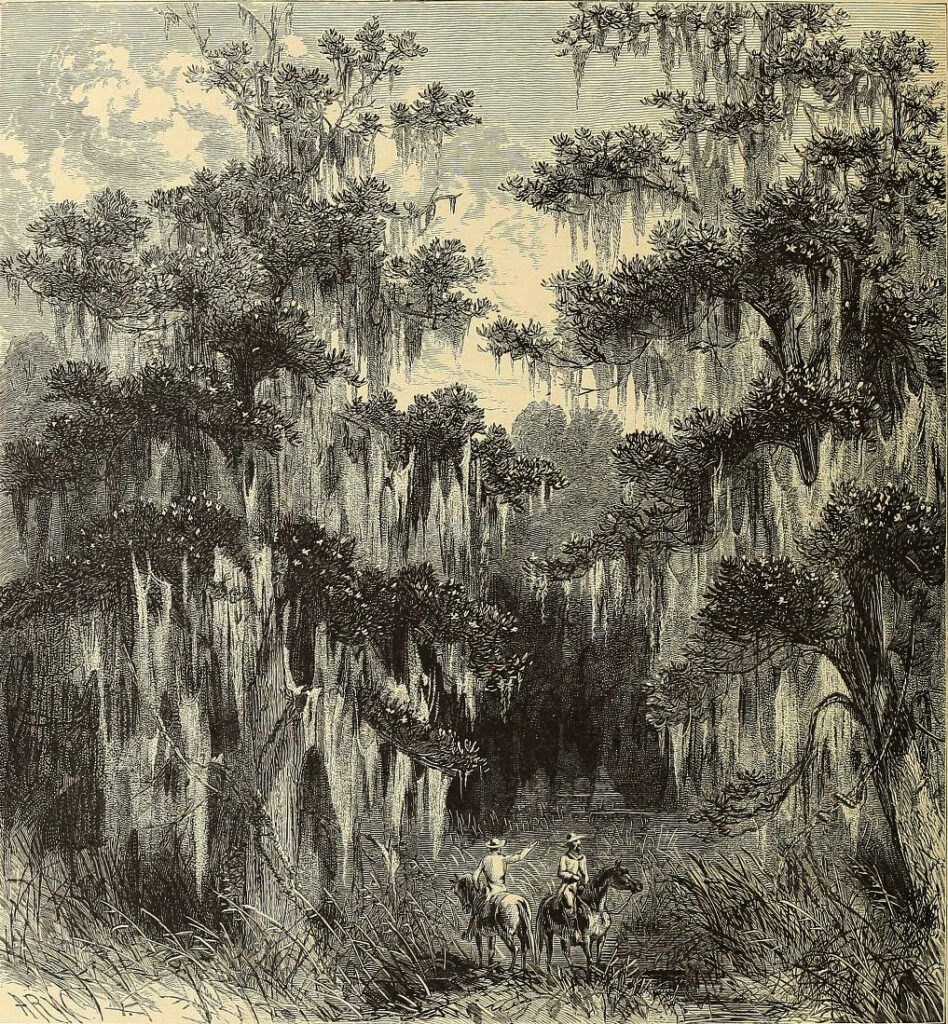
Mesophile and paludial forests. — Evergreens, nearly all of them types of the Louisianian area, predominate in the tree growth which shades the damp or wet, more or less sandy, banks of the numerous streams rising in the maritime pine belt. Magnolia, white bay, and oaks with entire, narrow, persistent or semipersistent leaves (Quercus laurifolia [laurel oak], Q. aquatica [Quercus nigra, water oak]), with Cuban pine [slash pine, Pinus elliottii], loblolly pine [Pinus taeda], rarely shortleaf pine [Pinus echinata], pond cypress (Taxodium dlstichum imbricaria) [Taxodium ascendens], and “juniper” or white cedar (Chamaecyparis thyoides) lurgely prevail over the deciduous black gum [swamp tupelo] (Nyssa biflora), red gum [Liquidambar styraciflua], and swamp maples [Acer spp.]. Groves of the pond or upland cypress just mentioned — a variety closely connected with the type by intermediate forms — cover the shallow pine-barren ponds and semiswampy woods of a poor, sandy soil destitute of vegetable mold. This form of the cypress in the size and quality of its wood is greatly inferior to the typical cypress of the alluvial swamps, and is at once recognized by the leaves, which are closely appressed to the deciduous, annual shoots. By this peculiarity of the foliage a check to excessive tmnspiration is provided during the time of drought, when the sandy soil is laid bare to the sun and its supply of water is failing. The white cedar [Chamaecyparis thyoides] of the lower pine region is met with most frequently in the sandy swamps around the head waters of Perdido and Escambia rivers, and is there in full perfection. This tree attains a height of from 80 to 90 feet, with an average diameter of from 16 to 18 inches; trees over 24 inches in diameter are rarely seen. Being much sought for on account of the value of the timber, sound trees are at present frequent only in remote localities difficult of access. Among the trees of smaller size and the variety of shrubs forming the dense undergrowth of these forests the evergreens also predominate, of which the following species are examples:
Cliftonia monophylla [black titi], Myrica cerifera [Morella cerifera, common wax-myrtle], Cyrilla racemiflora [titi], Myrica inodora [Morella inodora, odorless bayberry], Ilex myrtifolia [myrtle-holly], Kalmia latifolia [mountain-laurel], Ilex lucida [Ilex coriacea, sweet gallberry], lllicium floridanum [Florida anise], Ilex glabra [inkberry holly].
Prominent by reason of their abundance and their showy flowers are Pieris nitida [Lyonia lucida, shining fetterbush] and Leucothoe axillaris [coastal doghobble] and Oxydendrum arboreum [sourwood], of the heath family, besides which may be mentioned:
Butneria (Calycanthus [floridus]) florida [sweet-shrub], Viburnum nudum (opossum haw), Clethra alnifolia [coastal sweet pepper-bush], Viburnum nitidum (opossum haw) [bog wild raisin], Mohrodendron (Haleisia) dipterum (Halesia diptera, [two-wing] silver bells), Viburnum molle (opossum haw) [soft arrowwood], Styrax pulverulenta [Styrax americanus var. pulverulentus] (storax bush) [downy American snowbell].
Mesophile herbaceous plant associations. — The herbaceous plant associations in these mesophile woods are identical with those of the same character prevailing in the upper division of the coast pine belt. Frequent among them is Macranthera fuchsioides [Macranthera flammea, hummingbird-flower], conspicuous on account of its profusion of large racemes of scarlet flowers, a coarse biennial extending from western Georgia and eastern Florida into this State and to the northern limit of the Louisianian area.
REGION OF THE COAST PLAIN OR LOW FLAT PINE BARRENS.
Physiographical features. — On their descent to the coast plain the rolling pine uplands disappear under the silt of sandy loams or merge imperceptibly into the coast sands and the most recent lacustrine formations which line the shore. The sandy loams form the second terrace of the lowlands of the coast, rising to a height of from 10 to 30 feet above the low flood plains and river bottoms, which are subject to occasional overflow.
Mesophile forests. — Open forests of long-leaf pine sparsely interspersed with Cuban pine [Pinus elliottii, slash pine] and loblolly pine [Pinus taeda] once covered the plain. After the removal of the original timber growth the long-leaf pine [Pinus palustris] was to a large extent superseded by the Cuban pine [Pinus elliottii], groves of which in every stage of development occupy the clearings. Upon these clearings, made scarcely two-thirds of a century ago, Cuban pine has already attained the dimensions of useful timber, the trees averaging from 18 to 24 inches in diameter, with a height of from 85 to 100 feet. A number of trees felled upon one of these old clearings in the suburbs of Mobile furnished sticks of merchantable timber 30 to 40 feet in length, none of them having reached an age of over 60 years.
Mesophile herbaceous plant associations (Rynchospora formation). — The terrace of sandy loams extends over the larger part of the coast plain. The ground being almost perfectly level and underlaid by a compact, somewhat impervious subsoil, is consequently more or less deficient in drainage, and being covered with a dense sod formed by the roots and rhizomes of low, perennial monocotyledonous plants, the ground remains damp and the decomposing vegetable matter, under the influence of sun and wind, is converted into an acid humus, giving rise to a peaty soil. This damp, mucky soil, in a semiboggy condition during seasons of rain, supports a vegetation of low, grass-like plants, mostly of the sedge family or sour grasses (Cyperaceae) of various genera, which in number vastly predominate over the true grasses (Poaceae), rushes (Junus), and golden-eyed grasses (Xyridaceae), which find their home in the flat, damp pine barrens of the plain. Horn rashes (Rynchosporae) largely prevail over the other representatives of the sedge family, and numerous species of this extensive genus, almost exclusively confined to eastern North America and the adjacent tropical zones, make up the largest portion of the sod vegetation, thus forming a more or less compact plant formation highly characteristic of this region. Among the mesophile associations which inhabit the scantily shaded, frequently open plain, with its sour, damp, shallow, and during the rainy seasons more or less boggy soil, there is found in many localities a tiny creeping peat moss (Sphagnum imbricatum) and other short-stemmed species (S. compactum, S. intermedium), which are able to resist the eflfects of occasional droughts. The following Cyperaceae are typical, and predominate on the flat expanse of this terrace of the plain:
Rynchospora plumosa [plumed beaksedge], Rynchospora divergens [white-seeded beaksedge], Rynchospora pusilla [dwarf beaksedge], Rynchospora microcarpa [southern beaksedge], Rynchospora rariflora [few-flower beaksedge], Rynchospora gracilenta [slender beaksedge], Rynchospora multiflora [Rhynchospora elliottii, Elliott’s beaksedge], Rynchospora cymosa globularis [Rhynchospora globularis, globe beaksedge], Rynchospora cymosa [Scirpus polyphyllus], Rynchospora oligantha [feather-bristled beaksedge], Rynchospora ciliaris [fringed beaksedge], Kobresia odorata, Rynchospora baldwinii [Baldwin’s beaksedge], Kobresia monocephala [possibly Carex simpliciuscula, bog-sedge], Rynchospora chapmani [Chapman’s beaksedge].
With these are found the following rushes:
Juncus elliottii [Elliott’s rush], Juncus marginatus aristulatus [grass-leaved rush], Juncus diffusissimus [diffuse rush], Juncus bufonius fascicularis [toad rush], Juncus marginatus [grass-leaved rush].
Grasses of the same region are — preferring the low flats with a more damp, sandy soil:
Andropogon mohrii [Anatherum mohrii, bog bluestem], Sieglingia poaeformis, Andropogon tetrastachys, Manisuris corrugata [Mnesithia rugosa, wrinkled jointgrass], Paspalum praecox [early crowngrass].
Most frequent on the low swells:
Sieglingia chapmani [Tridens chapmanii, Chapman’s triodia], Andropogon virginicus glaucus [Anatherum capillipes, dryland white bluestem], Chrysopogon nutans linnaeanus [Sorghastrum nutans, yellow Indiangrass], Andropogon virginicus dealbatus [Anatherum dealbatum, wetland white bluestem], Andropogon elliottii [Anatherum ternarium, splitbeard bluestem], Muhlenbergia trichopodes [Muhlenbergia expansa, Savanna hairgrass], Andropogon tener [Schizachyrium tenerum, slender bluestem], Panicum longipedunculatum [Dichanthelium strigosum var. strigosum, rough-hairy witchgrass].
After the ground has been once turned by the plow the glumaceous plants which formed the original sod disappear forever, the ground being taken possession of by carpet grass (Paspalum compressum) [Axonopus compressus, Southern carpetgrass], a West Indian species most probably introduced, and the creeping fingergrass (Syntherisma (Panicum) serotinum) [Digitaria serotina, dwarf crab grass]. Nearly all of the sundews [Drosera], sarracenias [pitcher-plants], gentians, and other species already mentioned among the associations which inhabit the sphagnous bogs of the pine hills also enter into the associations of this semi-paludial Rynchsopora formation.
During the latter part of January the Cuban pine [slash pine, Pinus elliottii] unfolds its flowers, with Bartonia verna [spring Bartonia] and Houstonia patens [Houstonia pusilla, tiny bluet], and these are succeeded by the following:
Chaptalia semifloscularis [Chaptalia tomentosa, pineland daisy], Euphorbia inundata [flatwood spurge], Pinguicula lutea [yellow butterwort], Helenium vernum [?], Pinguicula pumila [small butterwort], Helenium helenium [Helenium vernale], Lupinus villosus [pink sandhill-lupine], Helenium integrifolium [?], Helianthemum carolinianum [Crocanthemum carolinianum, Carolina sunrose], Polygala lulea [Senega lutea, orange milkwort], Drosera capillaris [pink sundew], Polygala polygama [Senega polygama, bitter milkwort], Drosera brevifolia [dwarf sundew], Limodorum multiflorum [Calopogon multiflorus, many-flowered grass-pink], Drosera filiformis [threadleaf sundew].
The Pinguiculas [butterworts] mentioned are insectivorous plants common in the pine flats from North Carolina to Florida and Mississippi. Euphorhia inundata [flatwood spurge] is known only from the coast of western Florida and as far west as the eastern shore of the Mobile Bay near Point Clear.
Remarkable is the occurrence of Limodorum multiflorum [Calopogon multiflorus, many-flowered grass-pink] in Mobile County (Fowl River Station). This beautiful orchid is otherwise known only from a few localities of peninsular and western Florida. It was first described by Chapman from the southern part of Florida and has been observed by the writer in the savannas near the upper waters of the St. Johns River. During the summer months bloom Linum floridanum [Florida yellow-flax], Polygala chapmanii [Senega chapmanii, Chapman’s milkwort], Polygala hookeri [Hooker’s milkwort], the latter two extending from western Florida to eastern Mississippi, and Zygadenus glaberrimus [Zigadenus glaberrimus, large death-camas], ranging from the pine flats of North Carolina to Louisiana, together with the following:
Habenaria nivea [Platanther nivea, snow-orchid], Centella stricta [?], Cracca hispidula [Tephrosia hispidula, sprawling hoarypea], Sabbatia gentianoides [Sabatia gentianoides, pinewoods sabatia], Polygala cruciata [Senega cruciata, drumheads], Pterocaulon undulatum (P. pycnostachyum) [pineland wingstem], Ludwigia hirtella [Rafinesque’s seedbox], Ludwigia linearis [eastern narrowleaf seedbox], Dasystoma pedicularia [Aureolaria pedicularia, annual oak-leech], Eryngium aquaticum [marsh eryngo], Gerardia paupercula [Agalinis paupercula], Eryngium synchaetum [Eryngium yuccifolium, rattlesnake-master], Ascyrum stans [Hypericum crux-andreae, St. Andrew’s-cross], Eryngium ovalifolium [Eryngium integrifolium var. integrifolium, Savanna eryngo], Ascyrum hypericoides [Hypericum hypericoides, St. Andrew’s-cross], Hydrocotyle verticillata [whorled water-pennywort], Hypericum spp [St. John’s-worts].
The species of Ascyrum and Hypericum constitute a characteristic open formation of low shrubs or suffrutescent perennials in the depressions surrounding shallow ponds, most striking during the latter part of the summer while covered with their golden-yellow flowers. Among the earliest appears Hypericum myrtifolium [myrtle-leaf St. John’s wort], followed by H. opacum [H. cistifolium], and last by H, aspalahoides [H. fasciculatum, peelbark St. John’s-wort], the most abundant, forming large patches. All are frequent from South Carolina to Mississippi. During the autumn Compositae with their bright yellow flowers prevail — for example:
Helianthus heterophyllus [Savanna sunflower], Coreopsis angustifolia [Coreopsis linifolia, Savanna coreopsis], Chondrophora (Bigelovia) nudata [Bigelowia nudata, rayless goldenrod], Bidens coronata leptophylla [northern tickseed sunflower], Solidago stricta [wand goldenrod], Baldwinia uniflora [Balduinia atropurpurea, purple balduina], Solidago angustifolia [Solidago sarracenicus, broad-leaved ragwort],
With these come azure-flowered lobelias, such as L. puberula [downy lobelia], common from the coast of southern New Jersey to Louisiana and in the southern Alleghanies, and L. brevifolia [shortleaf lobelia], ranging from western Florida to Louisiana, and Ruellia noctiflora [night-flowering wild-petunia], rare on the coast of the Mississippi Sound and sparsely scattered through the corresponding region from Louisiana to Georgia and Florida, all more or less frequent in the first pine barrens from North Carolina to Florida and the eastern Gulf States — besides the following:
Eupatorium leptophyllum [limesink dog-fennel], Lacinaria graminifolia pilosa [Liatris pilosa, grass-leaved gayfeather], Eupatorium capillifolium [common dog-fennel], Carphephorus pseudo-liatris [lavender-lady], Eapatorium linearifolium [Eupatorium tortifolium?], Trilisa odoratissima [vanillaleaf], Eupatorium mohrii [Mohr’s thoroughwort], Baldwinia uniflora [Balduina atropurpurea, purple balduina], Eupatorium semiserratum [threeleaf thoroughwort], Gerardia skinneriana [Agalinis skinneriana], Eupatorium pubescens [Indian roundleaf thoroughwort], Gerardia paupercula, Eupatorium verbenaefolium [Eupatorium pilosum, ragged thoroughwort], Gerardia aphylla [Agalinis aphylla, scalyleaf agalinis].
Of ferns and their allies Botrychium obliquum [Sceptridium dissectum, cut-leaf grapefern] is not rare on exposed grassy knolls and banks, while Ophioglossum crotalophoroides [bulbous adder’s-tongue] with Lycopodium carolinianum [Psuedolycopodiella caroliniana, slender clubmoss], preferring moister situations, are truly typical plants of the coast plain.
Hammock lands. — More or less extensive tracts of a black soil, generally well drained, rich in the decayed remains of former vegetations, occur on this second terrace as it skirts the lower river swamps or the low swamps of the tide-water regions. Constantly acted upon by the multitudinous forms of lower animal and plant life — rainworms, snails, centipedes, and a host of bacteria and saprophytic fungi — this soil has become converted into a highly fertile mold, which supports the same luxuriant and diversified vegetation of trees and shrubs, chiefly broadleaved evergreens, which characterizes the mesophile forests of the Louisianian area generally, to which is added here the live oak, Quercus virginiana [live oak], the most attractive and grandest feature in the flora of the coast plain. This oak is a tree of the seacoast. It approaches, in a high state of development, the Carolinian area near the northern limit of eastern North Carolina and extends westward along the Gulf coast to central Texas and northern Mexico. In the Gulf States the live oak is rarely found above the thirty-first parallel of latitude. Of the magnificent groves which once lined the shores of the Gulf and its numerous inlets, but few remain. From its native hammocks this tree was transplanted to adorn and shade the abodes of the earliest settlers. Trees planted about seventy-five years ago, now frequently met with in the suburbs of Mobile and at the older country seats, are from 2 to 3 feet in diameter and from 60 to 70 feet in height, their sturdy trunks sending out massive horizontal limbs at a distance of from 10 to sometimes 15 feet above the ground, their shade frequently covering an area nearly 100 feet in diameter.
In these hammocks the magnolia attains its highest development, in diameter rivaling the Cuban [Pinus elliottii, slash pine] and loblolly pines [Pinus taeda], with which it is often associated, and accompanied by the laurel oak [Quercus laurifolia], water oak [Quercus nigra], and beech [Fagus grandifolia], all draped with the wreaths of Spanish moss.
Of small trees and shrubs occurring here may be enumerated:
Osmanthus americanus (American olive, devil wood), Pyrus angustifolia [Malus angustifolia] (Southern crab apple), Crataegus apiifolia [Crataegus marshalii, parsley hawthorn] (haw), Ilex vomitoria (yaupon), Crataegus viridis (haw) [green hawthorn], Ilex opaca (common [American] holly), Chionanthus virginica (Northern fringe tree), Myrica cerifera (wax myrtle), Zanthoxylum clava-herculis (Southern prickly ash), Vacciniium arboreum (farkleberry), Ilex caroliniana [Ilex ambigua, Carolina holly] (holly), Prunus umbellata (prairie plum) [hog plum], Ilex coriacea (holly) [sweet gallberry].
The evergreen American olive, rarely seen among the pine hills, occurs here frequently. The last two hollies are shrubs which, together with the others mentioned, form a dense undergrowth.
Where the hammocks merge into the alluvial lands, the soil becoming of a semi-swampy condition, the silver-bell tree (Mohrodendron (Halesia) dipterum) is found, most frequently with swamp dogwood (Cornus stricta) [Swida foemina, southern swamp dogwood], interspersed with titi (Cliftonia monophylla), leatherwood (Cyrilla racemiflora), [dahoon] holly (Ilex cassine) and blue palmetto (Sabal adansonnii) [Sabal minor, dwarf palmetto], evergreen fetterbushes (Pieris nitida, Leucothoe axillaris) [Lyonia lucida, shining fetterbush; coastal doghobble] forming the brushy soil cover. In the liana formation, Vitis cinerea [graybark grape] mostly takes the place of the summer grape, and Sagaretia michauxii [Sageretia minutiflora, small-flowered buckwheat], which in the open and in dry soil is a straggling shrub 6 to 8 feet high, and is not rare on the coast from South Carolina to Florida and Mississippi, in these woods assumes the habit of a robust climber, ascending trees of great height. The stout root climbers Decumaria barbara [climbing hydrangea] and the Virginia creeper [Parthenocissus quinquifolia] are common. The American wistaria (Krauhnia frutescens) [Wisteria frutescens] of the hammocks, which are further enlivened by the flame-colored flowers of the woodbine (Lonicera sempervirens) [coral honeysuckle], and, very early in the spring, by the golden flowers of the yellow jessamine (Gelsemium sempervirens), these followed by the white bloom of the Cherokee rose.
The frequent vines of the bullace grape, Brunnichia [buckwheat-vine], Cissus [Cissus trifoliata, sorrel-vine], and Smilax [green-brier], which entwine bushes and trees, add to the intricacy of the maze of shrubbery on the low hammocks. In their deepest recesses Epidendrum conopseum [green-fly orchid] finds its home upon the limbs of old magnolias and hoary live oaks, being the only epiphytic orchid in the southeastern States outside of the narrow belt of the Antillean flora, skirting the coast of southern Florida and of the adjacent islands, the so-called Keys. Apteria setacea [Apteria aphylla, nodding-nixie] is strictly confined to the rich mold of the hammocks. This leafless saprophyte, of a pale bluish color, grows in dense clusters, its numerous contorted roots deeply buried in the ground. It is also not rarely found in Florida and southeastern Georgia. On the shady borders of the hammock are found, flowering early in the spring, Nemophila microcalyx [Nemophila aphylla, eastern baby-blue-eyes] and Asarum arifolium [Hexastylis arifollia, little brown-jugs], followed by the Atamasco lily (Atamasco {Zephyranthes) atamasco) [common Atamasco-lily] and hoary lupine (Lupinus villosus) [pink sandhill-lupine], and in the summer months by the following:
Rhexia mariana [Maryland meadow-beauty], Panicum proliferum inflatum [?], Rhexia lanceolata [Rhexia mariana var. exalbida, white meadow-beauty], Panicum rostratum [Coleataenia anceps ssp. anceps, beaked panic-grass], Agrimonia incisa [pineland agrimony], Oplismenus hirtellus, Amorpha glabra [mountain indigo], Eragrostis glomerata [?], Sanicula canadensis [black snakeroot], Carex hirsuta [Carex hirsutella, hairy-leaved sedge], Paspalum michauxianum [Paspalum distichum, joint paspalum], Carex caroliniana [Carolina sedge], Paspalum ciliatifolium [fringeleaf paspalum], Carex debilis prolixa [Carex debilis, white-edged sedge], Paspalum praecox [early crown grass], Melica mutica [two-flowered melic], Panicum viscidum [Dichanthelium scoparium, velvet witchgrass], Panicum verrucosum [Keliochloa verrucosa, warty panic grass], Panicum gibbum [Sacciolepis striata, American cupscale], Arundinaria tecta [switch cane], Panicum scabriusculum [Dichanthelium scabriusculum, tall swamp witchgrass].
We have here a mingling of mesophile and paludial types, all characteristic of the hammocks, the last three having also a wider range. Ferns are abundant in the damp shade. Dryopteris patens [Pelazoenuron (Thelypteris) patens, grid-scale maiden fern], a cosmopolitan species of subtropical and tropical regions, is confined in our territory almost exclusively to the hammocks. It is accompanied by the more frequent Dryopteris acrostichoides [Christmas fern], Pteris aquilina (form near to caudata) [Pteridium caudatum, lacy bracken], Asplenium platyneuron [ebony spleenwort], Woodwardia angustlfolia [Lorinseria areolata, netted chain-fern], and W. virginica [Anchistea virginica, Virginia chain-fern]; the last in more moist situations. Lycopodium cernuum [Palhinhaea cernua, nodding clubmoss] is remarkable as one of the few types extending from the tropics to the coast of the Louisianian area which appears to be indigenous with us. Where the terrace merges into the flats of the plain, the border of the hammock becoming frequently wet, tall wool grasses (Erianthus brevibarbis, E. strictus, E, saccharoides) [short-bearded plume grass, narrow plume grass, Erianthus giganteus, sugarcane plume grass], coarse beard grass (Andropogon glomeratus) [Anatherum glomeratum, common bushy bluestem], and royal fern (Osmunda regalis) form conspicuous features in the aspect of the vegetation.
Pine meadows. — Approaching the seashore the terrace of loamy silt passes imperceptibly into the flats of the purely siliceous coast sands, through which the sluggish water courses, subject to the ebb and flow of the tide, wind their way to the inlets of the Gulf. The fine sand forming the surface as well as the subsoil is closely packed, permitting the water to permeate but slowly, and in consequence is overflowed after every rainfall. The great poverty of the soil is manifest in the stunted growth of pines scattered over these flats and the dwarfed cypress and white cedar lining the sandy banks of the streams. The surface is exsiccated during the dry summer season, and supports a scanty growth of poverty grasses, particularly Aristida spiciformis and A. palustris, and the toothache grass (Campulosus aromaticus) [Ctenium aromaticum], with its stout aromatic rootstock deeply buried in the compacted sand, with which are found Scleria torreyana [Scleria muehlenbergii, pitted nutrush] and Lilium catesbaei [Lilium catesbyi, Catesby’ lily], and, during the late autiunnal rains, the rare Gyrostachys brevifolia [Spiranthes longilabris, giant spiral orchid], known also from western Florida.
Paludial arboreal associations (cypress brakes). — The bottom lands of the Mobile River and the islands in the delta, overflowed at every freshet, are covered with a high forest of deciduous trees, common to them and the lowlands of the same character along the Tombigbee and Alabama rivers in their course through the Louisianian area. Where the banks are almost perpetually submerged they are covered with cypress [Taxodium distichum]. This largest of the Atlantic forest trees was formerly found in the upper part of the river delta in great perfection. The mighty trunks rise to a total height of from 100 to 120 feet and over, with a diameter, measured above the buttresses which expand the bases, of from 3 to over 5 feet. The annual rings of growth are extremely narrow and difficult to count. On close investigation the age of full-grown trees can be estimated to vary between 300 and 500 years. They are the sole survivors in this part of the North American continent of an archaic type. The assemblage of these monarchs of the forest in the compact cypress brake, surrounded by the peculiar cone-shaped excrescences (cypress knees) rising from their roots 1 to 2 feet and more above the dark unruffled surface of the water, presents a feature in the arboreal flora of the present at once strange and imposing. As a result of the large demand for their valuable timber, the resources of these brakes in the delta and on the lower Alabama and Tombigbee rivers have been almost exhausted, and in this district the manufacture of cypress lumber has at present nearly ceased. The supplies of this timber needed for the manufacture of cypress shingles at Mobile are at present mostly drawn from the more remote brakes on the rivers named and their principal tributaries along their lower course. In these brakes the tupelo gum (Nyssa aquatica) is the only associate of the cypress, which it rivals in size, and the Carolina swamp ash [Fraxinus caroliniana] is the only tree of small size thriving in the gloomy shade beneath these trees.
In the mire of the swamps above the level of long-continued overflows a variety of hard-wood trees mingle with the cypress [Taxodium distichum] and finally super-sede it on ground slightly above the ordinary water level. Black gum [Nyssa biflora], water oak [Quercus nigra], water hickory [Carya aquatica], green ash [Fraxinus pensylvanica], more rarely Southern red oak [Quercus falcata], elm [Ulmus], black cottonwood [possibly Populus deltoides], and overcup oak [Quercus lyrata] of rather stunted growth form the high forest overshadowing the smaller trees, of which the most conspicuous are planer tree [Planera aquatica], red maple [Acer rubrum], hornbeam [Carpinus caroliniana], Crataegus viridis [green hawthorn], C. elliptica [C. flava, yellow hawthorn], and the apple haw [mayhaw] (Crataegus aestivalis). This haw was observed on the flooded banks of Davids Lake, a large inlet of Mobile River, with a slender stem fully 30 feet high. It unfolds its flowers during the first days of spring (early in February) and ripens its highly palatable, fine-flavored fruit in the beginning of April. Styrax americana [Styrax americanus, American snowbell], Osmanthus americanus [Cartrema americanum, wild olive], llex decidua [possum-haw], Ilex longipes [Georgia holly], parsley haw (Crataegus apiifolia) form the shrubby undergrowth. The handsome silverbells [Halesia], the dahoon holly [Ilex cassine], and the swamp dogwood [Swida foemina] occupy the drier outskirts of these swamps. In their interior the blue palmetto [Rhapidophyllum hystrix, needle palm] reaches its perfection, the trunk rising from 2 to 3 feet above the ground, the fan-shaped leaves with their stalks 8 to 10 feet long. Black willow [Salix nigra] and cottonwood [Populus deltoides] cover the recent alluvium. But a small number of paludial plants are found in the depths of these swamps, viz:
Onoclea sensibilis [sensitive fern], Peltandra virginica [green arrow-arum], Osmunda regalis [royal fern], Hymenocallis occidentalis [spiderlily], Woodwardia virginica [Virginia chain fern].
In the openings the shallow pools are filled with —
Carex stipata [var.] maxima [large stalk-grain sedge], Homalocenchrus virginicus [Leersia virginica, white grass], Carex vulpinoidea [fox sedge], Polygonum portoricense [Persicaria densiflora, dense-flower smartweed], Homalocenchrus oryzoides [Leersia oryzoides, rice cutgrass], Saururus cernuus (lizard’s tail).
Add to these, where the shade is deep, Azolla caroliniana [eastern mosquito-fern] and a fine Riccia in circular tufts which float on the surface. On the ground above the overflow are found —
Cyperus dissitiflorus [Cyperus thyrsiflorus, southern flatsedge], Sabbatia calycina [Sabatia calycina, coastal rose-pink], Panicum gymnocarpum [P. gymnocarpon, swamp phanopyrum], Bidens involucrata [Bidens polylepis, midwestern tickseed-sunflower], Gyrostachys odorata [Spiranthes odorata, fragrant ladies-tresses], Erianthus strictus [narrow plume-grass], Hypericum nudiflorum,
the last on the exposed borders of the pools.
Paludial and mesophile forests of the pine barrens. — Descending from the rolling hills to the flats of the coast plain the pine-barren streams overflow their low banks of shifting sands and gravel. In general the tree covering remains unaltered. When the soil is more deeply submerged, the pond cypress [Taxodium ascendens] and white cedar [Chamaecyparis thyoides] prevail over the white [seet] bay [Magnolia virginiana], magnolias, etc., and where the water is more shallow and the ground less oozy Osmanthus americanus [Osmanthus americanum, wild holly], Myrica inodora [odorless bayberry], and Ilex caroliniana [Ilex ambigua, Carolina holly] are more frequent than among the hills. The miry spaces between the roots of the trees, which in these wooded shallow swamps run partially above the ground, are filled with peat mosses and the moss-like tufts of Mayaca aubletii and studded with coarse ferns — Osmunda cinnamomea [cinnamon fern], O. regalis [royal fern], Woodwardia angustifolia [Woodwardia areolata, netted chain fern], and W. virginica [Virginia chain-fern]. A host of Cyperaceae thrive in the shade of these swamps, as —
Eleocharis tuberculosa [cone-cup spikerush], Carex leptalea [bristly-stalk sedge], Eleocharis acicularis [needle spikerush], Carex sterilis [sterile sedge], Rhynchospora miliacea [millet beaksedge], Carex baileyi [Bailey’s sedge], Rhynchospora axillaris [R. microcephala, small-headed beaksedge], Carex intumescens [bladder-sedge], Rhynchospora fascicularis [fascicled beaksedge], Carex folliculata australis [southern long-sedge?], Rhynchospora gracilenta [slender beaksedge], Carex elliottii [Elliott’s sedge], Dulichium arundinaceum [threadway sedge], Carex turgescens [pine-barren sedge], Carex atlantica [prickly bog-sedge].
With these grow —
Pinguicula planifolia [Chapman’s butterwort], Habenaria repens [water-spider orchid], Bartonia virginica [Virginia bartonia], Habenaria blephariglottis [Platanthera blephariglottis, white-fringed orchid], Habenaria clavellata [Platanthera clavellata, small-green wood-orchid], Habenaria cristata [Platanthera cristata, crested fringed-orchid],
truly characteristic for these tree-clad pine-barren swamps, preferring their open borders. Here also are found —
Hypericum fasciculatum [peelbark St. John’s-wort], Pogonia divaricata [Cleistesiopsis divaricata, large dragonhead pogonia], Rhexia ciliosa [Rhexia petiolata, ciliate meadow-beauty], Aster paludosus [Eurybia paludosa, savanna grass-leaved aster], Limodorum tuberosum [Calopogon tuberosus, common grass-pink], Aster purpuratus [Sympyotrichum laeve var. purpuratum, smooth blue-aster], Pogonia ophioglossoides [rose pogonia].
Arundinaria tecta [switch cane] formerly abundant in these swampy woods and in the hammocks, is now greatly reduced by the continued browsing of cattle.
Hydrophytic herbaceous plant associations. — One group of these belong to the open pine-barren swamps and ponds with a sour oozy soil filling the frequent depressions in the coast plain. In the stagnant water of the ponds flourish —
Castalia odorata [Nymphaea odorata, white waterlily], Potamogeton diversifolius [southern snailseed pondweed], Brasenia peltata [Brasenia schreberi, water-shield], Utricularia inflata [swollen bladderwort], Limnanthemum lacunosum [Nymphoides cordata, little floating heart], Spirodela polyrhiza [greater duckweed], Cabomba caroliniana [fanwort], Lemna minor [common duckweed], Nymphaea advena [Nuphar advena, broadleaf pondlily], Lemna trisulca [star duckweed].
With Castalia odorata [Nymphaea odorata var. odorata, white waterlily] occurs its variety with rose-purplish flowers. These all, with floating stems and leaves, form with Eleocharis interstincta [knotted spikerush], E. mutata, and E. cellulosa [gulf-coast spikerush] a mingling of the Hydrocharidian and Limnaean classes of hydrophytes. To the latter belong also the following types which inhabit the shallower pools and ditches and root in loamy silt free from peat:
Sagittaria mohrii [Sagittaria platyphylla, delta arrowhead], Eleocharis vivipara [viviparous spikerush], Sagittaria platyphylla [delta arrowhead], Eleocharis camptotricha [E. nana, dwarf spikerush], Sagittaria chapmani [Chapman’s arrowhead], Cyperus compressus [poorland flatsedge], Utricularia gibba [shortspur creeping bladderwort], Cypcrus haspan [sheathed flatsedge], Utricularia biflora [longspur creeping bladderwort], Juncus repens [creeping rush].
The following prefer the boggy borders of such pools:
Tillaea simplex [Crassula aquatica, pygmyweed], Eryngium prostraium [creeping eryngo], Oldenlandia boscii [Bosc’s bluet], Eryngium ovalifolium [Eryngium integrifolium, Savanna eryngo], Oldenlandia littoralis [Edrastima uniflora, oldenlandia], Pluchea foetida [stinking fleabane].
The same associations of Sarracenias, sundews, pipeworts, orchids, and Dichromenas which characterize the bogs of the uplands prevail in the boggy marshes of the plain. In the surrounding mire a number of marsh plants occur which are wanting, or are very rare, in the boggy hills. Of such the following are abundant all over this area:
Lycopodium alopecuroides adpressum [foxtail bog-clubmoss], Cyperus virens, Manisuris rugosa [Mnesithea rugosa, wrinkled jointgrass], Cyperus haspan [sheathed flatsedge], Paspalum praecox [early crown-grass], Xyris communis [Xyris jupical, Richard’s yellow-eyed-grass], Paspalum membranaceum [Paspalum dissectum, mudbank crown-grass], Xyris fimbriata [fringed yellow-eyed-grass], Panicum stenodes [Coleataenia stenodes?], Xyris serotina [gray-leaved yellow-eyed-grass], Scleria torreyana [Scleria muehlenbergii, pitted nutrush], Xyris ambigua [coastal plan yellow-eyed-grass], Fuirena squarrosa hispida [hairy umbrella-sedge], Rhexia slricta [Rhexia virginica, Virginia meadow-beauty], Fuirena squarrosa breviseta [Fuirena breviseta, short-bristled umbrella-sedge], Lobelia paludosa [white lobelia], Cyperus nuttallii [Cyperus filicinus, fern nutsedge], Tofieldia racemosa [Triantha racemosa, southern bog-asphodel].
The main channel of the gently flowing pine-barren streams is inhabited by a number of floating hydrophytes. Of the lower orders of plants Batrachospermurn sp., with dark-green moniliform floating thallus over 1 foot in length, attaches its roots to logs and submerged roots of trees, associated with the large fronds of a water moss (Fontinalis disticha). Of flowering plants, occur in these waters: Hydrochloa fluitans [Luziola fluitans, southern water-grass], its long, floating stems in dense tufts frequently filling the bed of the streams; Nuphar sagittifolia [narrowleaf pondlily], Utricularia purpurea [purple bladderwort], the golden club Orontium aquaticum [golden club], and Scirpus cylindricus [Sphoenoplectus etuberculatus, swamp bulrush].
The still waters of the estuary of Mobile River and of the larger streams emptying into the upper part of the bay, fresh, except at long intervals, when it is slightly brackish, harbor a number of submerged species, forming in their dense mass subaquatic meadows, the feeding grounds of large flocks of waterfowl. The thread-like, many-branched stems of Nitella acuminata var. and a short-stemmed species of the same genus, growing in dense tufts, form the floor of this limnaean vegetation, which is then made up of the following, which open their flowers above or below the water:
Zannichellia palustris [horned pondweed], Potamogeton lonchites [P. nodosus, longleaf pondweed], Ruppia maritima [widgeon-grass], Potamogeton perfoliatus [perfoliate pondweed], Ceratophyllum demersum [coontail], Myriophyllum laxum [loose water-milfoil], *Potamogeton crispus [*curled pondweed, *non-native], Utricularia vulgaris [U. macrorhiza, greater bladderwort], Potamogeton pusillus [small pondweed], Batrachium divaricatum [threadleaf water-crowfoot], Potamogeton hybridus [P. diversifolius, southern snailseed pondweed], Sagittaria filiformis (rare) [threadleaf arrowhead].
Nelurnbo lutea [American lotus-lily] also appears, though but rarely. *Vallesneria spiralis [*non-native] and the rarer Philotria (Udora) canadensis [Elodea canadensis, Canada waterweed], remarkable in their mode of fertilization, are also frequently associated with the above.
Other hydrophytic herbaceous associations have their seat in the open river marshes. The islands in the lower part of the delta and the low banks of the streams in the tide-water region are covered with deep and extensive open marshes, the soft silt of which, rich in humus, supports an association of paludial plants (halophytes), which take root firmly in the soil, their mostly strong, interlacing rhizomes forming a dense sod, resisting the action of waves and winds. Reed-like grasses, large rushes, and tall umbelliferous plants are the most conspicuous features of this association. Species are —
Phragmites communis [Phragmites berlandieri, tropical reed], Scirpus lacustris [Schoenoplectus tabernaemontani, softstem bulrush], Spartina polystachya [Sporobolus cynosuroides, giant cordgrass], Scirpus olneyi [Schoenoplectus americanus, Olney threesquare], Spartina cynosuroides [Sporobolus cynosuroides, giant cordgrass], Scirpus fluviatilis [Bulboschoenus fluviatilis, river bulrush], Zizania aquatica [southern wild-rice], Cladium effusum [Cladium jamaicense, sawgrass], Zizaniopsis miliacea [water-millet], Cyperus articulatus [chintul], Panicum virgatum [switchgrass], Cicuta maculata [water-hemlock], Panicum digitarioides [Paspalum districhum, joint paspalum], Oxypolis teretifolia [Taedemannia filiformis, water-dropwort], Typha latifolia [common cattail], Sium cicutaefolium [Sium suave, water-parsnip].
Zizania aquatica [southern wild-rice], Scirpus lacustris [Schoenoplectus tabernaemontani, softstem bulrush], and Typha latifolia [common cattail] are among the first to gain a firm hold on the muddy shoals, constantly formed by the deposits of silt with which the turbid waters are charged. The following plants constitute the lower and closer covering of the soil:
Cyperus erythrorhizos [redrooted flatsedge], Carex alata [broad-winged sedge], Cyperus strigosus [straw flatsedge], Homalocenchrus hexandrus [Leersia hexandra, southern cutgrass], Cyperus [strigosus var.] stenolepis, Andropogon glomeratus [var.] glaucopsis [Anatherum cretaceum, purple bluestem], Cyperus speciosus [C. odoratus, fragrant flatsedge], Rynchospora caduca [angle-stem beaksedge], Carex lurida [sallow sedge], Rynchospora corniculata [short-bristled horned beaksedge], Carex albolutescens [greenish-white sedge].
Among other paludial plants which adorn the reed marshes are:
Ipomoea sagittata [saltmarsh morning-glory], Vernonia gigantea [common ironweed], Mesadenia Ianceolata [Arnoglossum ovatum, Savanna Indian-plantain], Sagittaria falcata lanceotata [S. lancifolia var. media, scimitar arrowhead], Kosteletzkya virginica [Kosteletzkya pentacarpos, seashore-mallow], *Sagittaria montevidensis [*giant arrowhead, *probably non-native], Boltonia diffusa [southern doll’s-daisy], Sagittaria viscosa (rare) [Sagittaria latifolia var. latifolia, common arrowhead],
plants characteristic of such marshes from North Carolina to Louisiana. With these grow also —
Lythrum lineare [narrowleaf loosestrife], Echinodorus radicans [E. cordifolius, creeping burhead], Pontederia cordata [heartleaf pickerelweed], Sagittaria latifolia [common arrowhead], Rumex altissimus [pale dock],
of frequent occurrence as far as the northern limit of the Carolinian area; and Solidago sempervirens [northern seaside goldenrod] ranging from the coast of Nova Scotia southward. The Sagittarias often occupy considerable tracts almost exclusively. The dark waters of ditches and shallow pools at the outskirts of these marshes are filled with the floating stems of Jussiaea diffusa [Ludwigia peploides var. glabrescens, floating primrose-willow] and bordered by —
Hydrocotyle ranunculoides [swaamp water-pennywort], Ptilimnium capillaceum [eastern bishopweed], Hydrocotyle verticillata [whorled water-pennywort], Aeschynomene virginica [northern jointvetch], Ranunculus scleratus [?].
Eleocharis montana, with its densely matted rhizomes, forms wide patches of shining bright green, rarely accompanied by Eleocharis palustris [common spikerush], Triglochin striata [southern arrowgrass], Juncus scirpoides [lobe-headed rush], and J, polycephalos [many-headed rush] are scattered through the marsh, and Vigna glabra [Vigna luteola, wild cowpea] and Willughbya scandens [maybe Berchemia scandens, supplejack], intertwine their stems among the grasses and sedges lining the muddy banks. Sesbania macrocarpa [Sesbania herbacea, coffee-weed] and Glottidium floridanum [Sesbania vesicaria, bladderpod] occupy almost alone the alluvial banks bordering the swamps, covered with the debris left behind after every overflow.
LITTORAL BELT.
This division of the coast plain comprises the outlying islands and the narrow strip under the influence of the salty tide. Either sandy or marshy, this Littoral belt presents three distinct formations in its flora: (1) The plant formation of the strand or sandy flat beach, with its shingle and salty pools; (2) the plant formation of arid drifting sands, (3) and lastly the salt marsh.
Halophytic plant associatiatis of the strand. — The strand or sandy flat beach, of moderate extent, as found in Baldwin County, washed by the more or less brackish water of Mobile Bay and the smaller inlets to the east of this sheet of water, is almost destitute of vegetation. The flora of the strand lining the Gulf shore, always moistened by the salt spray of the surf and flooded by high tides, is poor in individuals and species. The species found are, many of them, at home on tropical shores, and they constitute a very open association of sandloving, salt-water plants (halophytes), similar to the Ipomoea pes-capreae [Ipomoea braziliensis, railroad vine] formation of tropical strands. This fine halophyte of the morningglory family, from which this association has received its name, is not rare on our Gulf shore. Its interlaced stems form large patches, which at once attract the attention by the rich dark green of their fleshy broad leaves and by their large rose-purple flowers. Sesuvium portulacastrum [large sea-purslane] inhabits the shallow salty pools with Cakile maritlma geniculata [gulf coast sea-rocket], both frequent in the West Indies; also with Iva imbricata [dune marsh-elder], a low shrubby perennial of southeastern North America, and Dondia (Sueda) linearis [Suaeda linearis, southern sea-blite] common on the Atlantic and Gulf shores from New England to Florida and Miasissippi.
Xerophile plant associations of the dry sands of Mobile and Perdido bays. — The benches of loose white sand extending along the shore of Mobile Bay and the land-locked waters of Perdido Bay present a varied vegetation of sand-loving plants (psammophytes), which are so scattering, however, as scarcely to hide the snow-white sands. When viewed under the glare of the noonday sun, the dark-green foliage of the stunted live oak, with gnarled limbs, stands out in strong contrast with the glistening sands. The stiff, leathery, narrow leaves, shining above and hoary beneath, peculiar to this maritime form, afford a safe protection against the injurious effects of excessive transpiration during a long-continued drought, when the sand is heated by the scorching rays of the summer sun.
The grasses are:
Panicum repens [torpedo grass], Cenchrus incertus (sand bur), Panicum littorale [Paspalum vaginatum, sand knotgrass], Cenchrus megacephalus (sand bur) [Cenchrus spinifex?], Stenotaphrum secundatum (Saint Augustine-grass), Sieglingia purpurea (purple sand grass) [Triplasis purpurea], Sieglingia americana (Southern sand grass) [Triplasis americana]
Of these the first two are frequent perennials, both confined to the coast and ranging from Florida to Mexico, true sand binders with their running rhizomes deeply buried. The sand burs are annuals from the same regions.
Of the sedge family Cyperus lecntei, ranging from the coast of Florida to Louisiana, and the common Cyperus strigosus [straw flatsedge], are frequent Other herlmceous plants here found are:
Euphorbia polygonifolia [northern seaside spurge], Polygonella gracilis [wireweed], *Salsola kali [*southern saltwort, *non-native], Physalis angustifolia [coastal ground cherry], Froelichia floridana [Florida cottonweed], Linaria floridana [Florida toadflax], Siphonychia erecta [smooth squareflower], Baldwinia multiflora [Balduina angustifolia, sandhill honeycomb-head], Siphonychia diffusa [Paronychia patula, pineland nailwort], Heterotheca subaxillaris [camphorweed], Paronychia riparia [P. baldwinii, perenneial dune whitlow-wort], Oenothera humifusa [seabeach evening-primrose], Stipulicida setacea [coastal plain wireplant].
Of these the first three range northward to New England and the Great Lakes. The remainder, except the last two, are typical littoral sand plants, ranging from the shores of North Carolina, Georgia, and Florida to Louisiana; the last two are perennials of about the same range.
A small group of low shrubs and suffrutescent perennials, highly characteristic types, mingle on the sandy benches above with these assoiations of herbs, all of which are at home in corresponding localities in southern Georgia and Florida. Chrysoma (Solidago) paucifloculosa [woody goldenrod], known as golden rod, is the most frequent among them, an undershrub, which is extremely conspicuous when covered with its profusion of golden yellow flowers, and later on account of its densely tufted stems retaining their foliage almost throughout the winter. With these are found Conradina canescens [gray rosemary], confined to the shores of western Florida and Alabama, with the rare Polygonella polygama [common October-flower] and Helianthemum arenicola [Crocanthemum arenicola, gulf coast sunrose], all sparsely diffused along the shore of western Florida. Cuscuta indecora [large-seed dodder], not observed in the State outside of this region, is frequently parasitic on the Chrysoma pauciflosculosa [woody goldenrod],
Xerophile plant associations of the dunes. — On the southern shore of Dauphine Island and on the main shore eastward to Perdido Bay hillocks of drifting white sands, thrown up by the unobstructed action of winds and waves, rise above the beach, frequently inclosing shallow swamps and pools between them. On these dunes the live oak [Quercus virginiana] makes a more or less scrubby growth, frequently not exceeding in size the sand oak (Quercus myrtifolia), with which it is associated. The latter is an evergreen shrub branched from the base and from 5 to 8 feet in height. These, with Ceratiola ericoides [Florida rosemary], and dwarfed wax myrtles [Morella cerifera], form an association of xerophile evergreen bushes, augmented by Chrysoma pauciflosculosa [woody goldenrod] and Polygonella gracilis [wireweed] the whole frequently intertwined with the stems of the woody creepers Ampelopsis incisa [Ampelopsis cordata?] and Smilax auriculata [dune greenbrier]. On the crests and steep sides of the hillocks the so-called sea oat (Uniola paniculata) forms open patches. The slender, wiry culms of this grass, 3 to 4 feet high, with scanty involute rigid leaves, when bending under the burden of the large, more or less contracted, panicles of the broad, many-flowered drooping spikelets, render the species one of the most striking types of psammophile plants. It inhabits the dunes from the southern frontier of Virginia through North Carolina south to Texas and the Mexican coast. By its stout running rhizome, deeply buried in the sand and sprouting from the rather distant nodes, a single plant soon colonizes the bare dune. The flowers appear to be mostly infertile, as no spikelets with well-matured grain have been observed in the specimens from our coast, Ipomoea carnosa [Ipomoea imperati, beach morning-glory], similar in its subterranean stems and root system to the above grass, is not infrequently found along with it, the numerous long prostrate stems bearing bright green leaves, which cover the sand. Opuntia crus-corri [?] and Siphonychia erecta [Paronychia erecta, smooth squarestem] are not rare in the same localities. The dead tops and branches of the sand pine (Pinus clausa) and tops of the Spanish dagger (Yucca alnifolia), with the trunks almost completely buried in the drifting sands, increase the impression of aridity on these desolate shores.
Mesophile plant associations of the dunes. — In the shallow sandy pools, formed mostly by the accumulations of rain water in the depressions and rendered more or less brackish by the influx of the waves of the sea during storm tides, many of the plants of the semiswampy coast plain mingle with types of various families not found outside of the littoral belt. Of the former class occur the following, the first two being most frequent:
Rynchospora torreyana, Linum medium, Hypericum aspalathoides, Scleria pauciflora glabra, Lechea torreyi.
Of plants peculiar to the littoral belt occur:
Scirpus americanus [Schoenoplectus americanus, Olney threesquare], Xyris torta pallescens [Xyris caroliniana, pineland yellow-eyed grass], Fuirena scirpoidea [rush fuirena], Cassia (Chamaecrista) mississippiensis, Scleria gracilis [Scleria gerogiana, Georgia nutrush].
Open groves of Cuban pines [slash pine, Pinus elliottii] cover the flats behind the dunes, merging frequently into the pine meadows of the coast plain.
Xerophilc plant associations of the sandy dry hammocks. — Between Bon Secour and Perdido Bay low, sandy hills or ancient dunes, rising above the saline swamps, support a high forest of evergeen trees, principally live oak [Quercus virginiana], but with a mixture of laurel oak [Quercus laurifolia] and Cuban [Pinus elliottii, slash pine] and long-leaf pine [Pinus palustris]. On these dry, sandy hammocks the sand pine (Pinus clausa), frequent in peninsular and western Florida, reaches its western limit. In this locality the tree has been found from 50 to 60 feet high, rarely over a foot in diameter, breast high. Stunted Spanish oak [Quercus falcata], barren oak [Quercus marilandica?, blackjack oak], blue jack [Quercus incana], and the common wax myrtle [Morella cerifera] form the undergrowth, and the procumbent stems of the saw palmetto [Serenoa repens] deeply rooting in the sand often closely cover the soil. On the borders of these woods, and almost confined to them, Rynchospora dodecandra [R. megalocarpa, sandhill beaksedge] is frequent with the rare Carex dasycarpa [velvet sedge], both of which occur also in South Carolina.
Mesophile plant associations of the salt marshes covering the outlying isands. — Dauphine Island is the most easterly of the interrupted chain of islands which incloses the waters of Mississippi Sound; it is the largest that fronts the Alabama coast and was originally covered with the Cuban pine [slash pine, Pinus elliottii]. The flora of this island presents no new features, the vegetation of its dunes, saline marshes, and pine flats being identical with that of the corresponding situations on the mainland.
The low islets closer to the main shore and flooded by every high tide are bare of tree growth, and their borders, if not their whole surface, are almost always soaked by the briny sea, and are not rarely covered with a floor of fine salt. Where sand and shingle, thrown up by the waves, have raised the ground above continued overflow, evergreen shrubs preferring a saline soil (halophytes), such as Iva frurtescens [southern maritime marsh elder], Baccharis halimifolia [saltbush] and B. angustifolia [false-willow], fringe their shores, together with Chenopodium berlandieri [var. boscianum] and Lycium carolinianum (sea cherry) [Carolina wolfberry]. Batis maritima [beachwort], Salicornia bigelovii [dwarf glasswort], and S. ambigua [woody glasswort], low shrubby paludial halophytes, with Fimbristylis spadicea, form a dense, close cover of perpetual verdure on these islands.
Mesophile plant associations (halophytic) of the salt marshes on the main sliore. — The shallow, tranquil waters of the numerous inlets of the sea, with their floor of deep, sandy mud, which receive the smaller pine-barren streams, are covered exclusively by the black rush (Juncus roemerianus). The rigid, sharp-pointed, leafless stems which rise 2 feet or more above the water, and are more or less crowded, present a rather compact plant formation highly characteristic of the vegetation of the littoral region of the Southern Atlantic and Gulf States. This formation might fitly be designated as the Southern Juncaceous formation. This rush also forms the great bulk of the vegetation of the extensive saline marshes lining the shore, which at low tide are above water and which by their position are protected against the violent action of the waves. In these marshes, associated with the black rush occur:
Fimbristylis castanea [marsh-fimbry], Distichlis spicata [saltgrass], Fimbristylis puberula [hairy fimbry], Chaetochloa imberbis perennis [Setaria parviflora, knotroot bristlegrass], Spartina polystachya [Sporobolus cynosuroides, giant cordgrass], Paspalum vaginatum [sand knotgrass], Cladium effusum [Cladium jamaicense, sawgrass].
Also the following halophytes:
Limonium carolinianum [Carolina sea-lavender], Borrichia frutescens [silver seaside oxeye], Gerardia maritima [Agalinis maritima, southern saltmarsh agalinis], Cynanchum palustre [Pattalius paluster, swallow-wort].
In receding from the water front the marsh gradually rises above continuous overflow, and the ground affords a firmer foothold. In such situations the rushes and grasses disappear and a more or less open vegetation of low perennials and herbaceous plants of various families finds its home on the damp, often bare, ground, which is covered with a salty efflorescence. On such bare places the following are found:
Sabbatia stellaris [Sabatia stellaris, annual sea-pink], Tissa marina [Spergularia marina, saltmarsh sand-spurrey], Gratiola hispida [Sophronanthe hispida, pineland hedge-hyssop], Atriplex arenaria [seabeach orach], Oldenlandia littoralis [Edrastima uniflora, oldenlandia], Heliotropium curassavicum [seaside heliotrope], Monniera monniera (Herpestis monniera) [Bacopa monieri, Indian-pennywort], Eleocharis capitata, Lippia cuneifolia [Phyla cuneifolia, wedgeleaf frogfruit], Distichlis spicata [saltgrass],
Lippia cuneifolia [Phyla cuneifolia, wedgeleaf frogfruit] is a prostrate perennial, with rooting, creeping stems.
In the submerged salt marshes, with a firmer floor, formed by deposits of a heavier silt, large-stemmed and broad-leaved rushes and grasses prevail, forming a compact halophile association of reeds, with deeply submerged stout rhizomes tightly interlaced. The slender, pale Spartina patens [Sporobolus pumila, small saltmeadow cordgrass], with its stiff stems and erect involute leaves, chiefly prevails with the tall Scirpus robustis [Bulboschoenus robustus, saltmarsh bulrush], and Spartina polystachya [Sporobolus cynosuroides, giant cordgrass], and with Kosteletzkya virginica altheaefolia [Kosteletzkya pentacarpos, seashore-mallow] and Ipomoea sagittata [saltmarsh morning-glory],
Shell hammocks. — On the shore of the sea and of the larger inlets, and along the banks of the bayou’s narrow tortuous marine channels, heaps of bivalve shells, frequently many yards in length and from 6 to 15 feet and over in height, are encountered, the accumulation of refuse from the food supply which served a race of men unknown to history. Large live oaks, aged magnolias, and pignut hickories [Carya glabra] cover these heaps, along with dense copses of the red buckeye [Aesculus pavia], the sea plum, and the lime-loving Carolina buckthorn [Frangula caroliniana], the last two not known from any other locality in the lower pine region. On these shell banks the West Indian red cedar (Juniperus barbadensis) [Juniperus silicicola] is frequently found in full perfection, the sturdy trunk spreading out its almost horizontal branches, with their drooping branchlets, at from 12 to 18 feet above the ground. This tree is frequently found on the low hammocks lining the shores of the Gulf and its inlets from Mississippi to Florida and along the Atlantic shore to Georgia. On the driest summits of the shell heaps and on the sandy shores of the open sea, exposed to wind and tide, it is frequently of low stunted growth with the trunk divided from the base. Prickly pear [Opuntia] in large patches frequently spreads over the open places; Evolvulus alcinoides [slender dwarf morning-glory], widely distributed in littoral regions within the tropics of the New and Old World, has been observed on the shell banks of Dauphine Island. Remarkable is the never-failing occurrence on these shell banks from South Carolina to Texas of Limnodea (Thurberia) arkansana [Limnodea] in the scanty cover of herbs.
From the Plant Life of Alabama by Charles Mohr (1901), pp. 106-133.
Natural Plant communities of Coastal Plain Ecoregion
Mississippi
“June 3d, after proceeding three miles, the river was narrowed by a point of willows on the right to a quarter of a mile wide, and five miles after, it widens gradually to half a mile.
In the next nineteen miles we passed several islands, giving a relief to the eye, by their variety and some fine views.
We then passed on the right, the Grand lake, now grown up with willows, where the river formerly entered, and encircled a cotton tree [Populus deltoides, cottonwood] island, which still rears itself predominant over the surrounding willow marsh. Two miles below, the old willow channel returns again, diagonally, to the present river bank, on the opposite side of which, on the left, the old channel seems to have been continued, there surrounding another clump of cotton trees, called Seary’s island, (No. 90) which is about a mile long, and which confines the present channel within a limit of a quarter of a mile, which contraction shoots the river so strongly against the low willow bend of the old channel below, that not being able to bear the impetus of the torrent in the present flooded state of the river, the tall willows are undermined, and falling every moment, dash up the white foam in their fall, and sometimes spring up again, as the root reaches the bottom of the river, in such a manner as to impress the beholder with astonishment.
Fourteen miles more brought us to island No. 92, where we moored for the night. We found abundance of blackberries on this island, but in gathering them, we were attacked by such myriads of musquitoes, generated by a pond in the middle, that we named it Musquitoe island.
June 4th, in eleven miles we arrived at Crow’s nest island, where invited by the beauty of its appearance, some of us landed in the skiff. It is a little narrow island, about a hundred and fifty paces long by forty broad. It is sufficiently raised above inundation, and is very dry and pleasant, with innumerable blackbirds, which have their nests amongst the thirty tall cotton wood trees it contains. It is covered with brush, through which is an old path from one end to the other. A quantity of drift wood lies on its upper end, which projecting, forms a fine boat harbour just below it, quite out of the current. There are but few musquitoes on the dry part, but a low, drowned point, covered with small poplars, and extending a hundred yards at the lower end swarms with them, and many of the largest size, called gannipers..
..The canes or reeds, which grow to an immense size on the [Mississippi] river banks, had now began to take the place of brush or copse wood, but they do not prevent the growth of the forest trees, which appear to gain in size the lower we descend.
..The river in general at its greatest height never rises more than a foot higher than it was now. It is ten miles from hence to Yazoos river, and twenty to the Walnut hills..
..on the left, opposite, is discernible the bed of an old schute of the Mississippi, or rather a mouth of the Yazoos, as the low willows which mark this old bed join that river two miles above where it enters the Mississippi..
..we saw over the trees, a cliff of the Walnut hills [Vicksburg, MS] three miles lower down, and soon after, two large, well cleared farms, cultivated from the bank to the top of the hills, where are seen the earthen ramparts of Fort M’ Henry, now abandoned. These hills are about as high as the lower Chickasaw Bluffs, but differ from them by rising gradually with a gentle slope, having a most delightful effect on the eye after the level banks with which it has been fatigued, since passing the Bluffs..
..Let it be remarked that the [Mississippi] river is generally from half to three quarters of a mile wide, except in such parts as I have particularized its breadth.
Big Black river, which is deep, but only forty yards wide at its mouth, after a S. W. course from the Chickasaw nation, discharges itself into the Mississippi on the left, seven miles below Point Pleasant… A quarter of a mile below Big Black, a ridge of hills called the Grand Gulph hills, terminates abruptly at a bluff on the left bank. At the base of the bluff, are a heap of loose rocks, near which is a quarry of close granite, from which some industrious eastern emigrants have cut some excellent mill and grindstones. These hills form a barrier which turns the river suddenly from the eastern course it had held for a few miles above, to a S. W. direction, and it is at the same time narrowed by a projecting point on the right, called Trent’s point, to about a quarter of a mile wide.
..I may here observe that the banks of the Mississippi form a natural dam, barrier or levee, more or less broad, from fifty paces to three or four miles, behind which the land slopes to nearly the level of the bed of the river, so that in every summer flood, there is a general back inundation, on the subsiding of which, so much stagnant water remains, as to cause annual attacks of fever and ague, which accounts for the sallow complexion of the inhabitants of the banks.
..The contrast between our situation now, and while in the Mississippi was very striking. From a noble, majestick, stream, with a rapid current, meandering past points, islands, plantations and wildernesses, and bearing the produce of the inland states, in innumerable craft of every kind, to New Orleans and the ocean. To find myself suddenly in a deep, dark, narrow stagnate piece of water, surrounded closely by a forest of tall willows, poplars, and other demi aquatick trees, and not a sound to be heard, except the monotonous croakings of frogs, interrupted occasionally by the bull like roaring of an alligator — the closeness of the woods excluding every current of air, and hosts of musquitoes attacking one in every quarter.”
From the Sketches of a Tour to the Western County (Early Western Travels) by Fortescue Cuming (1807-1809), pp. 300-310.
“On Monday 2 2d August, I set out from Bruinsbury on horseback, for the purpose of visiting the most improved parts of the Mississippi territory, and the adjacent part of the Spanish province of West Florida.
..It [Judge Bruin’s propery] is a mile below the mouth of bayau Pierre, the banks of which being low and swampy, and always annually overflowed in the spring, he projected the intended town of Bruinsbury, where there was a tolerably high bank and a good landing..
..Our first two miles was through the river bottom, the most remote part of which from the river, is inundated annually by the back waters of bayau Pierre, which overflows all the neighbouring low lands for forty miles from its mouth, when its current is checked by the rising of the Mississippi. On the subsiding of the floods, so much water remains stagnant, as to cause the fever and ague to be endemick in all the tract of country washed by the bayau Pierre, from ten miles above the town of Port Gibson.
On leaving the swamp we ascended a hill, on the brow of which is a charmingly situated plantation owned and occupied by a Mr. Smith. The increased elasticity of the air, renovated our spirits… A mile of a delightful road through open woods on a dry ridge brought us from Mr. Smith’s, to Mr. Robert Cochran’s fine plantation. It was near dinner time, and a thunder cloud rising before us, gave my companion a pretext for wishing to stop, but I having declared before that I would not, and now refusing Mr. Cochran’s invitation, who from the stile as we passed told us dinner was on the table, the good man good humouredly sacrificed his desire to mine, and proceeded with me, by which complaisance he got wet to the skin. He only accompanied me another mile, turning off to the left to go to Greenville, while I continued my route to the southward along the lower Natchez road, which runs nearly parallel to the Mississippi, on the ridges behind the river bottoms.
A thunder cloud which had been threatening at a distance for some time before, now began to rise and spread rapidly. It was in vain that I put spurs to my horse — I was instantly deluged with torrents of rain, accompanied by as tremendous thunder and lightning as I ever had before witnessed, and a heavy gust of wind at the same time, blew down several trees in every direction close round me. My horse though an old steady traveller, was so affrighted that I could not manage him but with great difficulty…
The face of the country became now more broken, but the soil improved, and the road degenerating to a bridle path through the woods, and being hilly, and forked and intersected by cattle paths, was both difficult to find and disagreeable to travel..
..I stopped at Uniontown to feed my horse, (I make use of the active verb feed instead of the passive one, to have my horse fed, as travellers in this country, who will not take the trouble of giving corn and fodder to their horses themselves, may expect to have them soon die of famine, although they pay extravagantly for food and attendance.)..
..The road turning more to the S. W. led us through a wood along a high ridge a little broken by hills, descending abruptly on each hand at intervals, with only one small settlement in the six miles to Sulserstown, which is a village of ten small houses… After passing it, I observed to the N. W. an extensive cotton plantation, with a good house in a very picturesque situation, occasioned by an insulated hill near it, with a flat plain on the top, cultivated in cotton, supported on every side by a cliff, clothed with wood, rising abruptly from the cultivated plantation below, which beyond the insulated hill, was bounded by a range of broken higher hills, cultivated to near the tops, and crowned with woods.
..Natchez, in latitude 31° 33′ N. — longitude 91° 29′ W. of Greenwich.. is situated on a very broken and hilly ground, but notwithstanding the irregularity and inequality of the surface, the streets are marked out at right angles, which makes them almost impassible in bad weather… A small plain of a hundred and fifty yards wide in front of the town rising gradually to the edge of the high cliff or bluff which overhangs the river, veils the view of that interesting object from the inhabitants, but at the same time contributes to defend the town from the noxious vapours generated in the swamps immediately on the river banks, yet not so effectually as to prevent its being sometimes subject to fevers and agues, especially from July to October inclusive, when few strangers escape a seasoning, as it is called, which frequently proves mortal. The surrounding country at a little distance from the Mississippi, is as healthy as most other countries in the same parallel of latitude..
..The road led from hence southerly through pleasant open woods..
..The Homochito is a beautiful little river of clear water, and a sandy bottom, here about fifty yards wide. It falls into the Mississippi ten or twelve miles from hence..
Friday 26th, I was ferried across the Homochito by an old Spaniard..I found the country hilly, but the road was pleasant, and the soil rich, though thinly inhabited. I had eight miles to Mrs. Crosby’s, a remarkably fat widow, who keeps a tavern and receives the toll of a bridge over Buffaloe creek, which is a deep, slow and muddy little river, joining the Mississippi, six or seven miles from hence, through a long and extensive swamp. My fat landlady made breakfast for me, while my horse was feeding, after which I pursued my way to the left of the swamp, mounting into a hilly country, covered with a thick cane brake, through which a wagon road is cut in a S. W. direction eleven miles, without settlement, house or water, in all that distance, so that it is both fatiguing and dreary.
I emerged from the hills and canes over a small creek..A good road with a ridge of hills called Loftus’s heights on the left, and the swamp which commenced at Buffaloe creek on the right, leads from hence to Fort Adams in a distance of six miles, there being a few plantations on both sides of the road, those on the right joining the swamp, and the left hand ones being on the broken land beyond the cliffs and hills..
The ridge of hills near Natchez, bounds the prospect to the northward, but there is nothing for the eye to rest on, not even a plantation to be seen, as they are all veiled by the surrounding forests, the gloom of which is heightened by the idea, that a principal portion of the vast tract in sight, is nothing but an unwholesome swamp, which will cost thousands of lives before it can ever be made habitable, or fit for cultivation..”
From the Sketches of a Tour to the Western County (Early Western Travels) by Fortescue Cuming (1807-1809), pp. 310-321.
“I was now in the district of New Feliciana, in the Spanish province of West Florida [Mississippi]. A wagon road through a naturally fine country, with some small plantations at distances from half a mile to a mile, brought me in eight miles to Don Juan O’Connor’s..
..Mr. O’C. conducted me through the woods by a bridle path, instead of keeping the main road, for the purpose of seeing some of his people, who were sawing timber.. The sun being overcast, the old gentleman soon lost his direction in a labyrinth of cattle paths, by which we got involved sometimes in a thick cane brake, and sometimes in a copse of briars.
..On Monday, the 5th September, I proceeded on my tour, crossing Alexander’s creek, an inconsiderate stream, and having a good road to the eastward, through a forest abounding with that beautiful and majestick evergreen, the magnolia or American laurel..
All the tract of country from Pinckneyville to near Thompson’s creek, being watered by Bayau Sarah, or some of its tributary streams, is most generally known by the name of the Bayau Sarah settlements, and is part in the United States and part in the Spanish territory. It is esteemed as the finest soil, the best cultivated, and inhabited by the most wealthy settlers, of any part of the Mississippi territory or West Florida, but the land appeared to be liable to have its soil washed away, so as to lose it entirely in a few years after clearing it, on all the declivities. It is on the whole however, a charming country.
My road now led through a thick wood, much impeded by copse and briers, and it being a dead flat, the whole of it was a complete slough, in some places deep enough to mire my horse to the saddle skirts for several himdred yards together, so that I made slow progress, for the first six miles, in an easterly direction..
..soon after leaving a Mr. Carter’s plantation on the right, I entered the most beautiful plain I had seen in this country. It was a savanna or prairie, about six miles long, and from half a mile to a mile wide, skirted by woods, and a few plantations, and abounding with clumps of oak, ash, mulberry, poplar and other indigenous trees, affording between them beautiful vistas of various character, while large herds of cattle and horses appeared here and there, to enliven the scene, which had additional interest from two men galloping after and noosing some wild horses.
Leaving the plain, the road soon became as bad as possible, to be capable of being travelled. Three and a half miles of it brought me to Droghen’s plantation..
..[four miles from Baton Rouge] I passed some small neglected French plantations on the left on the summit of a range of low hills, which extend from Montesano, while on the right I had a swamp, out of which the cypress has been cut, between me and the river, the road being very bad, through a natural savanna of coarse grass, intersected by deep ravines, and miry sloughs.”
From the Sketches of a Tour to the Western County (Early Western Travels) by Fortescue Cuming (1807-1809), pp. 332-339.
“The Austroriparian embraces the narrow strip corresponding to the Atlantic and Gulf Coastal plain, westward to and beyond the Mississippi River into Louisiana and Texas to 98° of longitude. Its arid counterpart stretching through western Texas, New Mexico, and southern California, and southward into Mexico, is known as the Lower Sonoran Zone.
…All of Misstssippi is embraced within the Austroriparian Area of the Lower Austral Zone, though a number of species, which properly belong in the Carolinian Area, reach this state in its extreme northeast corner.”
From Plants of Mississippi by E. N. Lowe (1921), p. 22
“Most forests in Mississippi are mixed growth of a great variety of broad-leafed trees. The taller trees receive the direct light from above; beneath this canopy a lower tier of trees receive upon their foliage such lght as sifts through the overlapping branches of their taller neighbors; below these a still lower tier of small trees and shrubs receive upon their tender green foliage only the subdued light that reaches the interior of the forest. Barely rising above the ground in cool damp air, tender herbaceous plants and green velvety mosses subsist in the shadows of almost twilight depth. Each group occupies a position and sustains a relation to light and other factors best suited to its needs. Many of these plants ot the deep shade, if placed in open, untempered light where grasses thrive best, would soon die.
…All the region east of the Mississippi River, including Mississippi, lies within a potential Woodland Formation, and yet it is well known that even within our state we not only have woodlands of different kinds, but much of the state does not support a forest growth at all. Nothing is more familiar knowledge than that even within restricted areas vegetation will vary decidedly. A single pasture or meadow will show one plant assemblage in one part and a different one in another part; a forest will show oaks and hickories in one part, beeches and maples in another, and perhaps pine in still another part. These differences are due to soil variation, which will be noticed more fully in the description of the vegetational regions of Mississippi. While so far as broad climatic influences are concerned, our whole state lies within a woodland formation, diversity of soil conditions has greatly modified the results, giving us a checkered and varied vegetation.”
From Plants of Mississippi by E. N. Lowe (1921), pp. 23-24
“TOPOGRAPHIC AND FLORISTIC REGIONS OF MISSISSIPPI.
General Considerations.—The surface of Mississippi presents considerable diversity both in elevation and in character of soil. The greatest elevation known in the state, in the extreme northeastern part, is about 800 feet above sea level, while a fringe of flat lands five to twenty-five miles wide bordering the Gulf, is only a few feet above tide water. While this difference in elevation is not considered important as a climatic factcr in the state, it undoubtedly has an appreciable effect upon plant distribution, but the extent of this effect has not yet been ascertained.
The north and south length of the state is somewhat more than 300 miles, or nearly five degrees of latitude. This is sufficient to produce a noticeable difference between the flora of the northernmost parts of the state and those parts bordering the Gulf; but when are added to this factor of climatic difference the ameliorating effect of the Gulf in the southern counties, and the greater elevation in the northern, we are prepared to expect important floral differences. Comparison of the floral of the Tennessee River region with that of the Gulf region of the state reveals a marked dissimilarity. Yet this dissimilarity is due very largely to soil differences and other factors as well as to latitude and altitude.
Topographically and geologically Mississippi has been divided into ten more or less distinctly marked regions, and in a previous publication I have regarded these as regions of plant distribution. Geological structure has such a direct influence upon topography and soil, which in turn distinctly influence the distribution of plant species, that the regions given below (See sketch map), will be accepted here to represent the floristic regions of the state. As has already been said, the whole state, excepting possibly a small area in the northeastern corner, lies in the Austroriparian Area; hence the divisions given are not major in importance, but are local and subordinate divisions within the Austroriparian Area, based mainly upon soil differences.
The regions recognized are the following: 1, Tennessee River Hills; 2, Northeasern Prairie Belt; 3, Pontotoc Ridge; 4, Flatwoods; 5, North Central Plateau; 6, Jackson Prairie Belt; 7, Loess or Bluff Hills; 8, Yazoo-Mississippi Delta; 9, Long Leaf Pine Belt; 10, Coastal Pine Meadows.
Tennesee River Hills—Consulting the accompanying sketch map, it will be seen that in the extreme northeast corner of the state a small narrow division, embraced mostly in four counties, is marked off and called the Northeastern or Tennessee River Hills. The area is one of high, broken topography— the highest point being 800 feet above sea level. This was originally a plateau lifted upon the southern flank of the great Appalachian fold, and sloping gently toward the south, but its surface is now much cut up by erosion into steep hills and ridges. The steep slopes and cliffs bordering the valley of the Tennessee River and its tributaries for a few miles south of the river, exhibit everywhere the outcropping limestones, shales and chert beds of the Carboniferous formations, from 50 to 75 feet of the tops of the hills and ridges being capped by Cretaceous gravel deposits. Farther south the gravel deposits are largely covered by sandy soils of Cretaceous age, the old Carboniferous rocks rising to the surface here and there along the larger streams. The soils of this region, as would be expected, are light, sandy, and infertile, except in the stream bottoms. This region in topography and geology represents a transition from the old Appalachian uplift to the Coastal Plain; we would therefore expect to find a similar transitional character in the flora of the region, and such is found to be the case.
The hills and slopes of this region were originally clothed with forests, and in the more broken parts still remain in forest, though the large timber has been mostly removed. The most abundant trees of the hills are short-leaf [Pinus echinata] yellow pine and loblolly pine [Pinus taeda], much of the latter in thick stands of second growth. Mixed with these, and especially on the lower slopes of the ridges are various species of oak, black jack [Quercus marilandica], post oak [Quercus stellata], Spanish [southern red] oak [Quercus falcata], and white oak [Quercus alba]. A common oak on the cherty and gravelly hills is the chestnut or mountain oak (Quercus prinus) and on the rocky ledges along Bear Creek the red oak, (Quercus rubra) is very common. Chestnut tan-bark [black] oak (Quercus velutina), dogwood [Cornus florida] and hickory [Carya] are fairly common on the uplands.
Down on the limestone slopes occur chinquapin oak (Quercus acuminata) [Quercus muehlenbergii], mulberry [Morus rubra], butternut [Juglans cinerea], yellow [tulip] poplar [Liriodendron tulipifera], [cucumber] magnolia (Magnolia acuminata), and occasionally black walnut [Juglans nigra]. Scrub [Virginia] pine (Pinus virginiana) is found on the high cherty hills near the mouth of Bear Creek.
Common shrubs on the upland slopes are several species of the Heath family—the dwarf inedible deerberry, and other species of vaccinium; the hazle nut (Corylus americana), the brilliantly colored mountain laurel [Kalmia latifolia] and bush honeysuckle [non-native?], witch hazle [Hamamelis virginiana], trailing arbutus [Epigaea repens], the sweet-smelling calycanthus [Calycanthus floridus, sweet-shrub] and the mountain holly [Ilex montana]; and on the rich lower shaded slopes the wahoo (Euonymus atropurpureus).
Numerous herbaceous forms common under the dry upland woods, are the following:
Hypoxis erecta [H. hirsuta, common star-grass], Hieracium scabrum [rough hawkweed], Fragaria Virginica [Fragaria virginiana, wild strawberry], Ranunculus fasicularis [early buttercup], Viola pedata [bird’s-foot-violet], Phlox pilosa [downy phlox], Lithospermum hirtum [Lithospermum carolinense, coastal-plain-puccoon], Viola palmata [southern three-lobed violet], Silene stellata [starry campion], Delphinium virescens [Delphinium carolinianum var. virescens, prairie larkspur], Silene Virginica [fire-pink], Houstonia cerulea [quaker ladies].
Many interesting forms occupy the rich shaded soil on the lower limestone slopes, such are:
Chimaphila maculata [pipsissewa], Hepatica triloba [H. americana, round-lobed hepatica], Asarum Canadense [Canada wild-ginger], Trilium recurvatum [recurved trillium], Solea concolor [Cubelium concolor, eastern green-violet], Pachysandra procumbens [Allegheny spurge], Zanthorhiza apiifolia [Xanthorhiza simplicissima, yellowroot], Cimicifuga racemosa [Actaea racemosa, black cohosh], Thalictrum purpurascens [Thalictrum amphibolum, skunk-meadowrue], Cheilanthes lanosa [Myriopteris lanosa, hairy lipfern], Cystopteris fragilis [fragile fern], Viola pubescens [hairy yellow forest-violet], Hepatieca acutiloba [sharp-lobed hepatica], Trillium grandifiorum [large-flowered trillium], Botrychium ternatum [Sceptridium lunarioides, winter grapefern], Anemonella thalictroides [Thalictrum thalictroides, rue-anemone], Oenothera linifolia [flaxleaf sundrops], Actaea alba [A. pachypoda, doll’s-eyes], Porteranthus stipulatus [Gillenia stipulata, midwestern Indian-physic], Phlox reptans [Phlox stolonifera, creeping phlox], Symphoricarpus symphoricarpus [S. orbiculatus, coralberry].
Clinging to limestone ledges are the following:
Saxifraga Virginiensis [Micranthes virginiensis, early saxifrage], Camptosorus rhizophyllus [Asplenium rhizophyllum, walking fern], Heuchera villosa [rock alumroot], Asplenium angustifolium [Diplaziopsis pycnocarpa, glade fern], Heuchera Americana [American alumroot], Cardamine Pennsylvanica [Quaker bittercress], Sedum ternatum [mountain stonecrop], Iris cristata [dwarf-crested iris].
In the larger river bottoms exist remnants of what were once a good growth of white [Quercus alba], water [Quercus nigra], and willow oaks [Quercus phellos], basket oak [Quercus michauxii], sycamore [Platanus occidentalis], beech [Fagus grandifolia], river maple [possibly Acer saccharinum], black gum [Nyssa sylvatica], sweet gum [Liquidambar styraciflua], and ceyprses [bald cypress, Taxodium distichum]. Hackberry [Celtis spp.], ash [Fraxinus spp.], redbud [Cercis canadensis], great-leaved magnolia, silver-bell [Halesia spp.], storax [Styrax spp.], paw-paw [Asimina triloba], and red birch [Betula nigra, river birch] are less useful, but equally handsome species.
An inspection of this list shows a considerable number of trees, shrubs, and herbaceous species that are distinctly of Appalachian distribution, most of which are not distributed in the state south of this region. A few are found also on Pontotoc Ridge, and occasionally in the northernmost tier of counties to the westward.”
From Plants of Mississippi by E. N. Lowe (1921), pp. 29-32
Pontotoc Ridge.—This, the next topographic and soil division to be recognized, consists of a broad high ridge intricately eroded into hills and subordinate ridges with intervening valleys of streams whose headwaters begin here. This broken upland, having in places, an elevation of nearly 800 feet above sea level, forms the water-shed of streams flowing east and southeast into the Tombigee, southwest into the Mississippi, and north into the Tennessee.
The soils of the region are red sandy loams derived from the weathering of the glauconitic sandy marls of the basal Tertiary and uppermost Cretaceous beds. These red soils are much richer in plant food than their appearance would indicate, and support a rich growth. The plants of Pontotoc Ridge present decided differences from those of the prairies lying to the east, and the tertiary Flatwoods on the west.
The northern part of the ridge is much broken into precipitous hills and sand ridges about the headwaters of the Hatchie River, and the soil is sandy and rather sterile, so that the growth partakes largely of the character of the red sand hills of the prairie belt. Pines [shortleaf and loblolly] (Pinus mitis [Pinus echinata] and Pinus taeda) are the principal tree growth, but with considerable admixture of oaks (Quercus stellata, Quercus nigra, Quercus falcata, Quercus prinus [likely Q. montana]) [post oak, black oak, southern red oak, chestnut oak] and chestnut [Castanea dentata]. From New Albany, in Union County, southward the soil is less sandy, richer, and the hills less broken. In this part, the tree growth presents, besides the above species, the following in considerable abundance:
Quercus rubra [red oak], Acer rubrum [red maple], Quercus acuminata [Quercus muehlenbergii, chinquapin oak], Fagus ferruginea [Fagus grandifolia, American beech], Quercus alba [white oak], Quercus pagodaefolius [Quercus pagoda, cherrybark oak], Quercus phellos et aquatica [Q. nigra; willow oak and black oak], Quercus Texana [Nuttall oak], Juglans nigra et cinerea [black walnut and butternut], Liquidamber styraciflua [sweetgum], Gleditsia triacanthos [honeylocust], Carya alba [C. tomentosa, mockernut hickory], Acer dasycarpum [Acer saccharinum, silver maple], Liriodendron tulipifera [tulip poplar], Magnolia macrophylla [bigleaf magnolia].
Common shrubs and vines on the upland slopes are:
Hydrangea arborescens [smooth hydrangea], Berchemia volubilis (not common) [Berchemia scandens, supplejack], Hamamelis Virginiana [witch hazel], Butneria florida [Calycanthus floridus, sweet-shrub], Smilax herbacea [smooth carrionflower], Smilax bona-nox [catbriar], Corylus Americanus [American hazel], Lindera benzoin [spice bush], Staphylea trifolia [bladdernut], Aesculus pavia [red buckeye], Euonymus atropurpureus [American wahoo], Hydrangea quercifolia [oakleaf hydrangea]
Quercus prinus [Q. montana, chestnut oak] is limited to the high hills about the headwaters of Hatchie River. It is nowhere abundant, but grows occasionally to large size. Butternut (Juglans cinerea) is occasional in this region on upland slopes, but no large specimens have been observed. Wahoo [Euonymus atropurpureus] seems not to be distributed farther south in the state than the vicinity of Pontotoc. Quercus rubra [red oak] is eccmmon here and in the Tennessee River Hills, but rare elsewhere in the state.
The tree and shrub flora listed above shows an undoubted northern affinity—almost as much so as that of the Tennessee River Hills. The herbaceous forms, perhaps even more than the trees, show their northern affiliation. Some of the more characteristic, mostly spring-flowering species, are given below:
Uvularia grandiflora [large-flowered bellwort], Asarum Canadense [Canada wild ginger], Silene stellata [starry campion], Circaea lutetiana [Circaea canadensis, Canada enchanter’s-nightshade], Geum album [G. canadense, white avens], Obolaria Virginica [pennywort], Sanguinaria Canadensis [bloodroot], Geranium maculatum [wild geranium], Botrychium Virginianum [Botrypus virginianus, rattlesnake fern], Polemonium reptans [Jacob’s-ladder], Aralia racemosa [spikenard], Cynoglossum Virginicum [Andersonglossum virginianum, southern wild comfrey], Actaea alba [A. pachypoda, doll’s eyes], Thalictrum purpurascens [T. amphibolum, skunk-meadow-rue], Cimicifuga racemosa [Actaea racemosa, black cohosh], Sanicula Canadensis [black snakeroot], Smilax errichata [S. walteri, coral green-briar], Aristolochia serpentaria [Endodeca serpentaria, Virginia snakeroot], Smilacina racemosa [Maianthemum racemosum, false-Solomon’s-seal], Claytonia Virginica [Virginia spring-beauty], Erigenia bubosa [harbinger-of-spring], Trillium recurvatum [recurved trillium]
The following are common clinging to limestone bluffs:
Camptosorus rhizophyllus [Asplenium rhizophyllum, walking fern], Saxifraga Virginiensis [Micranthes virginiensis, early saxifrage], Woodsia obtusa [common woodsia], Dentaria laciniata [Cardamine concatenata, cutleaf toothwort], Iris cristata [dwarf crested iris], Anemonella thalictroides [Thalictrum thalictroides, rue anemone]
Flatwoods.—This region, as the name implies, presents usually a low lying flat topography, though in certain parts the surface becomes rolling and even hilly. The characteristic feature, however, is its flatness, which has caused it to be likened to a broad river valley This region extends as a belt or zone from three to fifteen miles wide north and south aleng the west edge of Pontotoc Ridge from the line of Tennessee to the point of the Ridge. South of Houston, Chickasaw County, the Flatwoods skirt the western edge of the Cretaceous prairie region.
The soil of this region is prevailingly a heavy, tenaceous, dark gray clay, with a subsoil of gray joint clay. The drainage is usually not good, so that the soil, except in dry years, is wet and cold, and more or less acid. This heavy type of soil shades in places into a lighter, sandier soil, which lies higher and is better drained. Both types of soil are lacking in lime and are deficient in other elements of plant food. The close texture of the heavy clay soil makes it very tenaceous of moisture, so that it is either too wet to favor plant growth, or when dry becomes too hard and compact. So that the region is not one of rich growth and those species present are usually of xerophytic habit, which fits them for the extreme alternate conditions of sterile, water-logged, acid soil, and dry soil of stony hardness.
These conditions are reflected in the tree and shrub growth of the region, which consists chiefiy of pine (Pinus mitis and Pinus taeda) [Pinus echinata, shortleaf pine and loblolly pine] and of oaks of a few xerophytie species, as black jack [Quercus marilandica], post oak [Quercus stellata], and Spanish oak [Quercus falcata, southern red oak]. These usually form open forests, with here and there on the lower flats scattered growth of haws (Crataegus, several species) and deciduous holly [Ilex decidua].
Since soil and topographic features cf the Flatwoods shade into those of the larger region lying to the west—and next to be considered—the floristic features of the two merge. Hence further deseription will be embraced under discussion of the next region.
North Central Plateau.—This region is much larger than any of those so far considered It occupies all that region of the northern half of the state lying west of the Flatwoods and east of a belt fifteen to twenty miles wide bordering the Yazoo-Mississippi Delta. The boundaries may be traced on the sketch map.
The surface of this regicn is that of a maturely eroded plateau of varying altitude, from less than 400 to more than 600 feet above sea level, the higher altitudes being in the northern parts of the area. Many streams trench the surface, the larger having broad flats 100 to 200 feet lower than the Plateau surface. Usually two or more terraces fringe the stream valleys. On account of the mature erosion the original plateau has been cut into hills and ridges, the surface being more broken and intricately dissected near the larger streams, while in the wider areas between streams the original plateau presents a gently rolling surface. As may be inferred from the foregoing statements the uplands of the region are well drained. In the stream valleys the first bottoms in many places are badly drained and occupied with swamp growth, which will be deseribed presently.
The upland soils of the region present two very well defined aspects which really constitute two sub-regions, as the species occupying the two differ considerably. A north-south zone occupying about the east one-half of the area shows clay soils similar to those of the Flatwoods, though somewhat sandier and the surface more rolling. Over much of the area the tops of the hills and ridges are capped with yellow and red sandy loam soils; toward the western part of this subdivision the sandy soils very much predominate and the topography becomes more broken. These soils, as are those of the Flatwoods, are derived from weathering of outcropping clay and sand formations of the Eocene Tertiary.
The western subdivision of the North Central Plateau has overlying the eroded surface of the eocene sands a blanket covering of a tawny or yellowish-brown silt loam, which has been called the Brown Loam. This is a medium light soil, moderately rententive of moisture but is well drained. It is fairly rich in plant food, and a good agricultural soil. This soil is derived from the Loess, being the thin eastward extension of it, varying in thickness from eight or ten feet down to one or two.
As the flora of this region is representative cf at least one-third of the entire state, it will be treated somewhat fully. In the sandy eastern half of this region from Grenada County north, and in all the central parts of the state south of Grenada and north of Jackson prairies, the chief tree growth is pine (Pinus taeda and Pinus mitis being the commen species) [Loblolly pine and shortleaf pine]. The forests, however, are not usually pure pine forests, but have a considerable admixture of oaks of several species, and other hardwood trees. The oaks most abundantly mixed with the pines are black jack [Quercus marilandica], post oak [Q. stellata], and Spanish oak [Q. falcata, southern red oak]. The typical forests cf the sandy uplands are:
Ulmus alata [winged elm], Pinus mitis [Pinus echinata, shortleaf pine], Ulmus Americana [American elm], Pinus taeda [loblolly pine], Prunus Americana [American plum], Quercus nigra [water oak], Sassafras officinale [Sassafras albidum, sassafras], Quercus stellata [post oak], Cornus florida [flowering dogwood], Quercus falcata [southern red oak], Vaccinium arboreum [farkleberry], Quercus velutina [black oak], Diospyros Virginiana [American persimmon], Carya tomentosa [mockernut hickory], Castanea vesca [Castanea americana, American chestnut], Carya porcina [Carya glabra, pignut hickory]
Of original growth, Pinus mitis [Pinus echinata], the short-leaf yellow pine, is the most common tree of the region, often growing in almost pure stand over large areas. The old field pine (Pinus taeda) [loblolly pine] is everywhere the most abundant second growth tree, in a few years covering with a dense growth of seedlings all old fields thrown out of cultivation.
The shrubby undergrowth is somewhat typical, showing a decided xerophytie character, as will be seen from the following list: Vitis rotundifolia [muscadine], Vaccinium stamineum [deerberry], Rhus radicans [Toxicodendron radicans, poison ivy], Rhus copallina [Rhus copallinum, winged sumac], Ceanothus Americanus [New Jersey tea], Hamamelis Virginiana [witch hazel], Hyrangea quercifola [oakleaf hydrangea], Corylus Americana [American hazel], Hydrangea arborescens [smooth hydrangea], Rhus glabra [smooth sumac]
All the species, both of trees and of shrubs mentioned as common in this sandy subdivision, occur also in the western subdivision where the silt loam soils prevail, the difference consisting mainly in different proportions of the species. On the silt loam soil pine is not prominent as a part of the original growth and becomes less so as the loess bluffs are approached, while the number of varieties of hardwood species become greater and of more mesophyte character.
The upland herbaceous forms of this region present less diversity than its extent and soil differences would lead us to expect. Common open land species are the following:
Plantago aristata [buckhorn plantain], Claytonia Virginica [Virginia spring-beauty], Houstonia patens [H. pusilla, tiny bluet], Anemone Caroliniana [Carolina anemone], Houstonia longifolia [longleaf bluet], Asclepias tuberosa [monarch’s-delight], Ranunculus fascicularis [early buttercup], Ascyrum Crux-Andreaa [Hypericum crux-andreae, St. Peter’s-cross], Nothoscordum striatum [Nothoscordum bivalve, crow-poison], Linum Virginianum [Virginia yellow-flax], Stylosanthes elatior [Stylosanthes biflora, pencil-flower], Oenothera frusticosa [sundrops], Rudbeckia hirta [black-eyed susan], Stellaria media [*non-native], Commelyna Virginica [Commelina virginica, Virginia dayflower], Ipomea pandurata [wild potato], Draba brachyearpa [shortpod draba], Erigeron bellidifolius [Erigeron pulchellus, Robin’s plantain], Ionactis linariifolius [stiff-leaved aster], Apogon humilis [Krigia cespitosa, opposite-leaf dwarf-dandelion], Geranium Carolinanum [wild geranium], Krigia Virginica [Virginia dwarf-dandelion], Specularia perfoliata [Triodanis biflora, southern venus’s-looking-glass], Krigia dandelion [colonial dwarf-dandelion], *Cerastium viscosum [*non-native], Coreopsis lanceolata [longstalk coreopsis], Salvia lyrata [lyre-leaved sage]
Herbs that grow chiefly beneath open upland woods are the following:
Tephrosia Virginica [Tephrosia virginiana, Virginia goat’s-rue], Podophyllum peltatum [mayapple], Antennaria plantaginifolia [plantain pussytoes], Smilacina racemosa [Maianthemum racemosum, false solomon’s-seal], Ruellia ciliosa [sandhill wild-petunia], Mitchella repens [partridge-berry], Viola palmata [three-lobed violet], Rosa humilis [Rosa carolina, Carolina rose], Viola pedata [bird’s-foot violet] (in the pine region), Potentilla Canadensis [dwarf potentilla], Geranium maculatum [wild geranium], Viola villosa [southern wooly violet], Cyripedium pubescens [C. parviflorum, large yellow lady’s-slipper], Spiranthes gracilis [S. lacera, southern slender lady’s-tresses], Galium pilosum [Trichogalium pilosum, hairy bedstraw], Galium circaezans [licorice bedstraw], Dioscorea villosa [wild yam], Heuchera Americana [American alumroot], Pedicularis Canadensis [wood-betony], Chamaelirium Carolinianum [Chamaelirium luteum, fairy-wand], Tradescantia Virginica [T. virginiana, Virginia spiderwort], Asclepias variegata [redring milkweed], Asclepias obtusifolius [A. amplexicaulis, claspting milkweed], Lithospermum canescens (in pine region) [hoary puccoon], Pteris aquilina [Pteridium latiusculum, eastern bracken], Phegopteris hexagonoptera [broad beech-fern], Spigelia Marilandica [Indian-pink], Sanicula Canadensis [black snakeroot].
The lowland soils of this region are sandy loams rich in plant food, although usually deficient in lime. A heavy hardwood forest of numerous species originially occupied all the stream bottoms.
Quercus alba [white oak], Quercus Michauxii [swamp white oak], Quercus lyrata [overcup oak], Quercus aquatica [Q. nigra, water oak]
Some cf the common lowland trees are:
Platanus occidentalis [American sycamore], Carpinus Carolinianus [eastern hornbeam], Ulmus Americanus [American elm], Ulmus fulva [Ulmus rubra, slippery elm], Quercus rubra [red oak] (not very common), Fagus ferruginea [Fagus grandifolia, American beech], Acer dasycarpum [Acer saccharinum, silver maple], Acer rubrum [red maple], Ilex opaca [American holly], Cercis Canadensis [eastern redbud], Carya alba [Carya tomentosa, mockernut hickory], Liriodendron tulipifera [tulip-poplar], Taxodium distichum [bald cypress], Betula nigra [river birch].
Shrubs and vines of the lowlands are:
Cephalanthus occidentalis [buttonbush], Aralia spinosa [devil’s walking-stick], Euonymus Americanus [heart’s-a-bustin], Ilex decidua [deciduous holly], Vaccinium corymbosum [highbush blueberry], Staphylea trifolia [bladdernut], Ampelopsis quinquefolia [Parthenocissus quinquifolia, Virginia creeper], Cissus bipinnata [Nekemias arborea, pepper-vine], Asimina triloba [pawpaw], Crataegus apiifolia [C. marshallii, parsley-leaf hawthorn], Alnus serrulata [tag alder], Rosa Carolina [Carolina rose], Cornus stricta [Swida foemina, southern swamp dogwood], Lonicera sempervirens [coral honeysuckle], Vitis rotundifolia [musucadine], Tecoma radicans [Campsis radicans, trumpet-creeper], Smilax rotundifolia [common greenbriar].
Herbaceous forms of the wooded lowlands, especially in rich shaded soils, are represented by the following:
Phlox divaricata [eastern blue phlox], Arisaema triphyllum [jack-in-the-pulpit], Trillium sessille [sessile trillium], Uvularia perfoliata [perfoliate bellwort], Arisaema dracontium [green dragon], Uvularia sessilifolia [merrybells], Osmunda regalis [Osmunda spectabilis, royal fern], Boehmeria cylindrica [swamp nettle], Osmunda cinnamomea [Osmundastrum cinnamomeum, cinnamon fern], Medeola Virginica [cucumber-root], Adiantum pedatum [maidenhair fern], Thalictrum purpurascens [Thalictrum amphibolum, skunk meadowrue], Habenaria ciliaris [Platanthera ciliaris, yellow-fringed orchid], *Elodea campanulata [*non-native], Platanthera bracteata [Dactylorhiza viridis, frog-orchid], Galium trifidum [Hydrogalium trifidum, northern three-lobed bedstraw], Platanthera psychodes [P. psycodes, small purple fringed orchid], Dioclea Boykinii [Lackeya multiflora, clusterpea], Microstylis ophoioglossoides [Malaxis unifolia, green adder’s-mouth]
In open marshy places and bordering or growing in the water of ponds and sluggish streams, the following are representative :
Eupatorum perfoliatum [boneset], Zygadenus glaberrimus [Zigadenus glaberrimus, large death-camas], Eupatorium rotundifolium [common roundleaf thoroughwort], Ranunculus pusillus [low spearwort], Senecio lobatus [Packera glabella, butterweed], Linaria Canadensis [common toadflax], Physestegia Virginiana [obedient plant], Typha latifolia [common cattail], Dulichium spathaceum [D. arundinaceum, threeway sedge], Rhexia Mariana [Maryland meadow-beauty], Sagittaria variabilis [S. latifolia, common arrowhead], Rhexia Virginica [Virginia meadow-beauty], Scirpus lacustris [Schoenoplectus tabernaemontana, softstem bulrush], Ludwigia alternifolia [alternate-leaved seedbox], Peltandra undulata [Peltandra virginica, green arrow-arum], Ludwigia palustris [common water purslane], Hibiscus moscheutos [eastern rose-mallow], *Acorus calamus [*non-native].
Loess or Bluff Region—This region embraces a narrow strip from 15 to 20 miles wide bordering the eastern edge of the Delta lowlands from the northern boundaries of the state to and beyond the line of Louisiana on the south. From Vicksburg south the bluffs lie close in towards the river, and are rather more pronounced than farther north. The bluff hills lie on or somewhat below the general level of the central plateau, which it borders on the west, the characteristic precipitous hills of this region being remnants of the ragged edge of the interior plateau produced by the deep cutting of streams in passing from the plateau level to that of the Delta lowlands.
The marked broken and intricate character of the topography is due to a peculiarity of the material eroded. For 15 or 20 miles back from the Delta edge a thick deposit of calcareous loess silt overlies the surface to a depth of from 30 to 79 feet, and forms the basis for the soil and for the peculiar character of erosion into vertical faces. This loess is a fine yellowish, calcareous silt, non-stratified, and containing numerous snail shells. It is thickest next to the Delta edge and thins toward its eastern margin.
On account of the lime content the soil derived from this material is more fertile than that of the plateau farther back, and supports a somewhat different vegetation. In this region, the upland flora of the plateau and the lowland flora of the Delta come into competition, with the result that the flora, while of hill type, has some characters derived from the Delta.
The extent cf the region from north to south is such that, while the distinctive features of the flora persist, some species appear in the southern part that have not been found in the northern part, and vice versa.
The tree growth of the Loess hills is almost entirely of hardwoods. Pines are not at all a common feature, except as second growth in old thrown out fields or other openings. Red cedar [Juniperus virginiana] is not uncommon on the slopes, but was probably not a part of the original flora. Magnolias of several species are common and characteristic; several species of lime-loving trees that are common in the lime soils of northeast Mississippi skip the intervening regions and reappear here. Such are Durand’s oak [Quercus durandii], the butternut [Juglans cinerea] and hackberry [Celtis sp.]. The gray [Spanish] moss (Tillandsia usneoides) drapes the trees, being especially abundant in the southern half of the region, and gradually disappearing before the northern boundary of the state is reached. Myrica cerifera [Morella cerifera, wax-myrtle] has been observed toward the southern end of the region, but has not been seen farther north, though east of Pearl River in sandy loam soils, it is found considerably farther north.
The beautiful white Cherokee rose (*Rosa laevigata) [*non-native], with its dark, glossy, trifoliate leaves and long trailing stems is very common and striking in the southern half of this region, and in the rich loam soils east ef the Bluff region in the same latitudes.
A few herbaceous species have been observed in this region are Croton Texensis [Texas croton], *Parthenium hysterophorus [*non-native] and Heter-as far north as Natchez, and nowhere else in the state. These otheca Larmarkii. *Pteris serrulata [*Pteris multifida, *non-native] has been noted once clinging to the vertical loess bluffs at Natchez, and only once elsewhere in the state, on the walls of the Old Capitol at Jackson several years ago, before the repair of that building.
The tree growth of the loess hills is rich, both in variety and in quantity. In its original state the forests were heavy and gloomy on account of the luxurrant growth of the gray [Spanish] moss which festocned all the trees, and because of abundance of lianas and creepers that matted the forests. Prominent in these forests were the following trees:
Carpinus Caroliniana [American hornbeam], Castanea pumila [chinquapin], Ostrya Virginica [American hop-hornbeam], Carya tomentosa [mockernut hickory], Magnolia grandiflora [southern magnolia], Carya myristicaeformis [nutmeg hickory], Magnolia acuminata cordata [yellow cucumber magnolia], Quercus alba [white oak], Magnolia macrophylla [bigleaf magnolia], Quercus velutina [black oak], Liriodendren tulipifera [tulip poplar], Quercus Texana [Nuttall oak], Juglans nigra [black walnut], Quereus Durandi [Durand’s oak], Juglans cinerea (north) [butternut], Quercus Michauxii [swamp chestnut oak], Fagus feruginea [Fagus grandifolia, American beech], Quercus aquatica [Q. nigra, water oak], Celtis Mississippiensis [C. laevigata, southern hackerry], Ulmus Americana [American elm], Tilia pubescens [Tilia americana var. caroliniana, southern basswood], Ulmus fulva [Ulmus rubra, slippery elm], Morus rubra [red mulberry]
Climbers and shrubs cf the region are represented by the following species:
Ampelopsis quinquefolia [Parthoncissus quinquifolia, Virginia creeper], Calycocarpum Lyoni [cupseed lyonia vine], Bignonia capreolata [cross-vine], Hydrangea quercifolia [oakleaf hydrangea], Tecoma radicans [Campsis radicans, trumpet-vine], Arundinaria macrosperma [A. gigantea, river cane], Rhus radicans [Toxicodendron radicans, poison-ivy], Cornus florida [flowering dogwood], Cissus bipinnata [Nekemia arborea, peppervine], Cornus stolonifera [Swida sericea, red-osier dogwood], Cissus ampelopsis [Ampelopsis cordata, heartleaf peppervine], Hydrangea arborescens [smooth hydrangea], Vitis rotundifolia [muscadine], Asimina triloba [pawpaw], Vitis riparia [riverbank grape], Euomymus Americana [hearts-a-bustin], Vitis labrusca [fox grape], Hamamelis Virginica [H. virginiana, witch hazel], Berchemia volubilis [B. scandens, supplejack], Callicarpa Americana [American beautyberry], Vitis cordifola [Vitis vulpina, frost grape], Crataegus spathulata [littlehip hawthorn], *Rosa laevigata [*non-native], Crataegus viridis [green hawthorn], Gelsemium sempervirens [Carolina jessamine], Lindera benzoin [spicebush], Lonicera sempervirens [coral honeysuckle], Myrica cerifera (south) [Morella cerifera, wax-myrtle].
Common herbaceous forms growing on the uplands and loess slopes are the following:
Rubus villosus [R. serratus, bottomland dewberry], Rubus trivialis [southern dewberry], Heterotheca Lamarckii [H. subaxillaris, camphorweed], Equisetum rubustum [E. praealtum, tall scouring-rush], Arisaema dracontium [green dragon], Galium pilosum [Trichogalium pilosum, hairy beadstraw], Ascyrum Crux-Andreae [Hypericum crux-andreae, St. Peter’s-cross], Geum album [Geum canadense, white avens], Spigelia Marilandica [Indian-pink], Eryngium prostratum [creeping eryngo], Adiantum pedatum (north) [northern maidenhair fern], Ascyrum hypericoides [Hypericum hypericoides, St. Andrew’s-cross], Ruellia ciliosa [sandhill wild petunia], Epiphegus Viriginiana [Epifagus virginiana, beechdrops], Podophyllum peltatum [mayapple], Croton Texensis [Texas croton] (south), Aspidium acrostichoides [Polystichum acrostichoides, Christmas fern], Aspidium patens (south) [grid-scale maiden-fern], Desmodium rotundifium [roundleaf tick-trefoil], Actea alba [A. pachypoda, doll’s-eyes], Solidago caesia [Axillary goldenrod], Thalictrum purpurascens [Thalictrum amphibolum, skunk meadow-rue]
The lowlands ot this region present only slight differences from the flora of the adjacent Delta. A brief list of the trees and shrubs of the lowlands is given below:
Quereus alba [white oak], Quereus Michauxii [swamp chestnut oak], Quercus lyrata [overcup oak], Quercus acuminata [cucumber magnolia], Magnolia grandiflora [southern magnolia], Magnolia acuminata cordata [yellow cucumber magnolia], Liquidamber styraciflua [sweetgum], Nyssa sylvatica [black gum], Nyssa uniflora [Nyssa aquatica, water tupelo], Taxodium distichum [bald cypress], Fraxinus Americanus [white ash], Fraxinus quadrangulata [blue ash], Fagus ferruginea [Fagus grandifolia, American beech], Ilex opaca [American holly], Carya olivaeformis [C. illinoinensis, pecan], Carya aquatica [bitternut hickory], Planera aquatica [water-elm], Acer dasycarpum [A. saccharinum, silver maple], Populus deltoides [eastern cottonwood], Brunnichia cirrhosa [B. ovata, buckwheat vine], Arundinaria macrosperma [A. gigantea, river-cane]
A few herbaceous forms associated with the above on the lowlands are given below:
Polygonum Virginianum [Persicaria virginiana, jumpseed], Eclipta alba [E. prostrata, pie-plant], Mikania scandens [climbing-hempweed], Galium trifidum [Hydrogalium trifidum, northern three-lobed bedstraw], Galium cireaezans [licorice bedstraw], Impatiens fulva [I. capensis, orange jewelweed], Phryma leptostachya [American lopseed], Schizandra coccinea [Schisandra glabra, climbing-magnolia], Tillandsia usenoides [Spanish moss], Boehmeria cylindrica [swamp-nettle], Uvularia perfoliata [perfoliate bellwort], Ludwigia alternifolia [alternative-leaved seedbox], Jussiaea decurrens [Ludwigia decurrens, wingstem water-primrose], Mimulus alatus [winged mokeyflower], Lobelia cardinalis [cardinal flower], Pilea pumila [richweed], Aspidium thelypteris [Thelypteris palustris, marsh-fern], Euonymus Americanus [hearts-a-bustin], Asclepias perennis [smoothseed milkweed]
The Yazoo Delta.—The Delta region embraces all the alluvial lowlands bordering the Mississippi River and the lower courses of its tributaries. It is a narrow strip, from one to a few miles wide in south Mississippi, but north of Vicksburg, Warren County, it widens to a broad nearly level plain 60 miles wide at its widest part, and about 200 miles in length. This plain les so nearly level that the drainage is poor, and occasionally much of it overflows.
The soil is very rich, but presents two well-marked phases. Along the streams and for a few miles back the soil is a fine sandy loam which les a little higher and is better drained than the lands within the interstream areas, where owing to their relative lowness and the heavier clay soils, much of the surface is permanently occupied by bayous, lakes and swamps.
These Delta plains were orginally covered with heavy hardwood forests, much of which still stands in the low swampy areas. The trees are prevailingly of the moisture and water loving kinds, as would be expected, and differ from the tree flora of the last described region quantitatively rather than qualitatively. While no new species are found in this section, the bulk of the forest growth runs much more largely to a few dominant species. On the higher, better drained soils a fine growth of lowland oaks [Quercus] prevail, with an admixture of ash [Fraxinus], hickory [Carya], pecan [C. illinoinensis], beech [Fagus grandifolia], hackberry [Celtis], and magnolia, with comparatively little undergrowth except along bayous and stream channels. In the low swamp areas the tree growth becomes predominently a forest of swamp species, mainly of gum (Nyssa silvatica, N. unifiora and N. aquatica), red [sweet] gum (Liquidamber styraciflua) and cypress [Taxodium distichum], in dense growth. Cane [Arundinaria gigantea] and palmetto palm [Sabal minor] often form dense undergrowth all but impenetrable.
In open sand flats near the Mississippi River cottonwood [Populus deltoides] is a very common growth, as also is the willow (Salix nigra).
The herbaceous flora of the Delta is not very varied. The shade of the forest is such that few species thrive beneath them. A few species not already mentioned as occurring in the adjacent region, together with a few others most commonly found in the lowlands, are given here:
Polygonum Virginianum [Persicaria virginiana, jumpseed], Hymenocallis lacera [Hymenocallis rotata, spring-run spider-lily], Commelina hirtella [C. virginica,Virginia dayflower], Lythrum alatum [northern winged loosestrife] (openings), Penthorum sedoides [American penthorum], Ammannia coccinea [scarlet toothcup], Lippia lanceolata [Phyla lanceolata, marsh frogfruit], Spermacoce glabra [smooth buttonweed], Saururus cernuus [lizard’s-tail], Conobea multifida [Leucospora multifida, obi-wan conobea], Asclepias perennis [smoothseed milkweed], Spilanthes repens [Acmella repens, creeping spotflower].
From Plants of Mississippi by E. N. Lowe (1921), pp. 35-47
“Long Leaf Pine Region.—This division constitutes the whole of the state south of the Jackson prairies and east of the Loess region, except a low flat coastal stretch a few feet above sea level, and extending from five to fifteen miles inland from the beach. The soil here is sandy, and as just stated, the floristic characteristics are noticed in the eastern half of the state extending as far north as Meridian, thus lapping over that end of the Jackson prairie region. Since the red sandy formation that furnishes the soil of the long-leaf pine section extends north of Meridian, the flora of the region has followed the soil northward.
As mentioned above, this is a reddish-brown sandy loam, and is on the whole a more sterile soil than any of those already considered. It is generally poor in all the elements of plant food, and when above drainage is very dry. In the southern parts, however, low swales and flats between ridges are poorly drained, with wet and acid soil. The water–logged condition of the soil induces an acidity simulating the condition of a northern bog, with the result that these places support a flora very suggestive of bog flora.
The upland forests of this region are almost pure longleaf pine (Pinus australis) [Pinus palustris], with a very sparse sprinkling of other trees, though near the northern boundary there is a large admixture of short leaf [Pinus echinata] yellow pine, and on the western border a considerable hardwood growth invades from the loess forests. Along stream valleys the pines are replaced by hardwoods of numerous species, since the long leaf pine is not usually a lowland tree. Sterile sandy ridges in places support, besides the pine, a considerable shrubby growth of turkey oak [Quercus laevis] and blue jack [Quercus incana].
Remembering that over the greater part of this region the long-leaf pine constitutes fully ninety per cent of the tree erowth, we append a list of the trees growing on the uplands of the region.
Rhus typhina [staghorn sumac], Diospyros Virginiana [American persimmon], Sassafras officinale [S. albidum, sassafras], Pinus australis [P. palustris, longleaf pine], Pinus mitis [P. echinata, shortleaf pine], Pinus taeda [loblolly pine], Pinus heterophylla [P. elliottii, slash pine], Juglans cinerea [butternut], Quercus nigra [water oak], Quercus Catesbaei [Q. laevis, turkey oak], Rhus copallina [R. copallinum, winged sumac], Rhus toxicodendron [Toxicodendron pubescens, poison oak], Castanea pumila [chinquapin], Viburnum dentatum [arrow-wood viburnum], Pyrus angustifolia [Malus angustifolia, wild crabapple], Liquidamber styraciflua [sweet gum], Quercus stellata [post oak], Cornus florida [flowering dogwood], Prunus Americana [American plum]
The following is a partial list of herbaceous species which grow beneath the open upland pine forests:
Tephrosia Virginiana [Virginia goat’s-rue], Tephrosia spicata [spiked hoarypea], Phaseolus pauciflorus [Strophostyles leiosperma, small-flowered sand-pea], Coreopsis lanceolata [long-stalk coreopsis], Aster adnatus [Symphyotrichum adnatum, scale-leaf aster], Aster patens [Symphyotrichum patens, clasping-aster], Aster paludosus [Eurybia paludosa, savanna grass-leaved aster], Jatropha stimulosa [Cnidoscolus stimulosus, spurge-nettle], Stillingia salvatica [Queen’s-delight], Cassia nictitans [Chamaecrista nictitans, common sensitive-plant], Cassia chamaecrista [Chamaecrista fasciculata, partridge-pea], Micrantha fuchsioides [possibly Callicarpa americana?], Gerardia aphylla [Agalinis aphylla, scale-leaf agalinis], Ascyrum stans [Hypericum tetrapetalum], Ascyrum crux-andreae [Hypericum crux-andraea, St. Andrew’s-cross], Liatris spicata [gayfeather], Liatris squarrosa, Stylosanthes elatior [S. biflora, pencil-flower], Ruellia ciliosa [sandhill wild-petunia], Houstonia purpurea [summer bluet], Eringium yuccaefolium [rattlesnake-master], Pycnanthemum linifolium [P. flexuosum, savanna mint], Asclepias tuberosa [monarch’s-delight], Eryngium virgatum [E. ludovicianum, savanna eryngo], Polygala nana [Senega nana, candyroot], Polygala lutea [orange milkwort], Polygala grandiflora [Asemeia grandiflora, showy milkwort], Clitoria mariana [butterfly-pea], Centrosema Virginiana [spurred butterfly-pea], Rhynchosia reniformis [dollarweed], Chrysopsis gramifolia [Pityopsis graminifolia], Afzelia cassioides [Seymeria cassioides, senna seymeria], Dasytoma pectinata [Aureolaria pectinata, southern oak-leech], Rudbeckia hirta [black-eyed susan], Drosera rotundifolia [roundleaf sundew], Houstonia rotundifolia [H. procumbens, creeping bluet], Agave Virginica [Manfred virginica, false-aloe], Asclepias amplexicaulis [clasping milkweed], Lupinus villosus [pink sandhill lupine], Silphium scaberrimum [S. asteriscus var. asteriscus, rosinweed]
Trees and shrubs on stream bettoms and bordering swamps are the following:
Pinus taeda [loblolly pine], Quercus phellos [willow oak], Pinus glabra [spruce’s pine] Quercus laurifolia [laurel oak], Chamnaeeyparis thyoides [Panhandle white cedar], Quercus aquaticus [Q. nigra, water oak], Nyssa sylvatica [black gum], Quercus Virginiana [Virginia pine], Nyssa aquatica [water tupelo], Quercus Michauxii [swamp white oak], Liquidamber styraciflua [sweet gum], Magnolia grandiflora [southern magnolia], Acer dasycarpum [A. saccharinum, silver maple], Magnolia glauca [Magnolia virgininiana var. virginiana, white bay], Symplocos tinctoria [horse sugar], Magnolia macrophylla [bigleaf magnolia], Azalea nudiflora [Rhododendron periclymenoides, pinxterbloom azalea], Chionanthus Virginica [C. virginicus, fringe-tree], Azalea viscosa [Rhododendron viscosum var. viscosum, swamp azalea], Leucothoe axillaris [coastal dog-hobble], Cyrilla racemificra [titi], Smilax laurifolia [laurel-leaf greenbrier], Stewartia Virginica [S. malacodendron, silky camellia], Fraxinus Caroliniana [water ash], Taxodium distichum [bald cypress], Illicium Floridanum [Florida anise], Gelsemium sempervirens [Carolina jessamine], Halesia diptera [two-wing silverbell], Ilex vomitoria [Yaupon holly]
The herbaceous forms are sufficiently like those of the Coastal Pine Meadows, the next region to be discussed, that consideration of them will be deferred.
Coastal Pine Meadows.—This is a low-lying region of slight relief. It borders the Gulf like a penumbra five to fifteen miles in width, but occasionally, especially around bay heads, widening to twenty-five or thirty miles. It is nowhere more than twenty to thirty feet above sea level. Ground water lies near the surface over the whole area, coming to the surface in occasional depressions, forming marshes and swamps which tend to follow lines roughly parallel with the coast. Near the coast an occasional sand ridge from ten to twenty feet higher than surrounding parts marks the position of former beach dunes, now fixed and clothed with vegetation, which varies from carpet grass and sand peas to tall pine forests.
The soil is sandy and grayish in the higher parts, and in the intervening low wet meadows, where water usually stands, is black, peaty, and acid. All the streams flowing through this region are sluggish and tortuous, with sandy bottoms and clear, aimber-colored, peaty water.
This whole area is clothed with an open growth of pine and on the wet acid soils occurs an undergrowth of characteristic species resembling that of northern bogs. From a floristic point of view it is perhaps the most interesting region in the state, possessing more species peculiar to itself [endemic] than any other.
The trees and shrubs cf the dryer areas are represented by the following species:
Pinus australis [P. palustris, longleaf pine], Quercus cinerea [Q. incana, bluejack oak], Pinus taeda [Loblolly pine], Acer dasyecarpum [A. saccharinum, silver maple] (along Pinus heterophylla [P. elliottii, slash pine] streams), Quercus Virginiana [Virginia pine], Simplocos tinctoria [Symplocos tinctoria, horse-sugar], Quercus laurifola [laurel oak], Cyrilla racemiflora [titi], Quereus Catesbaei [Q. laevis, turkey-oak], Cliftonia ligustrina [C. monophylla, black-titi], Quercus nigra [water oak], Oxydendrum arboreum [sourwood], Magnolia grandiflora [southern magnolia]
Some of these species are also found along streams and bordering swamps. Others found in the low wet depressions are:
Ilex glabra (in dense thickets) [inkberry], Chamaecyparis thyoides [Atlantic cedar], Ilex vomitoria [yaupon holly], Cliftonia ligustrina [C. monophylla, black titi], Magnolia glauca [M. virginiana var. virginiana, white bay], Cyrilla racemiflora [titi], Andromeda nitida [Lyonia lucida, shining fetterbush], Azalea viscosa [Rhododendron viscosum, swamp azalea], Osmanthus Americana [O. americanum, American olive], Azalea nudiflora [Rhododendron periclymenoides, pinxterbloom azalea], Gaylussacia dumosa [southern dwarf huckleberry], Serenoa serrulata [Serenoa repens, saw palmetto], Nyssa aquatica [water tupelo], Persea pubescens [Tamala palustris, swamp bay], Nyssa uniflora [N. aquatica, water tupelo]
Herbaceous species of the higher and drier soils are represented by the following:
Polygala lutea [Senega lutea, orange milkwort], Hypericum densiflorum [mountain bushy St.-John’s-wort], Polygala nana [Senega nana, candyroot], Viola primulaefolia [primrose-leaf violet], Rhexia glabella [R. alifanus, smooth meadow-beauty], Trilisa odoratissima [vanilla-leaf], Rhexia Virginica [Virginia meadow-beauty], Linum Floridanum [Florida yellow-flax], Rhexia stricta [R. virginica, Virginia meadow-beauty], Pinguicula lutea [yellow butterwort], Rhexia serrulata [R. nuttallii, Nuttall’s meadow-beauty], Aster vernus [Erigeron vernus, whitetop fleabane], Sabbatia gracilis [Sabatia campanulata, slender marsh-pink], Sarracenia psittacina [parrot pitcher-plant], Sabbatia campanulata [slender marsh-pink], Ascyrum pumilum [Hypericum suffruticosum, pineland St. John’s-wort], Oenothera fruticosa [sundrops], Ascyrum stans [Hypericum tetrapetalum], Lobelia glandulosa, Zygadenus glaberrimus [Zigadenus glaberrimus, large death-camas], Lycopodium alopecuroides [foxtail bog-clubmoss]
On low, acid, marshy depressions and open savannas, and bordering or growing in marshes, are interesting forms, some of the commoner and more characteristic of which are given below:
Sarracenia rubra [redflower pitcher-plant], Stokesia laevis [Stokes’ aster], Sarracenia flava [yellow pitcher-plant], Chaptalia tomentosa [pineland daisy], Sarracenia Drummondi [S. leucophylla, whitetop pitcher-plant], Baldwinia uniflora [Balduina atropurpurea [bog honeycomb-head], Drosera rotundiflora [roundleaf sundew], Rhexia lutea [yellow meadow-beauty], Drosera filiformis [northern threadleaf sundew], Eriocaulon decangulare [common ten-angled pinewort], Drosera intermedia [water sundew], Eriocaulon septangulare [E. aquaticum, seven-angled pipewort], Pogonia ophioglossoides [rose pogonia], Lophiola aurea [golden crest], Pogonia divaricata [Cleistesiopsis bifaria, Appalachian dragonhead pogonia], Polygala ramosa [Senega ramosa, short pinebarren milkdwort], Calopogon pulchellus [C. tuberosus, common grass-pink], Polygala cymosa [Senega cymosa, tall pinebarren milkwort], Calopogon parviflorus [C. barbatus, bearded grass-pink], Aletris aurea [golden colic-root], Hibiscus aculeatus [savanna hibiscus], Aletris farinosa [northern white colic-root], Xyris torta [twisted yellow-eyed grass], Zygademus glaberrimus [Zigadenus glaberrimus, large death-camas], Lycopodium alopecuroides [foxtail bog-clubmoss]
The Gulf furnishes a strand flora quite distinct from that of the rest of the state. This is chiefly because of strand conditions, but also partly because of an accession of a number of tropical or subtropical species. In discussing the beach flora the species mentioned will include characteristic forms found on the islands off the coast.
Some of the common species found upon and immediately above the sandy beaches are given here.
Among trees the commonest are the live oak (Quercus gertinata) [Q. geminata, sand live oak], pine (Pinus australis, Pinus taeda, Pinus heterophylla) [P. palustris, longleaf pine; loblolly pine; P. elliottii, slash pine], myrica cerifera [Morella cerifera, common wax myrtle], and just above tide groves of Daubentonia longifolia [Sesbania drummondii, rattlebox].
Herbaceous plants common on the sandy beaches are:
Amphistelma filiforme [Orthosia scoparia, leafleass swallowwort], Cenchrus tribuloides [dune sandspur], Cenchrus megacephalus [?], Physalis angustifolia [coastal ground-cherry], Linum Foridanum [Florida yellow flax], Oenothera humifusa [seabeach evening-primrose], Croton maritimus [C. punctatus, silverleaf croton], Chrysopsis scabrella, Solanum sisymbriifolium [sticky nightshade], Opuntia pes-corvi [O. drummondii, dune prickly-pear], Solanum alaeagnifolium [S. elaeagnifolium, silverleaf nightshade], Panicum amarum [southern seabeach grass], Solanum aculeatissimum [S. capsicoides, soda-berry], Ipomoea saggitata [saltmarsh morning-glory], Solanum gracile [non-native?], Cakile fusiformis [C. lanceolata], Salsola kali [southern saltwort], Dondia linearis [Suaeda linearis, southern sea-blite], Sesuvium portulacastrum [large sea-purslane], Strophostyles helvolus [annual sand bean], Euphorbia polygonifolia [northern seaside spurge]
Of characteristic species on dunes a little back from the beach, a few dune formers and sand binders are given here:
Ilex vomitoria [yaupon holly], Myrica cerifera [Morella cerifera, common bayberry], Serenoa serrulata [S. repens, saw palmetto], Ipomoea pes-caprae [I. brasiliensis, railroad vine], Ceratiola ericoides [Florida rosemary], Ipomoea acetosaefolia [I. imperati, beach morning-glory], Uniola paniculata [sea oats], Panicum halophilum [P. gouinii, torpedo grass].
On live oak and pine flats immediately back from the beach dunes, especially on the larger islands, a few typical species occur, as given here:
Serenoa serrulata [S. repens, saw palmetto], Smilax auriculata [dune greenbriar], Myrica cerifera [Morella cerifera, common wax myrtle], Quercus geminata [sand live oak], Cenchrus megacephalus [?], Pinus taeda [loblolly pine], Cenchrus tribuloides [dune sandspur], Froelechia Floridana [Florida cottonweed], Calamintha coccinea [Clinopodium coccineum, scarlet calamint], Polygonella Americana [southern jointweed], Erythrina herbacea [coral bean], Jatropha stimulosa [Cnidoscolus stimulosus, spurge-nettle], Eryngium yuccaefolium [E. yuccifolium, rattlesnake-master] syn. chatum, Lechea tenuifolia [narrowleaf pinweed], Trilisa odoratissima [vanillaleaf], Cassia chamaechrista [Chamaecrista fasciculata, partridge-pea], Diodia teres [Hexasepalum teres, poorjoe], Cladonia rangiferina [reindeer cup lichen].
Forms that are found in salt marshes along the coast and upon the chain of islands, are the following:
Lycium Carolinianum [Christmas-berry], Heterotheca Lamarkii [H. subaxillaris, camphorweed], Avicennia nitida (on muck islands) [Avicennia germinans, black mangrove], Solidago sempervirens [northern seaside goldenrod], Borrichia frutescens [silver seaside oxeye], Pluchea camphorata [camphorweed], Aster tenuifolia [Symphyotrichum tenuifolium, perennial salt-marsh aster], Crantzia lineata [Lilaeopsis chinensis, marsh lilaeopsis], Gerardia maritima [Agalinis maritima, saltmarsh agalinis], Hydrocotyle ranunculoides [swamp water-pennywort], Seutera maritima [Pattalias paluster, swallow-wort], Hydrocotyle interrupta [H. verticillata, whorled water-pennywort], Batis maritima [saltwort], Sensuvium portulacastrum [Sesuvium portulacastrum, large sea-purslane], Salicornia herbacea [S. virginica, samphire], Iva frutescens [southern maritime marsh-elder], Atriplex cristata [seabeach orach], Statice Caroliana [Limonium carolinianum, Carolina sea-lavender], Utricularia subulata [slender bladderwort], Dichromena leucocephala [Rhynchospora colorata, narrowleaf whitetop sedge] (in brackish marshes)
The species given here are only a small proportion of those occurring in this regicn of coastal flats. Comparing the flora of these flats and adjacent pine uplands with the pine barrens flora of the Atlantic coastal regoin—of southern New Jersey, for example—a remarkable paralellism will be noted. In general character the two floras have much in common, and many species are identical, or represented by closely related forms. Both have a comparatively large number of species peculiar to the region, and, as just stated, a good many in common that are not shown by other regions, though the Bog fiora of the northern United States approaches closely in character and aspect that of the pine barrens. General similarity of soil conditions may be sufficient to explain the persistence of these peculiar floras in their particular situations, but hardly accounts for their origin in such widely separated areas.”
From Plants of Mississippi by E. N. Lowe (1921), pp. 49-55