
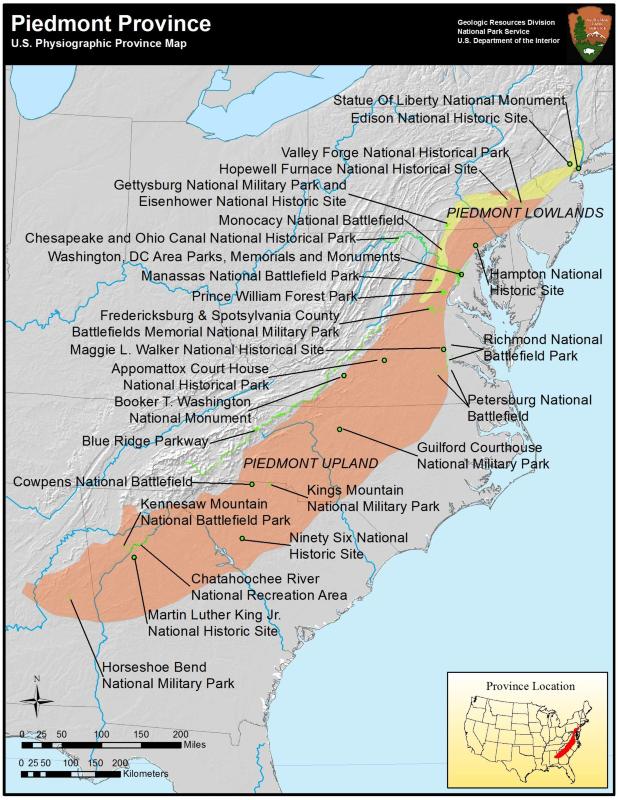
Pennsylvania
Virginia
“In the Year 1714 I travelled from the lower Part of St. James’s River in Virginia to that Part of the Apalatchian Mountains where the Sources of that River rise, from which to the Head of the Savannah River is about four Degrees distance in Latitude. As fome Remarks I then made may serve to illustrate what I have now said, I hope it may not be amiss to recite so much of them as may serve for that Purpose.
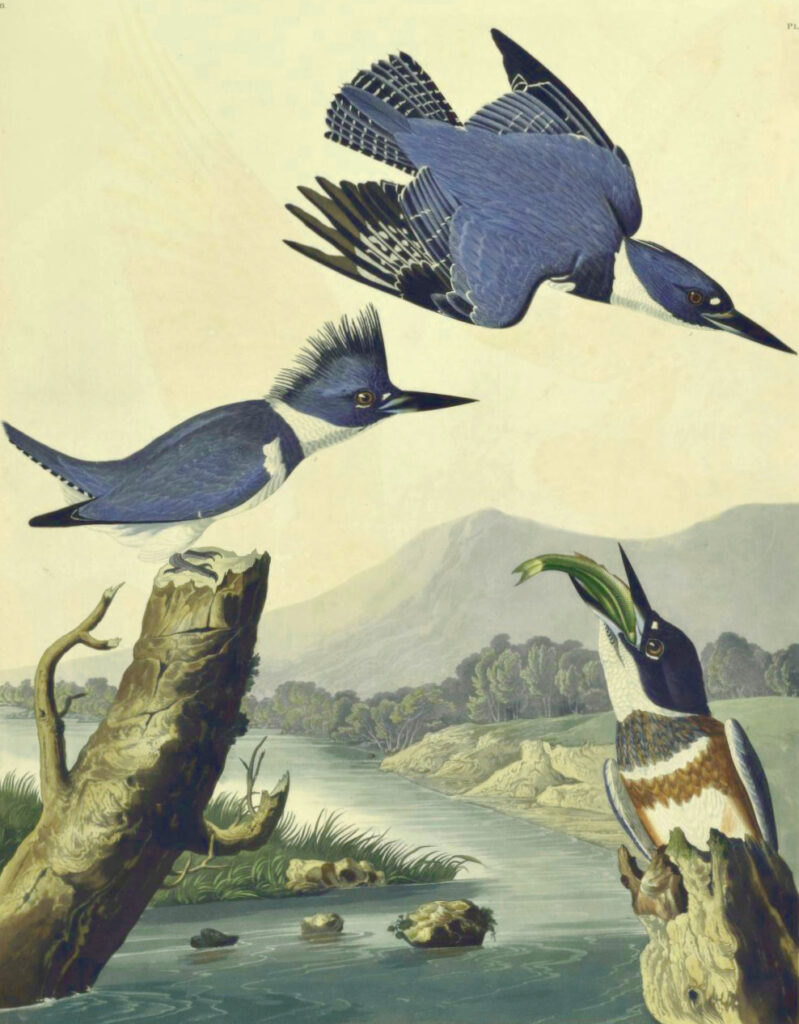
At sixty Miles from the Mountains the River, which fifty Miles below was a Mile wide is here contracted to an eighth Part, and very shallow, being fordable in many Places, and so full of Rocks, that by stepping from one to another it was every where passable. Here we kill’d plenty of a particular Kind of wild Geese; they were very fat by feeding on fresh Water Snails, which were in great plenty, sticking to the Tops and Sides of the Rocks. The low Lands joining to the Rivers were vastly rich, shaded with Trees that naturally dislike a barren Soil, such as black Walnut [Juglans nigra], Plane [Platanus occidentalis, sycamore], and Oaks [Quercus spp.] of vast Stature. This low Land stretched along the River many Miles, extending back half a Mile more or less, and was bounded by a Ridge of steep and very lofty Rocks, on the Top of which we climbed, and could discern some of the nearer Mountains, and beheld most delightful Prospects, but the Country being an entire Forest, the Meanders of the Rivers, with other Beauties, were much obscured by the Trees. On the Back of this Ridge of Rocks the Land was high, rising in broken Hills, alternately good and bad. Some Miles further the Banks of the River on both Sides were formed of high perpendicular Rocks, with many lesser ones scattered all over the River, between which innumerable Torrents of Water were continually rushing.”
From The Natural History of Carolina, Florida and the Bahama Islands by Mark Catesby (1731) pp. v
“The second part of the coastal area rises somewhat and rests on a base of granite and quartz covered by a layer of clay, above which is a shallow layer of topsoil. Since the clay is impervious to water, the land is in general not fertile and is unhealthful, particularly toward the south. Yet one can occasionally find in this area rather large stretches of excellent land which are not too remote from the coast. There is also good land in the colder regions, but it is expen-
sive because the settlements there are long established.”
From New Travels in the United States of America by J. P. Brissot (1788) p. 356
Carolinas
“We took up our Quarters by a Fish-pond-side; the Pits in the Woods that stand full of Water, naturally breed Fish in them, in great Quantities. We cook’d our Supper, but having neither Bread, or Salt, our fat Turkeys began to be loathsome to us, altho we were never wanting of a good Appetite, yet a Continuance of one Diet, made us weary.
The next Morning… about Noon, we pass’d by several fair Savanna‘s, very rich and dry; seeing great Copses of many Acres that bore nothing but Bushes, about the Bigness of Box-trees, which (in the Season) afford great Quantifies.of small Black-berries, very pleasant Fruit, and much like to our Blues, or Huckle-berries, that grow on Heaths in England. Hard by the Savanna we found the Town..”
From a New Voyage to Carolina (1709) by John Lawson p. 27
“We found here good Store of Chinkapin-Nuts, which they gather in Winter great Quantities of, drying them; to keep these Nuts in great Baskets for their Use; likewise Hickerie-Nuts, which they beat betwixt two great Stones, then sift them, to thicken their Venison-Broath therewith the small Shells precipitating to the Bottom of the Pot, whilst the Kernel in Form of Flower, mixes it with the Liquor. Both these Nuts made into Meal, makes a curious Soop, either with clear Water, or in any Meat-Broth.
From the Nation of Indians [sic], until such Time as you come to the Turkeiruros in North Carolina, you will see no long Moss [Spanish moss] upon the Trees, which Space of Ground contains above five hundred Miles. This seeming Miracle in Nature, is occasion’d by the Highness of the Land, it being dry and healthful; for tho’ this most bears a Seed in a Sort of a small Cod, yet it is generated in or near low swampy Grounds.
These Congerees have abundance of Storks and Cranes in their Savannas. They take them before they can fly, and breed em as tame and familiar as a Dung-hill Fowl. They had a tame Crane at one of these Cabins, that was scarce less than six Foot in Height [probably a description of a Whooping Crane], his Head being round, with a shining natural Crimson Hue, which they all have”
From a New Voyage to Carolina (1709) by John Lawson pp. 28-29
“Friday. In the Morning we made no Stay to get our Breakfast, but hasted on our Voyage, the Land increasing in Marble and Richness of Soil. At Noon we halted, getting our Dinner upon a Marble-Stone, that rose it self halt a Foot above the Surface of the Earth, and might contain the Compass of a Quarter of an Acre of Land, being very even, there growing upon it in some Places a small red Berry, like a Salmon Spawn, there boiling out of the main Rock curious Springs of as delicious Water, as ever I drank in any Parts I ever travell’d in
These Parts likewise affords good free Stone, fit for Building, and of several Sorts. The Land here is pleasantly seated, with pretty little Hills and Valleys, the rising Sun at once shewing his glorious reflecting Rays on a great many of these little Mountains.
…Saturday. As we wer on our Road this Morning, our Indian [sic] shot at a Tyger, that cross’d the Way, he being a great Distance from us. I believe he did him no Harm, because he sat on his Breech afterwards, and look’d upon us. I suppose he expected to have bad a Spaniel Bitch, that I had with me, for his Breakfast, who run towards him, but in the Midway stopt her Career, and came sneaking back to, us with her Tail betwixt her Legs.
We saw in the Path a great many Trees blown up by the Roots, at the Bottom whereof stuck great Quantities of fine red Bole; I believe nothing inferior to that of Venice or Lemma. We found some Holes in the Earth, which were full of a Water as black as Ink. I thought that Tincture might proceed from some Mineral, but I had not Time to make a farther Discovery. About Noon’ we pass’d over a pleasant stony Brook, whose Water was of a bluish Cast, as it is for several hundreds of Miles towards the Heads of the Rivers, I suppose occasion’d by the vast Quantities of Marble lying in the Bowels of the Earth. The Springs that feed these Rivulets, lick up some Potions of the Stones in the Brooks, which Dissolution gives this Tincture, as appears in all or most of the Rivers and Brooks of this Country whose rapid Streams are like those in Yorkshire, and other Northern Counties of England. The Indians [sic] talk of many Sorts of Fish which they afford, but we had not Time to discover their Species.
I saw here had been some Indian Plantations formerly there being several pleasant Fields of clear’d Ground and excellent Soil, now well spread with fine bladed Grass and Strawberry-Vines.
The Mould here is excessive rich, and a Country very pleasing to the Eye, had it the Convenience of a navigable River as all new Colonies (of Necessity) require. It would make a delightful Settlement.
We went eight Miles farther, and came to the Wateree Chickanee Indians [sic]. The Land holds good, there being not a Spot of bad Land to be seen in several Days going
Their country [that of the Wateree Chickanee] is wholly free from Swamps and Quagmires, being high dry Land, and consequently healthful, producing large Corn-Stalks, and fair Grain.”
From a New Voyage to Carolina (1709) by John Lawson pp. 31-32
“Next we shall treat of the Land hereabouts, which is a Marl as red as Blood, and will lather like Soap. The Town stands on this Land, which holds considerably farther in the Country, and is in my Opinion, so durable that no Labour of Man, in one or two Ages, could make it poor. I have formerly seen the like in Leicestershire, bordering upon Rutland. Here were Corn-Stalks in their Fields as thick as the Small of a Man’s Leg, and they are ordinarily to be seen…”
From a New Voyage to Carolina (1709) by John Lawson p. 40
“The Land held rich and good, in many Places there were great Quantities of Marble. The Water was still of a wheyish Colour. About 10 of the Clock, we waded thro’ a River, (about the Bigness of Dervent, in Yorkshire) which I take to be one of the Branches of Winjaw River. We saw several Flocks of Pigeons, Field-Fares, and Thrushes, much like those of Europe.”
From a New Voyage to Carolina (1709) by John Lawson p. 42
..This done, he ran into his Plantation, and got some Sassafras Root [to treat a lame man], (which grows here in great plenty) dry’d it in the Embers, scrap’d off the outward Rind, and having beat it betwixt two Stones, apply’d it to the Part afflicted, binding it up well. Thus, in a day or two, the Patient became sound. This day, we pass’d through a ‘great many Towns, and Settlements, that belong to the Sugeree-Indians, no barren Land being found amongst them, but great plenty of Free-Stone, and good Timber.
It was observable, that we did not see one Partridge from the Waterrees to this place, tho’ my Spaniel-Bitch, which I had with me in this Voyage, had put up a great many before.
…The Marble here is of different Colours, some or other of the Rocks representing most Mixtures, but chiefly the white having black and blue Veins in it, and some that are red.
…In the mean time, we went to shoot [Passenger] Pigeons, which were so numerous in these Parts, that you might see many Millions in a Flock; they sometimes split off the Limbs of stout Oaks, and other Trees, upon which they roost o’ Nights. You may find several Indian [sic] Towns, of not above 17 Houses, that have more than 100 Gallons of Pigeons Oil, or Fat; they using it with pulse or Bread, as we do Butter, and [the pigeons] making the Ground as white as a Sheet with their Dung. The Indians take a Light, and go among them in the Night, and bring away some thousands, killing them with long Poles, as they roost in the Trees. At this time of the Year, the Flocks, as they pass by, in great measure, obstruct the Light of the day.
On Monday, we went about 25 Miles, travelling through a pleasant, dry Country, and took up our Lodgings by a Hillside, that was one entire Rock, out of which gushed out pleasant Fountains of well-tasted Water.
The next day, still passing along such Land as we had done for many days before, which was, Hills and Vallies, about 10 a Clock we reach’d the Top of one of these Mountains, which yielded us a fine Prospect of a very level Country, holding so, on all sides, farther than we could discern. When we came to travel through it, we found it very stiff and rich, being a sort of Marl. This Valley afforded as large Timber as any I ever met withal, especially of Chesnut-Oaks, which render it an excellent Country for raising great Herds of Swine…At Night, we lay by a swift Current, where we saw plenty of Turkies, but pearch’d upon such lofty Oaks, that our Guns would not kill them, tho we shot very often, and our Guns were very good. Some of our Company shot several times, at one Turkey, before he would fly away, the Pieces being loaded with large.Goose-shot.
Next Morning, we got our Breakfasts, roasted Acorns being one of the Dishes. The Indians [sic] beat them into Meal, and thicken their Venison-Broath with them; and oftentimes make a palatable Soop. They are used instead of Bread, boiling them till the Oil swims on the top of the water, which they preserve for use, eating the Acorns with Fleshmeat. We travell’d, this day, about 25 Mites, over pleasant Savanna Ground, high, and dry, having very few Trees upon it, and those standing at a great distance. The Land was very good, and free from Grubs or Underwood. A Man near Sapona may more easily clear 10 Acres of Ground, than in some places he can one, there being much loose Stone upon the Land, lying very convenient for making of dry Walls, or any other sort of durable Fence. This Country abounds likewise with curious bold Creeks, (navigable for small Craft) disgorging themselves into the main Rivers, that vent themfelves into the Ocean. These Creeks are well stor’d with sundry sorts of Fish, and Fowl, and are very convenient for the Tranfportation of what Commodities this Place may produce. This Night, we had a great deal of Rain, with Thunder and Lightning.
Next Morning, it proving delicate Weather, three of us Separated ourselves from the Horses, and the rest of the Company, and went directly for Sapona Town. That day, we pass’d through a delicious Country, (none that l ever faw exceeds it.) We saw fine bladed Grass, six Foot high, along the Banks of these pleasant Rivulets: We pass’d by the Sepulchres of several slain Indians [sic]. Coming, that day, about 30 Miles, we reach’d the fertile and pleasant Banks of Sapona River, whereon stands the Indian Town and Fort. Nor could all Europe afford a pleasanter Stream, were it inhabited by Christians, and cultivated by ingenious Hands. These Indians live in a clear Field, about a Mile square, which they would have sold me; because I talked sometimes of coming into those Parts to live. This most pleasant River may be something broader than the Thames at Kingston, keeping a continual pleasant warbling Noise, with its reverberating on the bright Marble Rocks. It is beautified with a numerous Train of Swans, and other sorts of Water-Fowl, not common, though extraordinary pleasing to the Eye. The forward Spring welcom’d us with her innumerable Train of small Choristers, which inhabit those fair Banks, the Hills redoubling, and adding Sweetness to their melodious Tunes by their shrill Echoes. One side of the River is hemm’d in with mountainy Ground, the other side proving as rich a Soil to the Eye of a knowing Person with us, as any this Western World can afford…”
From a New Voyage to Carolina (1709) by John Lawson p. 43-46
“Friday Morning, the old King having shew’d us 2 of his Horses, that were as fat, as if they had belong’d to the Dutch Troopers, left us, and went to look after his Beaver-Traps there being abundance of those amphibious Animals in this River, and the Creeks adjoining. Taken with the Pleasantness of the Place, we walk’d along the River-side, where we found a very delightful Island, made by the River, and a Branch; there being several such Plots of Ground environ’d with this Silver Stream, which are fit Pastures for Sheep, and free from any offenfive Vermin. Nor can any thing be desired by a contented Mind, as to a pleasant Situation but what may here be found; Every Step presenting some new Object, which still adds Invitation to the Traveller in these Parts.
On Saturday, the Indians [sic] brought in some Swans, and Geese, which we had our Share of. One of their Doctors took me to his Cabin, and shew’d me a great Quantity of medicinal Drugs, the Produce of those Parts; Relating their Qualities-as to the Emunctories they work’d by, and what great Maladies he had heal’d by them. This Evening, came to us the Horses, with the Remainder of our Company, their Indian [sic] Guide (who was a Youth of this Nation) having kill’d, in their Way, a very fat Doe, Part of which they brought to us.
Sunday. This day, the King sent out all his able Hunters, to kill Game for a great Feast, that was to be kept at their Departure, from the Town, which they offer’d to sell me for a small matter. That Piece of Ground, with a little Trouble, would make an Englishman a most curious Settlement, containing above a Mile square of rich Land. This Evening, came down some Toteros tall, likely Men, having great Plenty of Buffelos, Elks, and Bears, with other sort of Deer amongst them, which strong Food makes large, robust Bodies…”
From a New Voyage to Carolina (1709) by John Lawson p. 48
“On Monday Morning, our whole Company, with the Horses, set out from the Sapona-Indian Town, after having seen some of the Locust, which is gotten thereabouts, the same Sort that bears Honey. Going over several Creeks, very convenient for Water-Mills, about 8 Miles from the Town, we pass’d over a very pretty River, call’d Rocky River, a fit Name, having a Ridge of high Mountains running from its Banks, to the Eastward; and disgorging itself into Sapona River, so that there is a most pleasant and convenient Neck of Land, betwixt both Rivers, lying upon a Point, where many thousand Acres may be fenced in, without much Cost or Labour. You can scarce go a Mile, without meeting with one of these small swift Currents, here being no Swamps to be found, but pleasant, dry Roads all over the Country. The Way that we went this day, was as full of Stones, as any which Craven, in the West of Yorkshire could afford, and having nothing but Moggisons on my Feet, I was so lam’d by this stony Way, that I thought I must have taken up some Stay in those Parts. We went, this day, not above 15 or 20 Miles. After we had supp’d, and all lay down to sleep, there came a Wolf close to the Fire-side, where we lay. My Spaniel soon discover’d him, at which, one of Our Company fir’d a Gun at the Beast; but, I believe, there was a Mistake in the loading of it, for it did him no Harm. The Wolf stay’d till he had almost loaded again, but the Bitch making a great Noise, at last left us and went aside. We had no sooner laid down, but he approach’d us again, yet was more shy, so that we could not get a Shot at him.
Next day, we had 15 Miles farther to the Keyauwees. The Land is more mountainous, but extremely pleasant, and an excellent Place for the breeding Sheep, Goats, and Horfes or Mules, if the English were once brought to the Experience of the Usefulness of those Creatures. The Valleys are here very rich. At Noon, we pass’d over such another stony River, as that eight Miles from Sapona. This is call’d Heighwaree, and affords as good blue Stone for Mill-Stones, as that from Cologn, good Rags, some Hones, and large Pebbles, in great abundance, besides Free-Stone of several Sorts, all very useful. I knew one of these Hones made use of by an Acquaintance of mine, and it prov’d rather better than any from Old Spain, or else where. The Veins of Marble are very large and curious on this River, and the Banks thereof.
Five Miles from this River, to the N. W. stands the Keyauwees Town. They are fortify’d in, with wooden Puncheons, like Sapona, being a People much of the same Number. Nature hath so fortify’d this Town, with Mountains, that to sere it a Seat of War, it might easily be made impregnable; having large Corn-Fields joining to their Cabins, and a Savanna near the Town, at the Foot of these Mountains, that is capable of keeping some hundred Heads of Cattle. And all this environed round with very high Mountains, so that no hard Wind ever troubles these Inhabitants. Those high Clifts have no Grass growing on them, and very few Trees, which are very short, and stand at a great Distance one from another. The Earth is of a red Colour, and seems to me to be wholly design’d by Nature for the Production of Minerals, being of too hot a Quality, to suffer any Verdure upon its Surface. These Indians [sic] make use of Lead-Ore, to paint their Faces withal, which they get in tho neighbouring Mountains. As for the refining of Metals, the Indians [sic] are wholly ignorant of it, being content with the Realgar. But if it be my Chance, once more to visit these Hilly Parts, I shall make a longer Stay amongst them; For were a good Vein of Lead found out, and work’d by an ingenious Hand, it might be of no small Advantage to the Undertaker, there being great Convenience for smelting, either by Bellows or Reverberation; and the Working of these Mines might discover some that are much rich.
At the Top of one of these Mountains, is a Cave that 100 Men may fit very conveniently to dine in; whether natural, or artificial, I could not learn. There is a fine Bole between this Place, and the Saps. These Valleys thus hemm’d in with Mountains, would (doubtless) prove a good place for propagating some sort of Fruits, that our Easterly Winds commonly blast…Near the Town, is such another Current, as Heighwaree…”
From a New Voyage to Carolina (1709) by John Lawson pp. 49-51
“Friday. The next day, we travell’d over very good Land, but full of Free-Stone, arid Marble, which pinch’d our Feet severely. We took up our Quarters in a sort of Savanna-Ground, that had very few Trees in it. The Land was good, and had several Quarries of Stone, but not loose, as the others us’d to be.
Saturday. Next Morning, we got our Breakfasts of Parch’d Corn, having nothing but that to subsist on for above 100 Miles. All the Pine-Trees were vanish’d, for we had seen none for two days. We pass’d through a delicate rich Soil this day; no great Hills, but pretty Risings, and Levels, which made a beautiful Country. We likewise pass’d over three Rivers this day; the first about the bigness of Rocky River, the other not much differing in Size. Then we made not the least Question, but we had pass’d over the North-West Branch of Cape-Fair, travelling that day above 30 Miles. We were much taken with the Fertility and Pleasantness of the Neck of Land between these two Branches, and no less pleas’d, that we had pass’d the River, which us’d to frighten Passengers from fording it. At last, determining to rest on the other side of a Hill, which we saw before us; when we were on the Top thereof, there appear’d to us such another delicious, rapid Stream, as that of Sapona, having large Stones, about the bigness of an ordinary House, lying up and down the River. As the Wind blew very cold at N. W. and we were very weary, and hungry, the Swiftness of the Current gave us some cause to fear; but, at last, We concluded to venture over that Night. Accordingly, we stripp’d, and with great Difficulty, (by God’s Assistance) got safe to the North-side of the famous Hau-River, by some called Reatkin; the Indians [sic] differing in the Names of Places, according to their several Nations. It is call’d Hau-River, from the Sissipahau Indians [sic], who dwell upon this Stream, which is one of the main Branches of Cape-Fair, there being rich Land enough to contain some Thousands of Families; for which Reason, I hope, in a short time, it will be planted. This River is much such another as Sapona; both seeming to run a vast way up the Country. Here is plenty of good Timber, and especially of a Scaly-bark Oak; And as there is Stone enough in both Rivers, and the Land is extraordinary Rich, no Man that will be content within the Bounds of Reason, can have any grounds to dislike it. And they that are otherwise, are the best Neighbours, when farthest of.”
From a New Voyage to Carolina (1709) by John Lawson pp. 54-55
“All the lower (which are the inhabited) Parts of Carolina, are a flat sandy Country, the Land rising imperceptably to the Distance of about an Hundred Miles from the Sea, where loose Stones begin to appear, and at length Rocks, which at the nearer Approach to the Mountains, increase in Quantity and Magnitude, forming gradual Hills, which also increase in Height, exhibiting extensive and most delightful Prospects. Many spacious Tracts of Meadow-Land are confined by these rugged Hills, burdened with Grass six Feet high; other of these Vallies are replenished with Brooks and Rivulets of clear Water, whose Banks are covered with spacious Tracts of Canes [Arundinaria gigantea], which retaining their Leaves the Year round, are an excellent Food far Horses and Cattle, and are of great Benefit particularly to Indian [sic] Traders, whose Caravans travel these uninhabited Countries; to these shady Thickets of Canes (in sultry Weather) resort numerous Herds of Buffello’s, where solacing in these limpid Streams they enjoy a cool and secret Retreat, Pine barren, Oak, and Hiccory-Land, as has been before observed to abound in the lower Parts of the Country, engross alfo a considerable Share of these upper Parts.
The richest Soil in the Country lies on the Banks of those larger Rivers, that have their Sources in the Mountains, from whence in a Series of Time has been accumulated by Inundations such a Depth of prolifick Matter, that the vast Burden of mighty Trees it bears, and all other Productions, demonstrates it to be the deepest and most fertile of any in the Country. Yet pity it is that this excellent Soil should be liable to annual Damage from the same Cause that inrich’d it, for being subject to be overflowed lessens the Value of it. In other Places on the Banks of these Rivers extend vast Thickets of Cane, of a much larger Stature than those before-mentioned, they being between twenty and thirty Feet high, growing so close that they are hardly penetrable but by Bears, Panthers, Wild Cats, and the like. This Land, in Depth of Soil, seems equal to the preceeding, and is equally lable to Inundations. Though the worst Land is generally remote from Rivers, yet there are interspers’d spacious Tracts of rocky Ground, covered with a shallow but fertile Soil. Many of these Vallies are so regularly bounded by steep Rocks, that in several of them remain only an Isthmus or narrow Neck of Land to enters otherwise would be wholly inclosed. From these Rocks gush out plentiful Streams of limpid Water, refreshing the lower Grounds, and in many Places are received into spacious Basons, formed naturally by the Rocks.
At the Diltance of about half Way between the Sea and Mountains, ten Miles wide of Fort Savannah, there lies, scattered on the Earth, irregular Pieces of white Stone, or Alabafter, some very large, but, in general they were from the Size of a Bushel to various Degrees less; some lay under the Surface, but none seemed to lie deep in the Earth. These Stones or Pieces of Rock extended five Miles in Width, where we crossed them, and, as the Traders and Indians afirmed to me, three Hundred in Length, running in a North-westerly Direction.
…The lower Parts of the Country, to about half way towards the Mountains, by its low and level Situation, differ considerably from those Parts above them, the latter abounding with Blessings, conducing much more to Health and Pleasure: But as the maritime Parts are much more adapted for Commerce, and Luxury, these delightful Countries are as yet left unpeopled, and possessed by Wolves, Bears, Panthers, and other Beasts.
…A great Part of these Mountains are covered with Rocks, some of which are of a stupendious Height and Bulk; the Soil between them is generally black and sandy, but in some Places differently coloured, and composed of Pieces of broken Rock, and Spar, of a glittering Appearance, which feem to be Indications of Minerals, and Ores, if proper Search was made after them: Fossil Coal fit for Fuel hath been discovered on Col. Byrd’s Estate in Virginia: Chesnuts [Castanea dentata] and small Oaks [Quercus spp.] are the Trees that principally grow on these Mountains, with some Chinapin [Castanea pumila], and other smaller Shrubs; the Grass is thin, mixt with Vetch and wild Peas; on some other Tracts of these Mountains is very little vegetable Appearance.
In this State, with regard to the Soil, and apparent Productions, the Mountains appear at the Sources of the Savannah River, continuing so with little Variation, as ’tis thought, some Hundred Miles North.”
From The Natural History of Carolina, Florida and the Bahama Islands by Mark Catesby (1731) pp. iv-v
“The two Carolinas and Georgia are naturally divided into the upper and lower country, but the upper embraces a greater extent. Just at the point where the maritime part is terminated the soil rises gradually till it reaches the Alleghany Mountains, and presents, upon the whole, a ground rather irregular than mountainous, and interspersed with little hills as far as the mountains. The Alleghanies give birth to a great number of creeks or small rivers, the junction of which forms the rivers Pidea, Santea, Savannah, and Alatamaha, which are hardly navigable above two hundred miles from their embouchure. In the upper country the most fertile lands are situated upon the borders of these creeks. Those that occupy the intermediate spaces are much less so. The latter are not much cultivated; and even those who occupy them are obliged to be perpetually clearing them, in order to obtain more abundant harvests; in consequence of which a great number of the inhabitants emigrate into the western country, where they are attracted by the extreme fertility of the soil and low price of land; since that of the first class may be purchased for the same money as that of the second in Upper Carolina; and, as we have already said, the latter is scarcely to be compared to that which in Kentucky and Cumberland is ranked in the third.”
From Early Western Travels by Francois Andre Michaux (1803) pp. 296-297
“In Upper Carolina the surface of the soil is covered with a kind of grass, which grows in greater abundance as the forests are more open. The woods are also like a common, where the inhabitants turn out their cattle, which they know again by their private mark. Several persons have in their flocks a variety of poll oxen, which are not more esteemed than those of the common species. In the whole course of my travels I never saw any that could be compared to those I have seen in England, which beyond doubt proceeds from the little care that the inhabitants take of them, and from what these animals suffer during the summer, when they are cruelly tormented by an innumerable multitude of ticks and muskitos, and in the winter, through the want of grass, which dries up through the effect of the first frosts. These inconveniences are still more sensible, during the summer, in the low country, through the extreme heat of the climate. The result is, that the cows give but little milk, and are dry at the end of three or four months.”
From Early Western Travels by Francois Andre Michaux (1803) p. 299
“They reckon fifty-five miles from Chester to Columbia; twenty-five miles on this side we passed through Winesborough, composed of about a hundred and fifty houses. This place is one of the oldest inhabited in Carolina, and several planters of the low country go and spend the summer and autumn there. Fifteen miles on this side Winesborough the pine barrens begin, and thence to the sea side the country is one continued forest composed of pines.
…The river Catabaw, about twenty fathoms broad, is only navigable during the winter; the rest of the year its navigation is stopped by large rocks that intercept [274] its course
From Travels to the West of the Allegheny Mountains by Francois Andre Michaux (1805) pp. 294-295
“The two Carolinas and Georgia are naturally divided into the upper and lower country, but the upper embraces a greater extent. Just at the point where the maritime part is terminated the soil rises gradually till it reaches the Alleghany Mountains, and presents, upon the whole, a ground rather irregular than mountainous, and interspersed with little hills as far as the mountains. The Alleghanies give birth to a great number of creeks or small rivers, the junction of which forms the rivers Pidea, Santea, Savannah, and Alatamaha, which are hardly navigable above two hundred miles from their embouchure. – In the upper country the most fertile lands are situated upon the borders of these creeks. Those that occupy the intermediate spaces are much less so. The latter are not much cultivated; and even those who occupy them are obliged to be perpetually clearing them, in order to obtain more abundant harvests; in consequence of which a great number of the inhabitants emigrate into the western country, where they are attracted by the extreme fertility of the soil and low price of land; since that of the first class may be purchased for the same money as that of the second in Upper Carolina; and, as we have already said, the latter is scarcely to be compared to that which in Kentucky and Cumberland is ranked in the third.
In the upper country the mass of the forests is chiefly composed of oaks [Quercus], nut trees, maples [Acer], and poplars [Liriodendron tulipifera]. Chesnut [Castanea dentata] trees do not begin to appear in these states for sixty miles on this side the mountains. It is only in the remote parts that the inhabitants manufacture maple sugar for their use.”
From Travels to the West of the Allegheny Mountains by Francois Andre Michaux (1805) pp. 296-297
“Monday – the face of the country now began to assume a different aspect…the country becoming more hilly and broken, pure streams of water…
Tuesday 12, proceeded on to Columbia, crossed over a fine bridge, which commands a beautiful view of the town, which is handsomely situated on a hill of considerable eminence..
Wednesday 13 – left Columbia in the morning, the road becoming more hilly and rough and the face of the country presenting a new appearance…
Monday 18 – …went in the afternoon to fish on the banks of the river, our sport was not very successful yet its novelty to me made it pleasing, the beauty of the surrounding scenery, the bold and majestic river unruffled by a breeze, the rich verdure of the trees which skirted its banks and seemed to droop to take its waters, the pure atmosphere that we inhaled, all conspired to make it lovely and interesting and worthy of a painter’s pencil or a poet’s pen; unfortunately, I am neither, nor can I ever give you a correct idea of its beauty..
Wednesday 27. … in the afternoon rode over to Catawba Springs [North Carolina – near Charlotte], the road was beautiful and the scenery around the springs is picturesque and romantic – the house is situated on the summit of a steep hill which commands a fine view of the whole extent of country around, a distant yet distinct view of the little mountains and as far as the eye can see, it rest on cultivated fields or richly glowing woods diversified by hill and dale – we returned late in the evening, crossed the Catawba [River], a lovely night, the moon had just begun to shed her silvery light and all nature was hushed and calm.
…[in Salem, NC] afterwards walked into the garden belonging to the [Moravian] establishment where we saw what I conceived to be a curiosity and in itself extremely beautiful. It was a large summer house formed of eight cedar trees [Juniperus virgininiana] planted in a circle, the tops whilst young were chained together in the center forming a cone. The immense branches were all cut, so that there was not a leaf, the outside is beautifully trimmed perfectly even and very thick within, were seats placed around and doors or openings were cut, through the branches, it had been planted 40 years – next visited the church yard, the walk leading to it was through a beautiful grove of cedars [Juniperus virginiana]…
…Wednesday 15 Rose early breakfasted and set out, the road becoming at every mile more hilly with the summit of the mountains full in view – appearing as it were to reach the clouds and e’en to rise over them, the road wound along the foot of (what to my lowland eye appeared like mountains but which were called) steep hills and they were so literally – in the course of a ride of 10 miles we crossed a creek known by the name of Laurel 37 times the waters were uncommonly pure and fine…the view from the top of these hills was extremely fine, – we were rising at every mile”
From the Journal of Juliann Conner (1827)
“It is hard to admire what is common; and it is, perhaps, asking too much of the citizens of Raleigh, that they should plant for ornament, or even cause to be retained about such institutions as their Lunatic Asylum, the beautiful evergreens that crowd about the town; but can any man walk from the Capitol oaks to the pine grove, a little beyond the Deaf and Dumb Institution, and say that he would not far rather have the latter than the former to curtain in his habitation? If he can in summer, let him try it again, as I did, in a soft winters day, when the evergreens fill the air with a balsamic odor, and the green light comes quivering through them, and the foot falls silently upon the elastic carpet they have spread, deluding one with all the feelings of spring.
The country, for miles about Raleigh, is nearly all pine forest, unfertile, and so little cultivated, that it is a mystery how a town of 2,500 inhabitants can obtain sufficient supplies from it to exist.
..[passed on the route from Raleight to Fatetteville, NC] A very fine oak tree, standing by itself on some elevated ground, having attracted me to a considerable distance from the road, I found that the spread of its branches covered a circle of the diameter of forty-two paces [about 105′].
After walking a few miles, the country became more flat, and was covered with old forests of yellow pine [Pinus taeda], and, at nine miles south of Raleigh, there were occasionally young long-leaved pines [Pinus palustris]: exceedingly beautiful they are while young, the color being more agreeable than that of any other pine, and the leaves, or straw, as its foliage is called here, long, graceful, and lustrous. As the tree gets older, it becomes of a stifier character and darker color.
I do not think I passed, in ten miles, more than half a dozen homesteads..”
From the A Jouney in the Seabord Slave States by Frederick Law Olmsted, p. 321 (1856)
Georgia
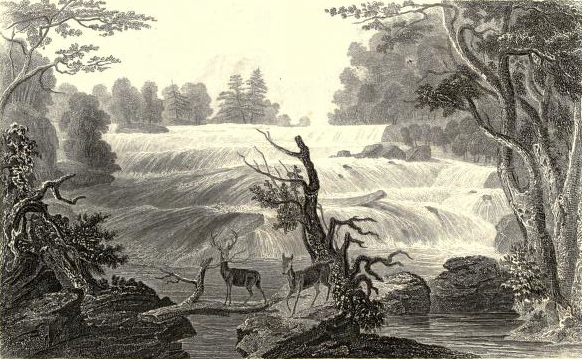
“Thus have I endeavoured to give the reader a short and natural description of the vast plain lying between the region of Augusta and the sea coast; for from Augusta the mountainous country begins (when compared to the level sandy plain already passed), although it is at least an hundred and fifty miles west, thence to the Cherokee or Apalachian mountains; and this space may with propriety be called the hilly country, every where fertile and delightful, continually replenished by innumerable rivulets, either coursing about the fragrant hills, or springing from the rocky precipices, and forming many cascades; the coolness and purity of which waters invigorate the air of this otherwise hot and sultry climate.”
Travels Through North and South Carolina, Georgia, East and West Florida, the Cherokee Country, the Extensive Territories of the Muscogulges, or Creek Confederacy, and the Country of the Chactaws by William Bartram (1773-1777)
“Upon the rich rocky hills at the cataracts of Augusta, I first observed the perfumed Rhododendron ferrugineum [likely Rhododendron minus, dwarf laurel], white-robed philadelphus inodorus [Philadelphus inodorus, Appalachian philadelphus], and cerulean Malva; but nothing in vegetable nature was more pleasing than the odoriferous pancratium fluitans [possibly Hymenocallis coronaria, Shoals lily], which almost alone possesses the little rocky islets which just appear above the water.
…The summer season now rapidly advancing, the air at mid-day, about this region, is insufferably hot and sultry. We sat off from Augusta, early in the morning, for the Great Buffalo Lick, on the Great Ridge, which separates the waters of the Savanna and Alatamaha, about eighty miles distant from Augusta. At this Lick the surveyors were to separate themselves, and form three companies, to proceed on different routes. On the evening of the second day’s journey, we arrived at a small village on Little River, a branch of Savanna: this village, called Wrightsborough, was founded by Jos. Mattock, esq. of the sect called quakers…The distance from Augusta to this place is about thirty miles; the face of the country is chiefly a plain of high forests savannas, and cane swamps, until we approach Little River, when the landscape varies, presenting to view high hills and rich vales. The soil is a deep, rich, dark mould, on a deep stratum of reddish brown tenacious clay, and that on a foundation of rocks, which often break through both strata, lifting their backs above the surface. The forest trees are chiefly of the deciduous order, as, Quercus tinctoria [Quercus velutina, black oak], Q. lasciniata [likely Quercus falcata, southern red oak], Q. alba [white oak], Q. rubra [northern red oak], Q. prinus [Quercus montana, chestnut oak], with many other species; Celtus, Fagus sylvatica [Fagus grandifolia, American beech], and, on the rocky hills, Fagus castanea [Castanea dentata, American chestnut], Fag. pumila [Castanea pumila, Allegheny chinquapin], Quercus castanea [likely Quercus muehlenbergii, chinquapin oak]; in the rich vales, Juglans nigra [black walnut], Jug. cinerea [butternut], Gleditsia triacanthos [honey locust], Magnolia acuminata [cucumber magnolia], Liriodendron [tulip-poplar], Platanus [American sycamore], Fraxinus excelsior [likely Fraxinius americana, white ash], Cercea [likely Cercis canadensis, redbud], Juglans exaltata [likley Carya ovata or possibly Carya laciniosa, shagbark or shell bark hickory], Carpinus [hornbeam], Morus rubra [red mulberry], Calycanthus [sweet-shrub], Halesia [silverbell], Æsculus pavia [red buckeye], Æsc. arborea [likely Aesculus sylvatica, painted buckeye].
Leaving the pleasant town of Wrightsborough, we continued eight or nine miles through a fertile plain and high forest, to the north branch of Little River, being the largest of the two, crossing which, we entered an extensive fertile plain, bordering on the river, and shaded by trees of vast growth, which at once spoke its fertility. Continuing some time through these shade groves, the scene opens, and discloses to view the most magnificent forest I had ever seen. We rise gradually a sloping bank of twenty or thirty feet elevation, and immediately entered this sublime forest. The ground is perfectly a level green plain, thinly planted by nature with the most stately forest trees, such as the gigantic Black Oak (Q. tinctoria) [Q. velutina], Liriodendron [tulip-poplar], Juglans nigra [black walnut], Platanus [American sycamore], Juglans exaltata [Carya ovata, shagbark hickory], Fagus sylvatica [Fagus grandifolia, American beech], Ulmus sylvatica [Ulmus americana, American elm], Liquidambar styraciflua [sweetgum], whose mighty trunks, seemingly of an equal height, appeared like superb columns. To keep within the bounds of truth and reality, in describing the magnitude and grandeur of these trees, would, I fear, fail of credibility; yet, I think I can assert, that many of the black oaks measured eight, nine, ten, and eleven feet diameter five feet above the ground, as we measured several that were above thirty feet girt, and from hence they ascend perfectly straight, with a gradual taper, forty or fifty feet to the limbs; but, below five or six feet, these trunks would measure a third more in circumference, on account of the projecting jambs, or supports, which are more or less, according to the number of horizontal roots that they arise from: the Tulip tree, Liquidambar, and Beech, were equally stately.
After about seven miles progress through this forest of gigantic Black Oaks [Quercus velutina], we enter on territories which exhibit more varied scenes: the land rises almost insensibly by gentle ascents, exhibiting desert plains, high forests, gravelly and stony ridges, ever in sight of rapid rivulets; the soil, as already described. We then passed over large rich savannas or natural meadows, wide-spreading cane swamps, and frequently old Indian settlements, now deserted and overgrown with forest. These are always on or near the banks of rivers, or great swamps, the artificial mounts and terraces elevating them above the surrounding groves. I observed, in the ancient cultivated fields, 1. Diospyros [persimmon], 2. Gleditsia triacanthos [honey locust], 3. Prunus Chicasaw [Prunus angustifolia, Chickasaw plum], 4. Callicarpa [beautyberry], 5. Morus rubra [red mulberry], 6. Juglans exaltata [Carya ovata, shagbark hickory], 7. Juglans nigra [black walnut], which inform us, that these trees were cultivated by the ancients, on account of their fruit, as being wholesome and nourishing food. Though these are natives of the forest, yet they thrive better, and are more fruitful, in cultivated plantations, and the fruit is in great estimation with the present generation of Indians, particularly Juglans exaltata commonly called shell-barked hiccory; the Creeks store up the latter in their towns. I have seen above an hundred bushels of these nuts belonging to one family. They pound them to pieces, and then cast them into boiling water, which, after passing through fine strainers, preserves the most oily part of the liquid: this they call by a name which signifies Hiccory milk; it is as sweet and rich as fresh cream, and is an ingredient in most of their cookery, especially homony and corn cakes.
After four days moderate and pleasant travelling, we arrived in the evening at the Buffalo Lick. This extraordinary place occupies several acres of ground, at the foot of the S. E. promontory of the Great Ridge, which, as before observed, divides the rivers Savanna and Alatamaha. A large cane swamp and meadows, forming an immense plain, lies S. E. from it; in this swamp I believe the head branches of the great Ogeeche river take their rise. The place called the Lick contains three or four acres, is nearly level, and lies between the head of the cane swamp and the ascent of the Ridge. The earth, from the superficies to an unknown depth, is an almost white or cinereous coloured tenacious fattish clay, which all kinds of cattle lick into great caves, pursuing the delicious vein. It is the common opinion of the inhabitants, that this clay is impregnated with saline vapours, arising from fossile salts deep in the earth; but I could discover nothing saline in its taste, but I imagined an insipid sweetness. Horned cattle, horses, and deer, are immoderately fond of it, insomuch, that their excrement, which almost totally covers the earth to some distance round this place, appears to be perfect clay; which, when dried by the sun and air, is almost as hard as brick.
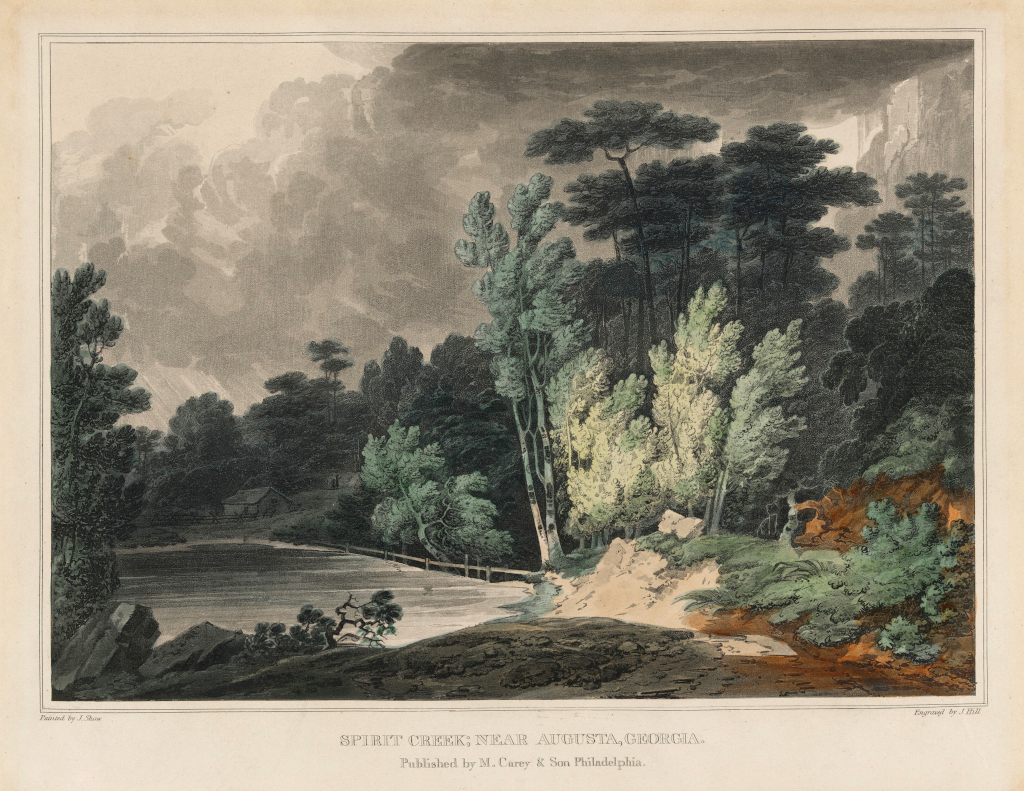
…The Great Ridge consists of a continued high forest; the soil fertile, and broken into moderately elevated hills, by the many rivulets which have their sources in it. The heights and precipices abound in rock and stone. The forest trees and other vegetable productions are the same as already mentioned about Little River: I observed Halesia [silverbell], Styrax [snowbell], Æsculus pavia [red buckeye], Æsc. sylvatica [painted buckeye], Robinia hispida [bristly locust], Magnolia acuminata [cucumber magnolia], Mag. tripetala [umbrella magnolia], and some very curious new shrubs and plants, particularly the Physic-nut, orIndian Olive [Nestronia umbellula]. The stems arise many from a root, two or three feet high; the leaves sit opposite, on very short petioles; they are broad, lanceolate, entire, and undulated, having smooth surfaces of a deep green colour. From the bosom of each leaf is produced a single oval drupe, standing erect, on long slender stems; it has a large kernel, and thin pulp. The fruit is yellow when ripe; and about the size of an olive. The Indians, when they go in pursuit of deer, carry this fruit with them, supposing that it has the power of charming or drawing that creature to them; from whence, with the traders, it has obtained the name of the Physic-nut, which means, with them, charming, conjuring, or fascinating. Malva scandens, Felix scandens, perhaps species of Trichomanes [possibly Lygodium palmatum, American climbing fern]; the leaves are palmated, or radiated; it climbs and roves about, on shrubs, in moist ground. A very singular and elegant plant, of an unknown family, called Indian lettuce [likely Frasera carolinensis, American columbo], made its first appearance in these rich vales; it is a biennial; the primary or radical leaves are somewhat spatuled, or broad, lanceolate, and obtuse pointed, of a pale yellowish green, smooth surface, and of a delicate frame, or texture; these leaves, spread equally on every side, almost reclining on the ground; from their centre arises a straight upright stem, five, six, or seven feet high, smooth and polished; the ground of a dark purple colour, which is elegantly powdered with greenish yellow specks; the stem, three fourths of its length, is embellished with narrow leaves, nearly of the same form of the radical ones, placed at regular distances, in verticillate order. The superior one-fourth division of this stem is formed into a pyramidal spike of flowers, rather diffuse; these flowers are of the hexandria, large, and expanded; of a dark purple colour, delicately powdered with green, yellow, and red, and divided into six parts, or petals; these are succeeded by triquetrous dry pericarpi, when ripe.
This great ridge is a vast extended projection of the Cherokee or Alegany mountains, gradually increasing in height and extent, from its extremity at the Lick, to its union with the high ridge of mountains anciently called the Apalachian mountains; it every where approaches much nearer the waters of the Alatamaha than those of the Savanna. At one particular place, where we encamped, on the Great Ridge, during our repose there part of a day, our hunters going out, understanding that their route was to the low lands on the Ocone, I accompanied them: we had not rode above three miles before we came to the banks of that beautiful river. The cane swamps, of immense extent, and the oak forests, on the level lands, are incredibly fertile; which appears from the tall reeds of the one, and the heavy timber of the other.
Before we left the waters of Broad River, having encamped in the evening on one of its considerable branches, and left my companions, to retire, as usual, on botanical researches, on ascending a steep rocky hill, I accidentally discovered a new species of Caryophyllata (Geum odoratissimum) [Geum radiatum, cliff avens]; on reaching to a shrub, my foot slipped, and, in recovering myself, I tore up some of the plants, whose roots filled the air with animating scents of cloves and spicy perfumes.
…The gold-fish is about the size of the anchovy, nearly four inches long, of a neat slender form; the head is covered with a salade of an ultramarine blue, the back of a reddish brown, the sides and belly of a flame, or of the colour of a fine red lead; a narrow dusky line runs along each side, from the gills to the tail; the eyes are large, with the iris like burnished gold. This branch of Broad River is about twelve yards wide, and has two, three, and four feet depth of water, and winds through a fertile vale, almost overshadowed on one side by a ridge of high hills, well timbered with Oak [Quercus], Hiccory [Carya], Liriodendron [tulip-poplar], Magnolia acuminata [cucumber magnolia], Pavia sylvatica [Aesculus sylvatica, painted buckeye], and on their rocky summits, Fagus castanea [Castanea dentata, American chestnut], Rhododendron ferrugineum [Rhododendron minus, dwarf laurel], Kalmia latifolia [mountain laurel], Cornus Florida [flowering dogwood], &c.
One of our Indian young men, this evening, caught a very large salmon trout [possibly a striped bass], weighing about fifteen pounds, which he presented to the colonel, who ordered it to be served up for supper. The Indian struck this fish, with a reed harpoon, pointed very sharp, barbed, and hardened by the fire. The fish lay close under the steep bank, which the Indian discovered and struck with his reed; instantly the fish darted off with it, whilst the Indian pursued, without extracting the harpoon, and with repeated thrusts drowned it, and then dragged it to shore.
…We at length happily accomplished our line, arriving at the little river, where our hunters bringing in plenty of venison and turkeys, we had a plentiful feast at supper. Next morning we marked the corner tree, at the confluence of Little River and the Savanna; and, soon after, the Indians amicably took leave of us, returning home to their towns.
…The rocks and fossils, which constitute the hills of this middle region, are of various species, as, Quartsum, Ferrum, Cos, Silex, Glarea, Arena, Ochra, Stalactites, Saxum, Mica, &c. I saw no signs of Marble, Plaster, or Lime-stone; yet there is, near Augusta, in the forests, great piles of a porous friable white rock, in large and nearly horizontal masses, which seems to be an heterogeneous concrete, consisting of pulverized sea-shells, with a small proportion of sand; it is soft, and easily wrought into any form, yet of sufficient consistence for constructing any building.
As for the animal productions, they are the same which originally inhabited this part of North America, except such as have been affrighted away since the invasion of the Europeans. The buffalo (Urus) once so very numerous, is not at this day to be seen in this part of the country; there are but few elks, and those only in the Apalachian mountains. The dreaded and formidable rattle-snake is yet too common, and a variety of other serpents abound, particularly that admirable creature the glass-snake: I saw a very large and beautiful one, a little distance from our camp. The alligator, a species of crocodile, abounds in the rivers and swamps, near the sea coast, but is not to be seen above Augusta. Bears, tygers [mountain lions]1, wolves, and wild cats (Felis cauda truncata) [bobcat] are numerous enough; and there is a very great variety of Papilio and Phalena, many of which are admirably beautiful, as well as other insects of infinite variety.”
1“This creature is called, in Pennsylvania and the northern States, Panther; but in Carolina and the southern States, is called Tyger; they are very strong, much larger than any dog, of a yellowish brown, or clay colour, having a very long tail; they are a mischievous animal, and prey on calves, young colts, &c.”
From Travels through North and South Carolina, Georgia, East and West Florida by William Bartram (1773) Chapter IV
“During part of three years spent at the University of Georgia, which is located in Athens, I had opportunity to make a somewhat extensive study of the interesting flora of that vicinity; and in the following notes I have brought together briefly some of the results of my observations on this flora. Although there have been other local botanists in Athens for many years, apparently no observations made since Elliott’s time on this immediate region have been mentioned in botanical literature. In Elliott’s Botany of South Carolina and Georgia (1816-1821) many plants, some of them types, are mentioned as having been collected in or near Athens by a Mr. Green, and I have been enabled to verify a number of Mr. Green’s stations which had been overlooked by later authors after a lapse of nearly eighty years.
Athens, the county-seat of Clarke County, is situated in that section of the state known as Middle Georgia, a region well defined geologically from the two newer sections, north and south Georgia. Middle Georgia occupies about one third of the area of the state, and is distinguished by its geological formation being wholly Archaean or metamorphic. My botanical explorations of this region, in the spring and fall of 1895 and 1896, and the spring of 1897, were confined mainly to the western half of Clarke County, and portions of the neighboring counties of Jackson, Oconee, Walton and Morgan. This territory which I explored lies in the lower foothills of the Blue Ridge, being entirely south of latitude 34°N., and east of longitude 83 31 W., and ranging from 500 to 800 feet above sea-level.
Taking Clarke County as typical of the surrounding region, its characteristic features of soil, topography, etc., may be briefly described. The predominating soil consists largely of red clay, derived from the disintegration of the granitic rocks which underlie the surface everywhere in this region and outcrop in many places, especially in the valleys. With the clay are mixed sand, organic matter, and numerous other constituents in proportions varying according to the local conditions.
Topographically, the country is quite hilly. The two branches of the Oconee River, known respectively as the Oconee and Middle Oconee, which traverse Clarke County from north to south, are joined by countless smaller creeks and “branches,” and all these streams flow in rather deep and narrow valleys between broad rounded ridges.
The average annual temperature of Athens, which corresponds very closely with the average for middle Georgia, is about 63 °F., with the following averages for the four seasons : spring, 62 ° ; summer, 8o° ; autumn, 64 ° ; winter, 46 . The average annual rainfall is about 55 inches, distributed among the seasons as folfows : spring, 14 inches; summer, 13 inches; autumn, 10 inches ; winter, 18 inches.
It has been estimated that about one-half the area of Clarke County is covered with forest, of which one-fifth is original and four-fifths second growth. The adjoining counties, which are not so thickly populated, would no doubt show a larger proportion of forest. The original forest is now mostly confined to the steep sides of the valleys, while the second-growth is found on the more level land along the ridge-tops.
The flora of this region is quite similar in general character to that of the whole belt of country lying at the same elevation along the eastern slope of the Appalachian range from New England to Alabama. A comparison of the flora of Middle Georgia with that of southern New England shows that at least half of the species of each region are common to both. There is less similarity between the flora of Middle Georgia and that of South Georgia, which, although much nearer, belongs to an entirely different floral province.
In the cool shady primeval forests on the northern slopes of the ridges in Clarke and adjoining counties are found many species which are supposed to be strictly Alleghanian in distribution, some of which are mentioned below. On the other hand, the number of species which reach their northern limits in this region is very small. Of the species which I have collected in Middle Georgia, about 95% are known from the region of the northern manuals, and the remaining 5% are mostly either recently described or recently introduced, or species of very restricted range.
A little study of the plants of the region under consideration shows that they maybe divided according to habitat into seven or eight well-marked principal groups. These groups overlap each other somewhat, but not as much as might be expected. In the following lists of plants I have prefixed an asterisk to those species which are mentioned in more than one list, to give some idea of the extent of overlapping.
Taking up the various floral areas in the order of their humidity, the swamps, bogs, meadows and marshes may be considered first. In the region about Athens these are of very small extent, owing chiefly to the narrowness and steepness of the valleys, and the number of hydrophytic species is correspondingly small. The following have been observed mostly in the meadows along Tanyard Branch in Athens and in the Sandy Creek marsh just north of the city:
*Selaginella apus [Selaginella apoda, meadow spikemoss], Typha latifolia [common cattail], Sparganium androcladum, Potamogeton diversifolius [southern snailseed], Alisma plantago-aquatica [Alisma subcordatum, southern water-plantain], Sagittaria latifolia [common arrowhead], Paspalum laeve, Homalocenchrus oryzoides [Leersia oryzoides, rice cutgrass], Eragrostis hypnoides [creeping lovegrass], Cyperus flavescens [yellow flatsedge], Cyperus strigosus [straw flatsedge], Kyllingia pumila [Cyperus hortensis, annual greenhead sedge], Eleocharis obtusa [blunt spikerush], Eleocharis tenuis [slender spikerush], Eleocharis acicularis [needle spikerush], Scirpus lacustris [Schoenoplectus tabernaemontani, softstem bullrush], Carex lurida [sallow sedge], Carex vulpinoidea [fox sedge], *Peltandra virginica [green arrow-arum], Juncus effusus [common rush], Juncus dichotomus [forked rush], Juncus acuminatus [sharp-fruited rush]
Polygonum sagittatum [Persicaria sagittata, arrowleaf tearthumb], Nymphaea advena [broadleaf pondlily], Ranunculus pusillus [low spearwort], Agrimonia parviflora [southern agrimony], Callitriche palustris [vernal water-starwort], Viola cucullata [blue marsh-violet], Ludwigia alternifolia [alternate-leaved seedbox], Isnardia palustris [Ludwigia palustriss, common water-purslane], Lysimachia nummularia [*creeping jenny *non-native], Hydrolea quadrivalvis [waterpod], Lycopus virginicus [northern bugleweed], Mimulus ringens [Allegheny monkeyflower], Gratiola sphaerocarpa [Gratiola virginiana, Virginia hedge-hyssop], *Ilysanthes refracta [Lindernia monticola, Piedmont pimpernel], Veronica serpyllifolia [*thymeleaf speedwell, non-native], Galium trifidum [Hydrogalium claytonii, three-lobed bedstraw], Vernonia noveboracensis [New York ironweed], *Mikania scandens [climbing hempweed], Eclipta alba [Eclipta prostrata, pieweed], Adopogon dandelion [Krigia dandelion, potato-dandelion]
Eleocharis acicularis [needle spikerush] and Scirpus lacustris [Schoenoplectus tabernaemontani, softstem bullrush] do not seem to have been reported from Georgia, at least within recent years, and they are probably rather rare in the state. I collected both in a small bog near the Middle Oconee River in Clarke County on May 28, 1897. The latter is mentioned in Dr. Feay’s “Catalogue of Phaenogamous Plants growing spontaneously within thirty miles of Savannah, Ga.” (Atlanta Med. Jour., 3: 167-217. i860), but might have been collected in South Carolina.
Certain species, particularly trees and shrubs, seem to flourish best on river banks, and are rarely or never found in other situations. The following is a partial list of such species:
*Uniola latifolia [Chasmanthium latifolium, river oats], *Danthonia sericea [silky oat-grass], Arundinaria tecta [switch cane], *Uvularia sessilifolia [merrybells], Allium mutabile [Allium mobilense, Mobile onion], *Smilax rotundifolia [common greenbriar], Salix nigra [black willow], Carpinus caroliniana [American hornbeam], Ostrya virginiana [American hop-hornbeam], Betula nigra [river birch], *Alnus rugosa [Alnus serrulata, tag-alder], Fagus americana [American beech], Quercus nigra (Q. aquatica) [water oak], Ulmus americana [American elm], Morus rubra [red mulberry], *Liriodendron tulipifera [tulip poplar], *Ranunculus recurvatus [hooked buttercup], Thalictrum polygamum [Thalictrum pubescens, common tall meadowrue], Podophyllum peltatum [mayapple], Calycanthus floridus [sweet-shrub], Arabis canadensis [Borodinia canadensis, Canada rockcress], Platanus occidentalis [American sycamore], Philadelplius grandiflorus [Philadelphus inodorus, Appalachian mock-orange], Porteranthus trifoliatus [Gillenia trifoliata, mountain Indian-physic]
Pyrus angustifolia [Malus angustifolia, wild crab-apple], Amelanchier canadensis [eastern serviceberry], Asimina triloba [pawpaw], Ptelea trifoliata [common wafer-ash], *Acer rubrum [red maple], Acer negundo [box-elder maple], Tilia pubescens [Tilia americana var. caroliniana, southern basswood], Cornus amonum [silky dogwood], *Azalea nudiflora [Rhododendron periclymenoides, wild azalea], Kalmia latifolia [mountain laurel], Leucothoe catesbei [Leucothoe fontenasiana, mountain doghobble], Vaccinium arboreum [sparkleberry], Symplocos tinctoria [horse-sugar], Mohrodendron carolinum [Halesia carolina, little silverbell], Styrax americana [Styrax americanus, American snowbell], Fraxinus americana [white ash], Chionanthus virginica [fringe-tree], Ipomoea lacunosa [small white morning-glory], *Bignonia capreolata [cross-vine], Catalpa bignonioides [southern catalpa], Cephalanthus occidentalis [button-bush], Lonicera sempervirens [coral honeysuckle], Actinomeris altemifolia [Verbesina alternifolia, common wingstem]
I have found the Arundinaria in fruit but once, on May 4, 1 897, at Tallasee Shoals on the Middle Oconee River.
In the wet woods, which have some species in common with the river banks on one hand and the rich woods on the other, I have collected the following plants of interest:
Botrychium obliquum [Sceptridium dissectum, cut-leaf grape fern], Woodwardia areolata [Lorinseria areolata, netted chain fern], Asplenium filix-foemina [Athyrium filix-foemina, common ladyfern], Onoclea sensibilis [sensitive fern], Osmunda regalis [royal fern], Osmunda cinnamomea [cinnamon fern], *Selaginella apus [Selaginella apoda, meadow spikemoss], Carex intumescens [Fernald’s bladder sedge], Carex crinita [long-fringed sedge], Carex leptalea [bristly-stalked sedge], Carex sterilis [sterile sedge], *Peltandra virginica [green arrow-arum], Arisaema triphyllum [common jack-in-the-pulpit], Adicea pumila [Pilea pumila, richweed], Boehmeria cylindrica [swamp nettle], Habenaria flava [Platanthera flava, southern rein orchid], *Alnus rugosa [Alnus serrulata, tag alder], *Liriodendron tulipifera [tulip-poplar], *Xanthorrhiza apiifolia [Xanthorhiza simplicissima, yellowroot], *Ranunculus recurvatus [hooked buttercup], *Trautvetteria carolinensis [false bugbane]
Lindera benzoin [spicebush], Penthorum sedoides [American Penthorum], Tiarella cordifolia [foamflower], Pamassia asarifolia [Appalachian parnassia], Decumaria barbara [climbing hydrangea], Itea virginica [sweetspire], *Acer rubrum [red maple], Falcata comosa [Amphicarpea bracteata, hog-peanut], Phyllanthus carolinensis [carolina leaf-flower], Impatiens biflora [Impatiens capensis, orange jewelweed], Viola obliqua [Viola cucullata, blue marsh violet], Viola primulaefolia [Viola primuliifolia, primrose-leaf violet], Oxypolis rigidus [Oxypolis rigidior, cowbane], *Azalea nudiflora [Rhododendron periclymenoides, wild azalea], Xolisma ligustrina [Lyonia ligustrina, he-huckleberry], Steironema ciliatum [fringed loosestrife], Gentiana elliottii [Gentiana catesbaei, coastal plain gentian], Chelone glabra [white turtlehead], *Mitchella repens [partridge-berry], Sambucus canadensis [common elderberry], Mikania scandens [climbing hempweed], Pluchea petiolata [Pluchea camphorata, camphorweed]
Of greatest interest perhaps are those species which inhabit the rich shady primeval forests on the north sides of hills. Among these may be mentioned the following:
Botrychium virginianum [Botrypus virginianus, rattlesnake fern], Adiantum pedatum [northern maidenhair], Asplenium platyneuron [ebony spleenwort], Polystichum acrostichoides [Christmas fern], Poa brevifolia [Poa cuspidata, bluegrass], Carex laxiflora [broad loose-flowered sedge], Tradescantia montana [Tradescantia subaspera, zigzag spiderwort], Juncoides campestre [Luzula echinata, spreading wood-rush], Juncoides pilosum [Luzula acuminata var. carolinae, carolina wood-rush], Chamaelirium luteum [fairy-wand], Uvularia perfoliata [perfoliate bellwort], Uvularia puberula [Carolina bellwort], Vagnera racemosa [Maianthemum racemosum, false-solomon’s-seal], Polygonatum biflorum [Solomon’s seal], Medeola virginiana [Indian cucumber-root], Trillium stylosum [Trillium catesbyi, Catesby’s trillium], Smilax ecirrhata [Smilax ecirrata, upright carrionflower], Dioscorea villosa [wild yam], Tipularia unifolia [Tipularia discolor, cranefly orchid], Corylus rostrata [Corylus corunuta, beaked hazel]
Castanea dentata [American chestnut], Waldsteinia parviflora [Waldsteinia doniana, southern barren strawberry], Quercus rubra [red oak], Geranium maculatum [wild geranium], Pyrularia pubera [buffalo-nut], Acer leucoderme [chalk maple], Silene stellata [starry campion], Rhamnus caroliniana [Frangula caroliniana, carolina buckthorn], Alsine pubera [star chickweed], Viola palmata [southern three-lobed violet], *Viola obliqua [Viola cucullata, blue marsh violet], Viola hastata [halberd-leaf violet], Viola tripartita [three-parted yellow violet], *Liriodendron tulipifera [tulip-poplar], Cimicifuga racemosa [common black-cohosh], *Xanthorrhiza apiifolia [Xanthorhiza simplicissima, yellowroot], Anemone quinquefolia [wood anemone], Panax quinquefolium [American ginseng], Hepatica triloba [H. acutiloba or H. americana], Oxydendrum arboreum [sourwood], Syndesmon thalictroides [Thalictrum thalictroides, rue-anemone], Pedicularis canadensis [wood-betony], Thalesia uniflora [Aphyllon uniflorum, ghostpipe], Sauguinaria canadensis [bloodroot], *Mitchella repens [partridge-berry], Dentaria laciniata [Cardamine concatenata, cutleaf toothwort], Viburnum acerifolium [maple-leaf viburnum], Heuchera americana [American alumroot], Eupatorium aromaticum [Ageratina aromatica, small-leaved white snakeroot], Hydrangea arborescens [smooth hydrangea], Solidago caesia [Axillary goldenrod], *Hamamelis virginiana [witch-hazel], Nabalus altissimus [tall rattlesnake-root]
Several of the above species reach the southern limit of their ranges in this region. Juncoides pilosum [Luzula acuminata var. carolinae, carolina wood-rush], Corylus rostrata [Corylus corunuta, beaked hazel], Pyrularia pubera [buffalo-nut], Silene stellata [starry campion], Anemone quinquefolia [wood anemone], Hydrangea arborescens [smooth hydrangea], Viola hastata [halberd-leaf violet], and Solidago caesia [Axillary goldenrod] have been collected by Dr. J. K. Small in the vicinity of Stone Mountain, a few miles farther south but at a higher altitude than my stations for the same species. A few others extend down along the foothills to about the same altitude in eastern Alabama. Some of those which seem to have never been collected farther south than I have found them will be mentioned more in detail at the end of this paper.
In the drier and more open woods, including those on the south sides of hills and the second-growth oak woods which are frequent on the broad summits of the ridges, the flora is quite different from that of the rich shady original woods, although it is in some places difficult to draw a sharp line between them, and a few species are common to both. The following are some of the characteristic species of dry woods:
Panicum commutatum [Dichanthelium commutatum, variable witchgrass], Carex pennsylvanica [Pennsylvania sedge], Stipa avenacea [Piptochaetium avenaceum, eastern needlegrass], Tradescantia reflexa [Tradescantia ohiensis, Ohio spiderwort], Melica mutica [two-flower melic], Juncus tenuis [slender rush], Uniola latifolia [Chasmanthium latifolium, river oats], *Smilax rotundifolia [common greenbriar], Danthonia sericea [silky oatgrass], Smilax herbacea [smooth carrionflower]
Hypoxis erecta [common stargrass], Sisyrinchium carolinianum [Sisyrinchium angustifolium, common blue-eyed grass], Juglans nigra [black walnut], Carya tomentosa [shagbark hickory], Carya glabra [pignut hickory], Castanea pumila [Allegheny chinquapin], Quercus digitata [Quercus falcata, southern red oak], Quercus coccinea [scarlet oak], Quercus marylandica [Quercus marilandica, blackjack oak], Quercus alba [white oak], Quercus minor [Quercus stellata, post oak], Quercus prinus [Quercus michauxii, chestnut oak], Silene virginica [fire pink], Asimina parviflora [small-flowered pawpaw], *Anemone virginiana [thimbleweed], Ranunculus fascicularis [thick-root buttercup], Crataegus spathulata [littlehip hawthorn], Crataegus boyntoni [Crataegus intricata var. boyntonii, Boynton’s hawthorn], Prunus serotina [eastern wild black cherry], Prunus umbellata [hog plum], Cercis canadensis [eastern redbud], Baptisia bracteata [creamy wild indigo], *Trifolium refiexum [buffalo clover], Psoralea pedunculata [Orbexilum pedunculatum, western sampson’s-snakeroot], Stylosanthes riparia [Stylosanthes biflora, pencil-flower], Lespedeza hirta [hairy lespedeza], Vicia hugeri [Vicia caroliniana, Carolina vetch], Linum virginianum [Virginia yellow flax], Jatropha stimulosa [Cnidoscolus stimulosus, spurge-nettle], Rhus glabra [smooth sumac], Euonymus americanus [heart’s-a-bustin], Aesculus octandra [Aesculus flava, yellow buckeye], Ceanothus americanus [New Jersey tea], Vitis aestivalis [summer grape], Vitis cordifolia [Vitis vulpina, winter grape], Vitis rotundifolia [muscadine], Parthenocissus quinquefolia [Virginia creeper], Viola pedata [bird’s foot violet], Viola villosa [southern wooly violet], Viola multicaulis [?]
Ligusticum canadense [American lovage], Sanicula canadensis [black snakeroot], Sanicula marylandica [Sanicula marilandica, Maryland sanicle], Zizia cordata [Zizia aptera, heartleaf golden-alexanders], Cornus florida [flowering dogwood], Chimaphila maculata [pipsissewa], Vaccinium stamineum [deerberry], Vaccinium corymbosum [highbush blueberry], Gelsemium sempervirens [Carolina jessamine], Gentiana villosa [striped gentian], Amsonia tabernaemontana [wide-leaf bluestar], Asclepias variegata [redring milkweed], Vincetoxicum hirsutum [Odontostephana carolinensis, Carolina spinypod], Convolvulus repens [Convolvulus binghamiae, coastal plain bindweed], Phlox amoena [hairy phlox], Onosmodium virginianum [Lithospermum virginianum, Virginia marbleseed], Hedeoma pulegioides [American pennyroyal], Calamintha caroliniana [Clinopodium georgianum, Georgia calamint], Salvia urticaefolia [Salvia urticifolia, nettle-leaf sage], Blephilia ciliata [downy woodmint], Scutellaria integrifolia [narrowleaf skullcap], Scutellaria pilosa [Scutellaria ovata var. ovata, heartleaf skullcap], Trichostema dichotomum [common bluecurls], Trichostema lineare [Trichostema setaceum, narrowleaf bluecurls], Dasystoma virginica [Aureolaria virginica, downy oak-leech], Gerardia tenuifolia [Agalinis tenuifolia, slenderleaf agalinis], Bignonia capreolata [cross-vine], Ruellia ciliosa [sandhill wild petunia], Ruellia strepens [limestone wild-petunia], Houstonia purpurea [summer bluet], Viburnum rufotomentosum [Viburnum rufidulum, rusty blackhaw], Elephantopus carolinianus [leafy elephant’s-foot], Solidago brachyphylla [Dixie goldenrod], Solidago petiolaris [downy goldenrod], Solidago erecta [slender goldenrod], Sericocarpus asteroides [Sericocarpus caespitosus], Aster patens [Symphyotrichium patens, clasping aster], Erigeron pulchellus [Robin’s plantain], Erigeron annuus [annual fleabane], Antennaria plantaginea [Antennaria plantaginifolia, plantain pussytoes]
Chrysogonum virginianum [green-and-gold], Coreopsis major [Anacis major, woodland coreopsis], Heliopsis helianthoides [eastern oxeye], Mesadenia atriplicifolia [Arnoglossum atriplicifolium, pale indian-plantain], Verbesina virginica [common frostweed], Carduus altissimus [Cirsium altissimum, tall thistle], Carduus occidentalis [Cirsium occidentale, cobweb thistle], Hieracium venosum [veiny hawkweed]
Another interesting area in middle Georgia may be called the dry fields, or the unforested portions of what are known as the gray gravelly and sandy lands (the latter designation including also those dry woods which have a soil of similar character). The soil of these dry fields consists mostly of gneissoid granite in all stages of disintegration, from large fragments to fine sand and clay. The flora of these fields, while somewhat poor in individuals, is quite rich in species, as may be seen from the following list:
Andropogon scoparius [Schizochyrium scoparium, little bluestem], Rhus copallina [Rhus copallinum, eastern winged sumac], Commelina virginica [Virginia dayflower], Hypericum maculatum [large spotted St.-John’s-wort], Tradescantia hirsuticaulis [hairy spiderwort], Passiflora incarnata [purple passionflower], Yucca filamentosa [curlyleaf yucca], Kneiffia fruticosa [Oenothera fruticosa, sundrops], Smilax glauca [wild sarsaparilla], Daucus pusillus [American carrot], Silene antirrhina [sleepy catchfly], Diospyros virginiana [persimmon], Anemone virginiana [thimbleweed], Apocynum cannabinum [hemp-dogbane], Delphinium carolinianum [Carolina larkspur], Asclepias tuberosa [butterfly’s-delight], Cebatha carolina [Nephroia carolina, Carolina moonseed], Asclepias obtusifolia [Asclepias amplexicaulis, clasping milkweed], Sassafras officinale [Sassafras albidum, sassafras], Acerates viridiflora [Asclepias viridiflora, green milkweed], Ipomoea pandurata [wild man-of-the-earth], Crataegus unifiora [oneflower hawthorn], Gilia rubra [Ipomopsis rubra, standing-cypress], Rubus trivialis [southern dewberry], Phacelia hirsuta [Ozark phacelia], Fragaria virginiana [Virginia wild strawberry], Verbena canadensis [Glandularia canadensis, rose verbena], Potentilla canadensis [dwarf potentilla], Salvia lyrata [lyre-leaved sage], Prunus angustifolia [Chickasaw plum], Scutellaria multiglandulosa [Small’s skullcap], Morongia angustata [Mimosa microphylla, eastern sensitive-briar], Physalis heterophylla [clammy ground-cherry], Physalis nyctaginea [Physalis heterophylla], Crotalaria rotundifolia [low rattlebox], Cracca virginiana [Tephrosia virginiana, Virginia goat’s-rue], Trifolium reflexum [buffalo clover], Linaria canadensis [common toadflax], Cracca spicata [Tephrosia spicata, spiked hoarypea], Pentstemon hirsutus [northeastern beardtongue], Plantago virginica [Virginia plantain], Clitoria mariana [butterfly pea], Houstonia longifolia [eastern longleaf bluet], Rhynchosia tomentosa [erect snoutbean], Eupatorium compositifolium [coastal dog-fennel], Oxalis recurva [Oxalis grandis, great yellow wood-sorrel], Acalypha virginica [Virginia copperleaf], Kuhnia eupatorioides [Brickellia eupatorioides, eastern Brickellia], Tragia urticaefolia [Tragia urticifolia, nettleleaf noseburn], Aster ericoides [Symphyotrichium ericoides, heath aster], Euphorbia corollata [eastern flowering spurge], Gnaphalium obtusifolium [Pseudognaphalium obtusifolium, eastern rabbit-tobacco], Silphium asteriscus, Adopogon carolinianum [Krigia virginica, Virginia dwarf-dandelion], Coreopsis grandiflora [large-flowered coreopsis], Senecio smallii [Packera anonyma, Appalachian ragwort]
Many of the above species are more common southward and westward, and do not range much farther northeast than Athens.
At many points in the gray gravelly and sandy lands the underlying rock is hard enough to resist disintegration and becomes exposed on the surface. On these granite outcrops, and particularly around their edges, where there is apt to be more or less moisture, are found some rather interesting plants, among them being the following:
Cheilanthes lanosa [Myriopteris lanosa, hairy lipfern], Arabis virginica [Planodes virginicum, Virginia-cress], Woodsia obtusa [blunt-lobed cliff fern], Diamorpha pusilla [Sedum pusillum, Puck’s orpine], Fimbristylis autumnalis [slender fembry], Saxifraga virginiensis [Micranthes virginiensis, early saxifrage], Trifolium carolinianum [Carolina clover], Carex cephalophora, Oxalis violacea [violet wood-sorrel], Juncus marginatus [grass-leaved rush], Crotonopsis linearis [Croton michauxii, Michaux’s croton], Nothoscordum bivalve [crow poison], Sarothra gentianoides [Hypericum gentianoides, pineweed], *Opuntia vulgaris [Opuntia ficus-indica, mission prickly-pear or possibly Opuntia humifusa], Agave virginica [Manfreda virginica, false-aloe], Myosotis verna [early forget-me-not], Talinum teretifolium [Phemeranthus teretifolius, Appalachian rock-pink], *Ilysanthes refracta [Lindernia monticola, Piedmont pimpernel], Cerastium braehypodum, Plantago elongata [prairie plantain], Valerianella radiata, Arenaria brevifolia [Arenaria leptoclados, slender sandwort]
Still another peculiar flora is found in deposits of dry sand along the rivers at a few points. The species frequenting this sand are quite few, on account of the very small relative extent of these deposits. I have noticed the following psammophilous species along the two rivers in Clarke Co.:
Pteris aquilina [Pteridium aquilinium, bracken fern], Breweria humistrata [Stylisma humistrata, southern dawnflower], Yucca filamentosa [curlyleaf yucca], Lupinus perennis [southern sundial lupine], Monarda punctata [eastern horsemint], Ascyrum hypericoides [Hypericum hypericoides, St.-Andrew’s-cross], Chrysopsis graminifolia [Pityopsis graminifolia], *Opuntia vulgaris [Opuntia ficus-indica, mission prickly-pear or possibly Opuntia humifusa], Vaccinium arboreum [sparkleberry]
I have found all of these, with the exception of Lupinus, much more abundant in south Georgia, where the soil is nearly all sand.
Lastly may be considered the plants of fields, roadsides and pastures, including the native and introduced weeds. The following is a partial list of such species:
Rumex crispus, Rumex obtusifolius, Rumex acetosella, Polygonum convolvulus, Amarantus spinosus, Amarantus retroflexus, Phytolacca decandra, Boerhaavia erecta, Mollugo verticillata, Portulaca oleracea, Agrostemma githago, Alsine media, Cerastium viscosum, Anychia dichotoma, Ranunculus parviflorus, Ranunculus abortivus, Lepidium virginicum, Coronopus didymus, Sisymbrium officinale, Cardamine hirsuta, Capsella bursa-pastoris, Draba verna, Stenophragma thaliana, Rubus nigrobaccus, Duchesnia indica, Alchemilla arvensis, Rosa rubiginosa, Rossa bracteata, Medicago arabica, Melilotus alba, Trifolium procumbens, Trifolium arvense, Trifolium pratense, Trifolium repens, Vicia hirsuta, Vicia sativa, Geranium carolinianum, Oxalis stricta, Melia azederach, Acalypha ostryaefolia
Euphorbia maculata, Euphorbia preslii, Modiola caroliniana, Oenothera laciniata, Hartmannia speciosa, Daucus carota, Chaerophyllum tainturieri, Anagallis arvensis, Heliotropium indicum, Lithospermum arvense, Verbena bracteosa, Lamium amplexicaule, Solanum nigrum, Solanum carolinense, Datura tatula, Verbascum thapsus, Verbascum blattaria, Veronica peregrina, Veronica arvensis, Plantago major, Plantago lanceolata, Plantago aristata, Plantago heterophylla, Houstonia coerulea, Legouzia perfoliata, Solidago canadensis, Erigeron canadensis, Filago nivea, Ambrosia artemisiaefolia, Artemisia trifida, Xanthium strumarium, Bidens frondosa, Bidens bipinnata, Helenium tenuifolium, Achillea millefolium, Anthemis cotula, Chrysanthemum leucanthemum, Arctium lappa, Carduus lanceolatus, Taraxacum officinale
I have not attempted to make all the above lists complete, and have purposely omitted from them several species which are rare or not characteristic of any of these areas. As my observations in this region have not extended over the summer months, I have doubtless omitted many species which are characteristic of the several areas, especially in the first group, that of hydrophytic plants.
In this connection it might be of interest to note what plants do not occur in middle Georgia. The genera Lycopodium and Polygala, for instance, which are represented by several species both in south Georgia and in the Northern States, seem to be wanting in middle Georgia. Some species of these two genera inhabit the northern forests, while others are found mostly near the coast, and the northern species do not seem to extend quite so far south, or the coast species so far inland, as middle Georgia. Also the genera Xyris, Eriocaulon, Lilium, Iris, Limodorum, Castalia, Sarracenia, Drosera, Triadenum, Proserpinaca, Myriophyllum, Bartonia, Limnanthemum and Utricidaria, which are represented north and south, seem to be rare or absent in middle Georgia. The same might be said also of many species of several other genera, such as Rhynchospora, Ludwigia and Sabbatia. The Orchidaceae, Hypericaceae and Asclepiadaceae are represented by fewer species in middle Georgia than in other parts of the country.
From the Notes on the Flora of Middle Goergia by Roland M. Harper (1901) pp 320-330
Alabama
MOUNTAIN REGION.
The extreme southern spurs of the Appalachian chains belong, with their western and eastern frontiers, to two distinct members of this mountain system. Their differences in topographical and stratigraphical conditions affect visibly the distribution and localization of species in the sections traversed by them.
RANGES OF HILLS OF THE METAMORPHIC AND OLDER PALEOZOIC STRATA.
Physiographical features and climate. — The spurs which enter the State at its eastern boundary are the continuation of the most easterly of the Alleghenian ranges, and are composed of metamorphic crystalline rocks skirted by the oldest sedimentary strata. They extend from the Coosa River to the Tallapoosa and include the most deviated parts of the State. The valleys reach an extreme elevation of about 1,000 feet above sea level, and the highest summits of the ridges reach an altiitude of from 2,000 to 2,400 feet above the Gulf of Mexico. These ridges rise abruptly from the valleys and above the lower hills; their steep flanks are covered with the sharp-edged fragments of the siliceous rocks which crown their crests with bold cliffs.
From the Plant Life of Alabama by Charles Mohr (1901) p. 58
Vegetation of the southern edge of the Metamorphic hills. — An extensive collection of the vascular plants, made in the vicinity of Auburn, Lee County (860 to 900 feet altitude), near the border line of the Louisianian area, was kindly contributed by the Biological Survey of Alabama. From a district investigated botanically but slightly before, it proved of particular interest, showing the intermingling of Alleghenian types with many trom the Coast plain and a number of local species sparsely scattered through the Carolinian and Louisianian areas, of which the following are remarkable examples:
Dryopteris floridana [Dryopteris ludoviciana, southern woodfern], Coleosanthus (Brickellia) cordifolius [Brickellia cordifolia, Flyr’s brickellia], Ophioglossum crotalophoroides [bulbous adder’s tongue], Eupatorium ageratoides [Ageratina altissima, common white snakeroot], Lycopodium alopecuroides [foxtail bog-clubmoss], Viola villosa [southern wooly violet], Leptorchis liliifolia [Liparis liliifolia, large twayblade], Solidago neglecta [Solidago uliginosa, bog goldenrod], Juncus canadensis [canadian rush], Solidago paliescens [Solidago brachyphlla, Dixie goldenrod[, Lobelia amoena glandulifera [Lobelia georgiana, Georgia lobelia].
Of these Dryopteris floridana [Dryopteris ludoviciana, southern woodfern] had hitherto been known only from peninsular Florida and from Louisiana; Ophioglossum crotalophoroides [bulbous adder’s tongue] and Lycopodium alopecuroides [foxtail bog-clubmoss] are known also from the coast plain of the Southern Atlantic and Eastern Gulf States, and the remainder extend hither from the Alleghenian area and the upper belt of the Carolinian.
The following, decidedly of northern distribution, seem to find on these highlands their southern limit of distribution:
Uvularia perfoliafa [perfoliate bellwort], Uvularia sessilifolia [merrybells], Vagnera racemosa [Maianthemum racemosum, false-solomon’s-seal], Trillium stylosum [Trillium catesbyi, Catesby’s trillium], Polygonatum biflorum [Solomon’s seal], Smiiax ecirrata [upright carrionflower], Achroanthes unifolia [Malaxis unifolia, green adder’s-mouth], Habenaria lacera [Platanthera lacera, fringed green orchid], Habenaria flava [Platanthera flava, southern rein orchid], Darbya umbellulata [Nestronia umbellula, Nestronia], Asarum virginicum [Virginia heartleaf], Asimina triloba [common pawpaw], Hydrangea arborescens [smooth hydrangea], Philadelphus grandiflorus [Philadelphus inodorus, Appalachian Philadelphus], Sanicula marilandica [Maryland sanicle], Sanicula trifoliata [beaked sanicle], Chimaphila maculata [pipsissewa], Azalea viscosa glauca [Rhododendron viscosum, swamp azalea], Xolisma ligustrina (the typical form) [Lyonia ligustrina, he-huckleberry], Vaccinium vacillans [Vaccinium pallidum, hillside blueberry], Koellia pycnanthemoides [Pycnanthemum pycnanthemoides], Houstonia tenuifolia [diffuse-branched bluet], Houstonia longifolia [eastern longleaf bluet], Solidago amplexicaulis [Solidago auriculata, eared goldenrod], Brachychaeta spachelata [Solidago sphacelata, limestone goldenrod], Aster shortii [Symphyotrichum shortii, midwestern blue heart-leaved aster], Aster sagittifolius [Symphyotrichum cordifolium, heart-leaved aster], Sericocarpus asteroides [toothed white-topped aster], Silphium compositum [Carolina rosinweed], Hieracium venosum [veiny hawkweed].
The following belong to these hills in common with the Louisianian area, and reach here their northern limit:
Ophioglossumm crotalophoroides [bulbous adder’s-tongue], Danthonia sericea [silky oat-grass], Campulosus aromaticus [Ctenium aromaticum, toothache grass], Eatonia filiformis [Sphenopholis filiformis], Cyperus stenolepis [Cyperus strigosus], Cyperus haspan [sheathed flatsedge], Peltandra sagittifolia [white arrow-arum], Commelina erecta [erect dayflower], Xyris iridifolia [irisleaf yellow-eyed-grass], Tofieldia pubens [Triantha racemosa, southern bog asphodel], Chrosperma muscaetoxicum [Amianthum muscitoxicum, fly-poison], Trillium underwoodii [Underwood’s trillium], Smiiax pumila [Sarsaprilla-vine], Polygala nana [Senega nana, dwarf milkwort], Polygala incarnata [Senega incarnata, pink milkwort], Hypericum drummondii [Drummond’s St. John’s-wort], Phacelia dubia [Appalachian phacelia], Ipomoea barbigera [^Ipomoea hederacea, ivyleaf morning glory ^maybe native], Mohrodendron diptera [Halesia diptera, two-wing silverbell], Pieris nitida [Lyonia lucida, shining fetterbush], Collinsonia anisata [southern horsebalm], Verbesina aristata (V. nudicaulis) [Coastal plain crownbeard], Aster purpureus [Echinacea purpurea, eastern purple coneflower], Aster dumosus subulaefolius [Symphyotrichum dumosum var. subulifolium, needleleaf bushy aster], Eupatorium pinnatifidum [Eupatorium x pinnatifidum, lacyleaf Eupatorium], Gaillardia lanceolata [Gaillardia aestivalis var. aestivalis, sandhill Gaillardia], Solidago petiolaris [downy goldenrod], Solidago brachyphylla [Dixie goldenrod],
From the Plant Life of Alabama by Charles Mohr (1901) pp 65-66